

Типы ручек для бумажных пакетов: какая из них действительно прочная?
Если бумажный пакет у вас порвался, то, скорее всего, первым сломалась ручка. Это не несчастье — это физика. Корпус пакета остаётся неподвижным под весом того, что вы несёте, в то время как ваша рука передаёт всю подъёмную силу на одну узкую полоску бумаги. Каждый грамм груза сосредотачивается на ручке, а каждый килограмм тяги — в двух точках соединения ручки с пакетом.
Именно в этом месте и происходит разрыв. Покупатели точно описывают это: пакеты «разрываются, как только я их поднимаю», ручки, которые, по словам одного покупателя продуктового магазина, «ломаются со скоростью 50%», пакет Whole Foods, разрывающийся прямо в метро. Общим моментом является то, что причина поломки почти никогда не кроется в стенках пакета — это место соединения, небольшая зона, где прикреплена или выбита ручка. Поймите принцип работы этого соединения — и вы поймёте устройство любой ручки бумажного пакета, представленной на рынке.
Две причины приводят к тому, что соединение разрушается быстрее, чем должно. Мокрая бумага теряет большую часть своей прочности, поэтому промокший от конденсата пакет из холодного ряда выдерживает нагрузку, составляющую лишь небольшую часть его прочности в сухом состоянии. А резкое угловое рывковое движение (такое, которое вы делаете, когда другая рука занята) концентрирует нагрузку на одной стороне соединения, вместо того чтобы распределить её по обеим. (Если вы зашли сюда в поисках уроков по оригами, прекратите чтение: «обращение» с пакетом — это творческое занятие, а не решение о покупке, о котором идет речь в этом руководстве.)
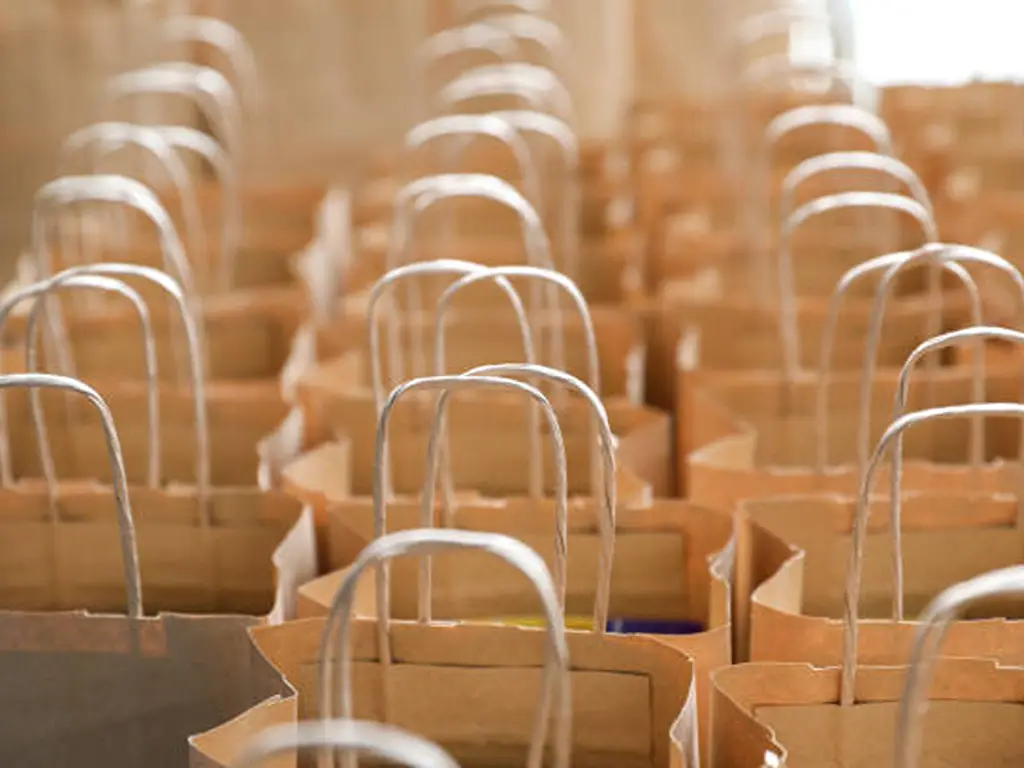
5 типов рукояток и в чем заключается преимущество каждой из них
Каждая ручка, представленная на рынке, относится к одному из пяти типов конструкции. Название указывает на ее внешний вид, а конструкция — на фактическую прочность.
Скрученные бумажные ручки. Две полоски крафт-бумаги, скрученные вместе, иногда вокруг армирующего сердечника. Такая скрутка — настоящий инженерный ход: она распределяет нагрузку между двумя переплетёнными нитями, а не одной плоской полоской, — именно поэтому такие пакеты являются стандартным выбором для продуктовых и розничных магазинов по всему миру.
Плоские бумажные ручки. Сверху приклеена сложенная полоска бумаги. Прочность обеспечивается за счет того, что при сгибании бумага укладывается в несколько слоев. Эта ручка изготавливается на полностью автоматизированных производственных линиях, что делает её самой дешёвой в производстве, и она широко используется в пакетах для еды на вынос и хлебобулочных изделиях.
Ручки, вырезанные по контуру. Здесь вообще нет никаких дополнительных материалов — отверстие пробивается прямо в верхней части пакета. Здесь нечего прикреплять и ничего не может отсоединиться, но всю нагрузку выдерживает именно выбранная вами бумага. Тонкий пакет с вырубленной ручкой имеет грузоподъемность, характерную для тонких пакетов; а у пакетов повышенной прочности с вырубленной ручкой в области ручки используется усилительный картон.
Ручки из верёвки. Хлопковый или полиэстеровый шнур, продетый через перфорированные отверстия или закрепленный с помощью пряжек. Прочность обеспечивается самим материалом шнура, а не самой сумкой. Это сегмент премиум-класса — роскошные розничные магазины, сувенирная продукция и высококлассные услуги по доставке еды на вынос.
Ручки-ленты. Лента из атласа, грогрейна или нейлона, которую обычно вшивают в складку верхнего края или закрепляют пряжками. Самым слабым местом является место крепления, поэтому качественная лента всегда пришивается — шов распределяет нагрузку по всему верхнему краю.
| Тип | Материал | Диапазон нагрузки | Лучше всего подходит для | Сбой происходит в первую очередь, когда | Относительная стоимость |
|---|---|---|---|---|---|
| Скрученная бумага | Бумага (по желанию — с сердечником) | От легкого до среднего | Продукты питания, розничная торговля, товары | Бумага влажная или имеет низкую плотность | Самый низкий |
| Гладкая бумага | Сложенная бумага | Свет | Еда на вынос, выпечка, фаст-фуд | Ручка отсоединяется от верхней клеевой части | Самый низкий |
| Высечка | Только бумажные пакеты | Зависит от стандарта GSM | Розничная торговля, рекламные акции | Бумага слишком тонкая или перегружена | Самый низкий |
| Веревка | Хлопковый или полиэстеровый шнур | От средней до высокой | Роскошные магазины, сувениры | Узел продевается через пробитое отверстие | От среднего до высокого |
| Лента | Сатин, грогрейн, нейлон | От легкой до средней (сшитая) | Подарки, косметика, бутик | Поломка шва или пряжки | Высокий |
Прежде чем сделать выбор, следует учесть один важный момент: универсального стандарта по нагрузочной способности ручек бумажных пакетов не существует. Приведенные выше диапазоны нагрузки отражают общепринятую отраслевую практику, а не являются сертифицированными техническими характеристиками — и именно поэтому следующие два раздела имеют такое большое значение.
Два вопроса, на которые ни одна статья не даёт ответа: действительно ли «Twisted» сильнее? И почему магазины отказываются от ручек?
Спор вокруг витой ручки: одна и та же ручка — противоположные заключения
Введите в поиск «ручки для бумажных пакетов» — и вы увидите, что скрученные ручки описываются как самый прочный вариант и как едва способные выдержать «больше пары фунтов», причем иногда эти описания встречаются на соседних страницах одних и тех же результатов. Скрученная конструкция действительно укрепляет ручку: две переплетенные нити распределяют нагрузку и предотвращают разрыв в месте крепления. Так почему же возникает такое противоречие?
Поскольку тип ручки является лишь одной из переменных. Решающими факторами являются плотность бумаги, количество нитей, наличие или отсутствие сердечника в веревке, а также способ крепления концов. Данные, полученные производителями, точно показывают, насколько это важно: у пакета плотностью 100 г/м² предел прочности ручки составляет около 120 Н, у пакета плотностью 120 г/м² — 185 Н, а у пакета плотностью 150 г/м² — 260 Н — то есть от нижней границы диапазона до верхней он увеличивается более чем вдвое. «Слабая скрученная ручка» — это, как правило, пакет с низкой плотностью, который носит название прочного.
The Twisted-Handle Debate, by the Numbers
100 gsm bag
≈ 120 N breaking point
120 gsm bag
≈ 185 N breaking point
150 gsm bag
≈ 260 N breaking point
The type name tells you the geometry — the grammage tells you the strength.
Why some stores stopped putting handles on paper bags
It is not a supply shortage — it is a deliberate product decision, and it has three drivers. Cost: a handle is the most expensive single component of a bag after the paper itself, and removing it removes materials and assembly steps at once. Recycling: a fully paper bag goes straight into the paper stream, while mixed-material handles (polyester, nylon, or polypropylene cord) have to be separated — some bag buyers are simplifying their recycling story by dropping handles entirely. And quality backlash: with handle-failure complaints piling up, at least one national chain has decided that no handle beats a handle that rips, telling shoppers in effect, “this way you carry it differently.”
Read it as a signal, not a verdict: the handle is going from a default feature to a deliberate option. That makes choosing well more valuable, not less — and it starts with what you specify.
What to Specify: Construction, Cost, and the Parameters That Matter
Construction: the other half of the strength
Here is the fact most buyers never hear: the handle carries half the load, and the bag’s top construction carries the other half. A double-fold top spreads tension across the entire edge instead of one glued spot. A reinforced board inside the handle area (400 gsm on heavy-duty die-cut bags) turns a punch hole into a load-bearing point. An eyelet protects the hole itself from tearing. And the attachment method decides how force is delivered: a knotted rope concentrates pull at a single hole, while a sewn-in handle distributes it along the whole seam. Specify the top construction, and you are specifying the failure mode.
The Other Half of the Strength
The handle carries half the load. The bag’s top construction — double fold, reinforcement board, eyelet, seam — carries the other half.
What each handle actually costs
Nobody in the SERP gives you numbers here, but the structure is simple. The cheapest handles are the ones with no additional material: die-cut openings and twisted paper rope. The cost then climbs with the material — paper below cotton below polyester and satin below nylon — and with the assembly step: flat paper handles run on automatic lines, while sewn ribbon handles are hand-assembled at some stage. A reasonable rule of thumb: handle cost moves in the same order as the table above, from lowest (twisted, flat, die-cut) to highest (rope, ribbon).
The spec sheet you can send a supplier
Before you order, ask for these in writing
- Paper grammage (gsm) and the bag size it applies to
- Handle material, strand count or diameter, and core (cored vs. uncored)
- Attachment method: knotted, buckled, or sewn — and where the stress concentrates
- Top construction: single fold, double fold, reinforcement board, eyelets
- Load test: what was measured, and how (there is no universal standard — ask for their method)
- MOQ and lead time, split between stock and custom-printed
- Recycling story: fully paper, or mixed materials with separation instructions
If a supplier can answer all seven points with specifics, you can compare them with confidence. If they answer with “very strong,” they have not tested it.
Where Handles Come From: What a Manufacturer Actually Controls
Everything in the spec sheet above is decided before your bag is made. Paper source sets the grammage and the fiber quality; the bag line sets the fold and reinforcement construction; the assembly step sets the attachment; the QC pass decides whether 100 of your 10,000 bags ship with a weak junction. Buyers choose specifications — manufacturers choose physics. The practical consequence: the same spec sheet that helps you choose a handle also helps you choose who makes it.
This is also where the industry’s honesty gap sits. Because there is no universal load standard, no manufacturer can hand you a certified “guaranteed” number — but any manufacturer who has actually tested will have a method and a data sheet, not an adjective. That is the difference worth paying attention to.
Before You Order: How to Verify a Supplier’s Handle (3 Questions)
When a bag fails, read the break before you blame the bag. A tear at the attachment point means a weak junction — construction or paper. A snapped cord means a material problem. A wet, overloaded, or yanked bag is a usage problem: even the best handle “breaks” when it is carrying three times its design load, and store staff will tell you that how a bag is snapped open — not the bag itself — is often what starts the tear.
Verify Before You Order
What is the attachment construction — knot, buckle, sewn, reinforced board?
What load was it tested at, and with what method? Reject “very strong” as an answer.
What is the recycling story — fully paper, or mixed materials that need separation?
Finish with a physical test: load the bag with your actual product at your actual weight, carry it with a normal sway, keep a sample for comparison.
The Business View: Handles Are a Product Decision, Not a Trim Decision
For a distributor or brand buying bags by the container, the handle is the cheapest component and the most expensive failure point. Eight out of eight failure stories you will find online are handle stories; the market has zero published load data; and the “no-handle” trend is quietly rewriting what customers expect. That combination is an information gap, and the gap is the margin: the supplier who can hand you a tested spec sheet is selling certainty, and certainty carries a premium no catalog price can match.
Turn the load ranges from this article into a three-tier product line: light (under 2 kg — flat or twisted paper), medium (2–5 kg — twisted with core, or polyester rope), heavy (5 kg+ — cotton rope, sewn ribbon, or die-cut with reinforcement). Offer the tiers to your customers by what they actually put in the bag — a bakery, a cosmetics seller, and a takeout chain are buying three different products. And given the no-handle trend, hedge your stock: fully paper no-handle bags, mid-duty twisted, and heavy-duty reinforced — not a single bet.
At YoonPak, paper bags are a core line rather than an afterthought: we build all five handle types in-house — flat, twisted, die-cut, rope, and ribbon — hold flexible MOQs from 500 pieces up, and quote custom printing in 3–5 weeks from artwork approval, so the seven-point spec sheet above is something we sign off on with every order. Browse our custom paper bag line (our custom paper bag line) and the kraft handle-bag spec (our kraft bag with handle spec) for the numbers.
Spec Your Bags With Numbers, Not Adjectives
Tell us what you pack — weight, volume, positioning — and we’ll match the handle type, construction, and MOQ to it. Flat, twisted, die-cut, rope, or ribbon; 500-piece minimums; custom printing in 3–5 weeks from artwork approval.
Запросить технические характеристики и образцы пакетовСписок литературы
- Jet Paper Bags. «Руководство по типам ручек для бумажных пакетов». 2024. https://jetpaperbags.com/blogs/paper-bag-blogs/a-guide-to-paper-bag-handle-types
- CNLIPACK. «Типы ручек для бумажных пакетов: сравнение 5 вариантов». 2024. https://cnlipack.com/guide-on-paper-bag-handle-types/
- YoonPak. «Бумажные пакеты на заказ». 2026. https://www.yoonpak.com/product-category/custom-paper-bags/
- YoonPak. «Индивидуальные одноразовые бумажные пакеты из крафт-бумаги с ручкой». 2026. https://www.yoonpak.com/product-item/customizable-disposable-kraft-paper-bag-with-handle/
- YoonPak. «Размеры бумажных пакетов». 2026. https://www.yoonpak.com/paper-bag-sizes/
- YoonPak. Главная страница. 2026. https://www.yoonpak.com/

 English
  German
  Spanish
  Italian
  Dutch
Dutch  French
  Portuguese
  Russian
  Arabic
  Korean