

Are Paper Cups Recyclable? Decoding PE, PLA & EPR Tax Risks
Every single day, millions of consumers responsibly toss their morning coffee cups into recycling bins, trusting that they are participating in a sustainable circular economy. However, for B2B procurement directors, sustainability officers, and packaging distributors, this innocent act masks one of the most complex and expensive logistical nightmares in the food and beverage industry. The assumption that a “paper” cup is 100% paper is a pervasive illusion—one that is increasingly colliding with stringent global legislation, brand reputation risks, and aggressive environmental taxation.
As the regulatory landscape shifts dramatically with the introduction of aggressive Extended Producer Responsibility (EPR) frameworks and anti-greenwashing directives across Europe and North America, buying the wrong disposable cup is no longer just an ecological misstep. It is a calculated financial liability. In this comprehensive guide, we will dismantle the chemical and physical realities of paper cup manufacturing, decode the critical differences between Polyethylene (PE), Polylactic Acid (PLA), and Aqueous coatings, and provide a hardcore, compliance-driven framework to audit your supply chain before the impending tax penalties destroy your profit margins.
The Big Question: Are Paper Cups Actually Recyclable?
To give you the unvarnished, industry-level truth that most mid-tier suppliers try to obscure: Theoretically, yes. Practically, in 99% of municipal recycling systems today, absolutely not.
This stark reality often shatters the carefully constructed "eco-friendly" narratives pushed by corporate marketing campaigns over the last two decades. According to comprehensive, peer-reviewed analyses by authoritative organizations such as the Ellen MacArthur Foundation and various Environmental Protection Agency (EPA) audits, the actual recycling rate for standard, traditional paper cups globally hovers at an abysmal fraction of a percent—often cited as being consistently less than 1%.
To understand the depth of this paradox, we must first look at the inherent value of the raw material itself. The structural core of a high-quality coffee cup is manufactured from virgin wood pulp. These are exceptionally long, robust, and high-value cellulose fibers. Under ideal, uncontaminated conditions, this premium wood pulp could be cycled through the paper-making process up to seven times, transforming seamlessly into everything from standard office paper to heavy-duty corrugated cardboard. The profound tragedy of the paper cup is that these incredibly premium fibers are effectively held hostage by a microscopic barrier.
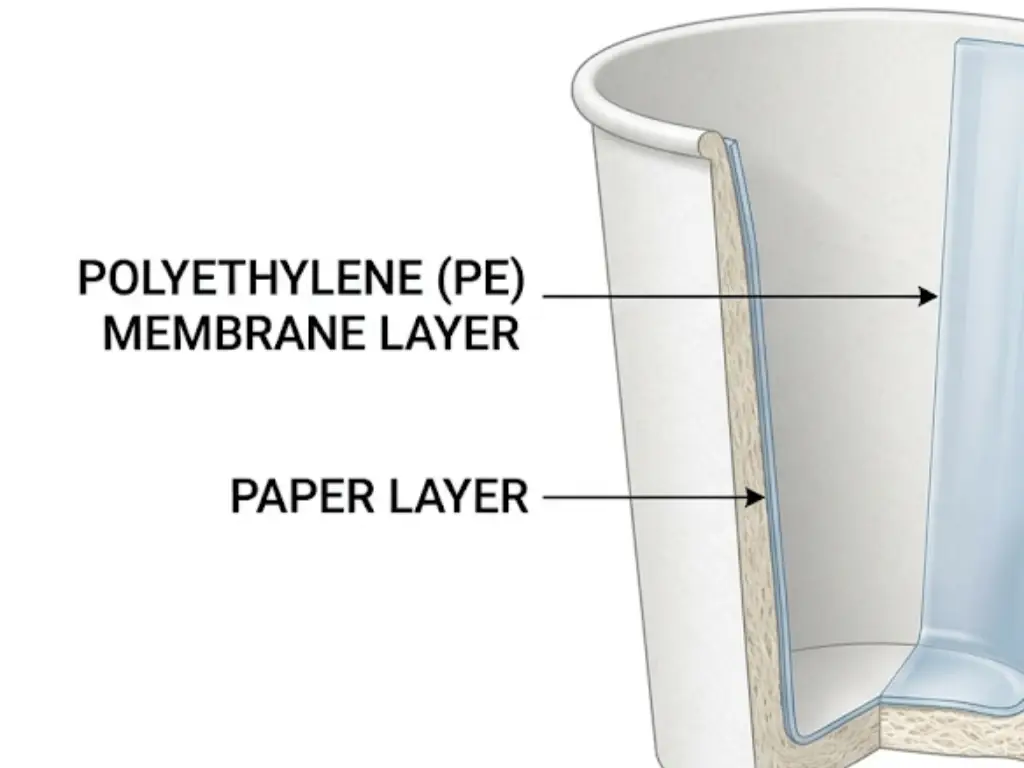
Paper, by its very chemical nature, is hydrophilic (water-loving). If you were to pour 90°C specialty coffee into a cup made purely of unlined paper, the cellulose fibers would disintegrate in seconds, resulting in catastrophic leaks, severe third-degree burns, and massive corporate liability. To achieve the necessary structural integrity, thermal retention, and waterproof performance expected by modern consumers, traditional manufacturing processes mandate the lamination of a remarkably thin layer of plastic onto the interior wall of the cup. Specifically, this is a Polyethylene (PE) coating, usually measuring just 15 to 20 microns in thickness.
Think of the recycling process like trying to perfectly extract melted chocolate chips out of a fully baked, hardened cookie without damaging the dough. That invisible 5% plastic barrier is the exact mechanism that transforms a highly recyclable, valuable natural resource into permanent municipal solid waste.
The Hidden Villain: Why Your "Paper" Cup is 5% Plastic
To fully grasp why local Material Recovery Facilities (MRFs) categorically reject your seemingly harmless paper coffee cups, we must step outside of the consumer mindset and enter the harsh, mechanical realities of a commercial paper mill.
The standard, globally accepted process for recycling paper involves a massive industrial machine known as a hydrapulper. Picture a giant, multi-ton industrial blender filled with heated water and massive mechanical rotors. When standard office paper, newspapers, or corrugated cardboard enter the hydrapulper, the mechanical agitation and the warm water quickly break the hydrogen bonds holding the cellulose together. Within minutes, the paper is turned back into a fluid, oatmeal-like slurry, ready to be pressed and dried into new paper products.
However, when a traditional paper cup enters this exact same environment, the laws of high-polymer physics work aggressively against the recycling process. The 95% paper fiber portion of the cup easily dissolves in the water, but the 15-20 micron PE plastic liner remains stubbornly intact. Polyethylene does not melt at these temperatures, and it certainly does not dissolve in water. Instead, as the paper fibers detach and wash away, this plastic film delaminates from the board and acts like a resilient, highly flexible net.
This flexible plastic film is catastrophic for paper mills. It wraps tightly around the mechanical rotors, clogging the delicate, precision-engineered screening equipment designed to filter out minor contaminants. Ultimately, this plastic contamination forces the entire multi-million-dollar production line to halt for manual cleaning, extraction, and maintenance. The immense financial cost of this equipment downtime, combined with the massive energy required to even attempt the separation, far outweighs the commodity value of the recovered pulp.
As a result, most standard recycling facilities simply cannot afford the operational nightmare. When well-meaning consumers throw PE-lined cups into the blue bin—a widespread phenomenon known in the waste management industry as wishcycling—they inadvertently contaminate massive bales of high-value paper. When mills discover these cups during intake inspections, entire batches are often rejected, re-routed, and sent directly to a landfill or an incinerator, entirely defeating the purpose of the recycling infrastructure.
Decoding Paper Cup Materials: PE vs. PLA vs. Aqueous Coating
For B2B buyers, navigating the high-stakes transition away from traditional plastics is a veritable minefield of scientific jargon, conflicting environmental claims, and marketing spin. To make commercially viable, legally compliant, and genuinely sustainable procurement decisions, you must understand the deep-level physical mechanics and chemical realities of the three primary coating generations available in the global market today. Ignorance of these materials is no longer a defense; it is a direct path to financial penalization.
Traditional Polyethylene (PE): The Recycling Nightmare
Polyethylene is the undisputed historical workhorse of the food packaging industry. From a purely functional and short-term economic standpoint, PE is a masterclass in chemical engineering. It provides absolute, 100% leak-proof reliability even for aggressively acidic or piping-hot beverages. It possesses an incredibly stable, multi-year shelf life, and because the global supply chain has spent decades optimizing its application, it is extraordinarily cheap to manufacture at a massive scale.
For massive global restaurant chains where a single leaky cup can instantly lead to a viral public relations disaster, stained clothing, or a personal injury lawsuit, PE has historically been the safest, most risk-averse bet for procurement officers.
Yet, as we have established, its end-of-life reality is an unmitigated ecological disaster. While there are a few highly specialized recycling plants globally (such as the renowned James Cropper facility in the United Kingdom) that utilize customized repulping technologies to physically shear and separate the PE film from the fibers, these facilities are statistical anomalies. They absolutely do not represent the standard municipal recycling infrastructure available to 99% of your customers. Continuing to rely heavily on PE means accepting that your packaging will inevitably end up in a landfill. More critically for your bottom line, it makes your brand a prime, highly visible target for impending, aggressive plastic taxation and consumer boycotts.
Polylactic Acid (PLA): The "Compostable" Illusion
As the global consumer backlash against traditional petroleum-based PE grew to a fever pitch, the packaging industry pivoted heavily toward Polylactic Acid (PLA). Derived from renewable, plant-based sources like fermented corn starch or sugarcane, PLA is widely marketed by optimistic sales reps as the ultimate eco-friendly savior. However, the term “compostable” has rapidly become one of the most misunderstood, legally precarious, and dangerous words in B2B procurement.
Here is the critical, unvarnished industrial reality that you must understand before signing a massive purchase order: PLA does not magically disappear if a consumer tosses it into a forest, a local river, or a backyard compost pile. To properly break down and metabolize into organic matter, PLA requires a highly aggressive, specialized, and precisely controlled environment—specifically, an Industrial Composting Facility. It mandates sustained, unwavering temperatures of 58°C to 60°C (136°F – 140°F), a very precise humidity level, and a specific, dense cocktail of thermophilic microorganisms.
If a PLA cup is thrown into a natural environment without these exact conditions, its hydrolysis and degradation process stalls exponentially. It will not degrade in "a few weeks"; rather, it can take months or even years to break down, during which time it acts practically identical to a conventional plastic bottle, posing the exact same physical threats to wildlife and ecosystems. Furthermore, if an uneducated consumer mistakenly throws a PLA cup into a standard paper recycling bin, its unique polymer melting point can contaminate and ruin entire batches of recycled paper pulp, infuriating recycling facility operators.
Therefore, PLA is only a viable, environmentally sound solution if the geographical market you are selling into possesses a highly robust, accessible industrial composting infrastructure. If you choose PLA, you must unequivocally ensure your supplier provides materials certified by strict, internationally recognized standards such as ASTM D6400 (US) or EN 13432 (Europe). Lack of these specific, verifiable certifications exposes your brand to severe "greenwashing" litigation from regulatory bodies.
Aqueous Coating (Water-Based): The Next-Gen Repulpable Solution
The absolute cutting edge of sustainable food packaging—and the most likely long-term survivor of upcoming regulatory purges—lies in Aqueous (Water-Based) coatings. This technology represents a fundamental paradigm shift because it alters the physical structure and application method of the waterproof barrier.
Unlike PE or PLA, which involve laminating a solid, distinct sheet of plastic film onto the paperboard, aqueous barrier coatings involve applying a precisely engineered, water-based polymer dispersion. This acts more like a microscopic layer of "paint" that forms an incredibly thin, highly effective barrier on the surface of the paper. The "black magic" of this chemical formulation is its specific behavioral response under mechanical stress in a warm-water environment.
When an aqueous-coated cup enters the standard hydrapulper at a run-of-the-mill municipal recycling facility, the mechanical shear and temperature cause the thin polymer layer to easily fracture, fragment, and disperse safely without clumping together. It completely avoids forming the dreaded "plastic net" that destroys machinery. This means that aqueous-coated cups are genuinely Repulpable and can be recycled directly alongside standard Old Corrugated Containers (OCC) and mixed paper without clogging the screens.
To verify this groundbreaking capability and ensure you aren’t buying a fake, B2B buyers must look for the stringent European PTS certification (e.g., PTS-RH 021/97). This specific certification empirically proves a product’s direct recyclability in standard paper mills, offering the ultimate defense against both functional failure and regulatory taxation.
The 2026 Material Reality Matrix
| Material Type | Waterproof Performance | Upfront Unit Cost | End-of-Life Processing (EPR) | Certifications Needed |
|---|---|---|---|---|
| Traditional PE | Excellent (Industry Standard) | Low | High Tax Risk (Non-repulpable) | FDA / LFGB (Food Safety) |
| Plant-Based PLA | Excellent | Medium – High | Medium Risk (Requires Industrial Composting) | ASTM D6400 / EN 13432 / BPI / DIN |
| Aqueous Coating | Excellent (Next-Gen) | Medium | Zero/Low Tax Risk (Fully Repulpable) | PTS-RH 021/97 / CEPI |
The True Cost of Greenwashing: Impending EPR Fees and Regulations
Before analyzing the severe financial implications of emerging environmental legislation, procurement teams must definitively separate scientific reality from marketing fiction. The three most commonly abused terms in the packaging industry operate under entirely different legal and physical frameworks:
With these definitions strictly locked in, we can clearly understand why the most dangerous and financially toxic word a B2B buyer can authorize to be printed on a custom coffee cup is "Biodegradable."
From a legal standpoint, "biodegradable" is meaningless and deeply deceptive. Regulatory bodies are aggressively cracking down on its usage to prevent greenwashing. Both the United States Federal Trade Commission (FTC) in their updated "Green Guides" and the European Union’s newly enforced Green Claims Directive have effectively weaponized consumer protection laws against these vague environmental claims. Using ambiguous terminology without scientifically verifiable temporal and environmental parameters can result in crushing corporate fines, forced public apologies, and entire shipping containers of product being seized at customs borders.
Beyond marketing restrictions, the true financial leviathan rapidly approaching the global packaging industry is the strict enforcement of Extended Producer Responsibility (EPR) legislation. The EU Packaging and Packaging Waste Regulation (PPWR), alongside similar stringent frameworks emerging across North America, are fundamentally rewriting the mathematics of bulk procurement.
Under robust EPR systems, the brand or the importer is held financially responsible for the entire lifecycle cost of the packaging they place into the market. This operates on a highly punitive sliding scale (eco-modulation) based on the material’s actual end-of-life processing difficulty.
Let us perform a highly realistic financial simulation: You might celebrate negotiating a contract that saves $0.01 per unit by sourcing a cheap, non-certified PE-lined cup from an unverified supplier. However, upon importing those millions of cups into an EPR-regulated market, the local environmental agency assesses your packaging. Because the municipal facility cannot physically recycle PE linings, your brand is hit with a "plastic pollution premium" of $0.05 per cup.
Your celebrated upfront savings are instantly vaporized, transformed into a massive backend financial deficit. Transitioning to certified, objectively verifiable, and genuinely repulpable materials is no longer a luxury ethical flex; it is an urgent, non-negotiable strategy for basic margin preservation.
B2B Procurement Guide: 3 Tests to Verify "100% Recyclable" Claims & Vendor Audit
Navigating these turbulent, legally perilous regulatory waters requires substantially more diligence than simply reading a supplier’s glossy marketing brochure. Before committing to a multi-million-unit purchase order, procurement directors must armor themselves with practical, unassailable methods to separate authentic sustainable innovation from dangerous greenwashing. Below are the definitive tests to verify claims, followed by the ultimate vendor audit framework.
1. The Physical Tear Test (The Immediate Red Flag)
You do not need a laboratory to spot a traditional plastic liner. Take the sample cup provided by the vendor and forcefully tear it in half down the seam. If you see a distinct, transparent, stretchy film pulling apart and holding the paper fibers together like a microscopic spiderweb, you are looking at PE or PLA lamination. If the cup tears cleanly and sharply, behaving exactly like a thick piece of standard newspaper or cardboard without any plastic stretching, it is highly likely to be an authentic Aqueous or dispersion-coated product.
2. The Lab-Grade Dispersibility Verification
Never rely on amateur "kitchen science" or office blender tests to verify a supplier’s claims. High-speed steel blades physically chop plastic film into microscopic pieces, creating a deceptive illusion of dissolving while actually generating catastrophic microplastics. True repulpability must be proven under strict industrial parameters.
Demand that your supplier provides a third-party dynamic repulping and screening test report conforming strictly to CEPI or PTS laboratory methods (e.g., PTS-RH 021/97). This documentation must explicitly outline the water temperature, the specific mechanical shear force applied (without cutting blades), and crucially, the Somerville Reject Rate (using a standard 0.15mm slot screen). If the supplier cannot provide this lab-grade verification, their claims of "recyclability" are scientifically invalid and legally dangerous.
3. The Hardcore Certification Audit (The Legal Firewall)
Physical tests are excellent for initial screening, but customs agents and tax auditors only care about rigorous paperwork. Never accept a low-res PDF with a generic green leaf logo. You must demand the exact certificate number and cross-reference it directly on the issuing body’s official database. For PLA, verify the BPI or DIN CERTCO registration. For repulpable Aqueous solutions, demand the CEPI or PTS test reports. Crucially, ensure the name on the certificate matches the actual manufacturing entity you are paying.
4. The Production Line Audit: Beyond Prototypes (AQL & Traceability)
Passing physical tests and producing lab reports for a handful of meticulously crafted prototypes is relatively easy for any supplier. Replicating that exact physical performance, leak-proof structural integrity, and flawless printing across 10 million consecutive units in a live production environment is where 90% of global suppliers completely collapse.
As a B2B buyer, your ultimate anxiety isn’t just about environmental certification; it is the catastrophic financial fallout of inconsistent batch quality leading to mass leakage complaints, severe burns, and the soul-crushing nightmare of cross-border dispute resolution.
This is precisely where the industry benchmarks are definitively set by top-tier, direct-source manufacturers like Yoonpak. With over 24 years of specialized industry experience and an immense production capacity exceeding 16 billion units annually, Yoonpak eliminates the "prototype vs. mass production" gamble entirely.
A vendor audit of Yoonpak reveals a highly standardized, zero-tolerance risk management architecture. They do not rely on end-of-line random sampling; their standard operating procedure mandates high-frequency, comprehensive quality checks every single hour on the production line. To guarantee absolute, undeniable traceability, every single cup features a precisely printed production date, time, and serial number on the bottom.
Most importantly for procurement directors seeking peace of mind, Yoonpak’s confidence in their materials (including fully BPI/DIN certified PLA and cutting-edge Aqueous coatings) is backed by an unprecedented 1-Year Quality Guarantee. If a batch breaches the stringent Acceptable Quality Limit (AQL), you are not forced to endure the expensive, time-consuming hassle of shipping defective products back across the ocean. By simply providing the tracking codes alongside video and photographic evidence, Yoonpak’s policy ensures a rapid, frictionless remake or compensation within 30 days. This is the caliber of supply chain architecture required to genuinely de-risk your transition to sustainable packaging.
The Future of Sustainable Packaging: Where is the Industry Heading?
The de-plastification of the global food and beverage industry is no longer a fringe environmental crusade or an optional marketing gimmick; it is an irreversible, financially punitive commercial mandate. The era of quietly slipping cheap, PE-lined cups into the market while hiding behind generic "recyclable" arrows is definitively over.
Between the relentless, rapid advancement of automated optical sorting technologies at recycling facilities, hyper-vigilant and legally aggressive consumer bases, and the crushing financial weight of impending, mandatory EPR taxes, profound supply chain adaptation is the only viable survival strategy for large-scale retail, coffee, and hospitality chains.
The future unequivocally belongs to brands that act proactively rather than reactively. While certified PLA serves as a highly effective transitional bridge for regions with advanced industrial composting networks, the ultimate, future-proof endgame resides in universally repulpable solutions like Aqueous dispersion coatings. By securing a robust, transparent supply chain partner capable of delivering these highly advanced materials with massive volume capacity, rapid 3-to-6-week lead times, and an uncompromising, zero-defect quality control matrix, you achieve much more than just dodging regulatory fines.
You actively elevate your brand equity, permanently safeguard your profit margins against volatile environmental taxes, and establish your enterprise as a genuine, unassailable leader in the sustainable future of global commerce.
Stop Guessing. Start Testing.
Are you ready to rigorously audit the performance of next-generation sustainable packaging for yourself? Do not risk your brand’s reputation and financial security on theoretical data or glossy sales brochures.
Request Your Free Evaluation Sample Kit TodayAlso read:




 English
  German
  Spanish
  Italian
  Dutch
Dutch  French
  Portuguese
  Russian
  Arabic
  Korean