

Choosing the right ice cream cup size is one of the most deceptively complex decisions a shop owner has to make. It is not merely about finding a vessel that can successfully hold a scoop of your product. Instead, the cups you select serve as the foundational building blocks of your entire pricing strategy, portion control, and brand presentation. Whether you are serving a dense, premium gelato, a light soft serve, or towering sundaes, the exact dimensions, materials, and structural integrity of your packaging directly impact your profit margins. In this guide, we walk you through everything you need to know to make an informed, profitable packaging choice for your business.
01Why Ice Cream Cup Size Is a Business Decision
Most ice cream shop owners pick their cup sizes by asking one question: “Can it hold a scoop?” That’s a start — but it’s also leaving money on the table.
Cup size touches three things that directly affect your bottom line. First, portion cost: every extra half-ounce per serving, multiplied by 200 servings a day, adds up to real money over a month. Second, customer perceived value: a cup that looks half-empty even when it contains exactly what you intended to serve creates a quiet disappointment. Customers won’t tell you about it — they’ll just come back less often. Third, operational speed: a cup that’s too narrow for your scoop slows down your team during the Saturday afternoon rush, when every second counts.
There’s also a technical reality most guides skip: ice cream isn’t a uniform product. A dense, low-overrun gelato (around 20–35% air) weighs significantly more per ounce than a high-overrun soft serve (40–60% air), meaning the same 6 oz cup can hold wildly different actual amounts of product depending on what you’re scooping (Taylor Company, 2025). This is why cup size alone — without understanding your product’s density — is an incomplete metric.
The cups you choose are containers, yes. But they’re also your portion-control system, your pricing architecture, and the frame around every photo your customers post. Let’s build that frame right.
02Standard Ice Cream Cup Sizes: The Complete Reference
Before we dive into use cases, here is the full landscape. The table below covers every standard ice cream cup size you’ll encounter, from 3 oz sample cups to 16 oz sharing portions — with the dimensional specifications most guides omit.
| Size (oz) | Capacity (ml) | Top Dia. (mm) | Bottom Dia. (mm) | Height (mm) | Typical Scoops | Best For | Recommended Lid |
|---|---|---|---|---|---|---|---|
| 3 oz | ~90 ml | 60–62 | 42–45 | ~50 | ½ scoop | Samples, kids servings, tasting flights | Flat lid |
| 4 oz | ~120 ml | 62–65 | 45–48 | ~60 | 1 scoop | Single scoops, gelato cups, controlled portions | Flat lid |
| 5 oz | ~150 ml | 75–80 | 50–55 | ~65 | 1 generous scoop | Light sundaes, kids’ upgrades | Flat or dome lid |
| 6 oz | ~180 ml | 92 | 52–56 | ~80 | 1–2 scoops | Standard menu items, two-scoop servings, light toppings | Flat or dome lid |
| 8 oz | ~240 ml | 92–96 | 55–58 | ~92 | 2 scoops | Regular sundaes, soft serve with toppings, parfaits | Dome lid |
| 10 oz | ~296 ml | 96 | 58–62 | ~95 | 2–3 scoops | Loaded sundaes, takeaway desserts | Dome lid |
| 12 oz | ~355 ml | 96–100 | 60–65 | ~100 | 3 scoops | Premium sundaes, milkshakes, floats, delivery orders | Dome or straw-slot lid |
| 16 oz | ~473 ml | 100–105 | 65–70 | ~115 | 3–4 scoops | Sharing portions, banana splits, family-size takeaway | Dome lid (double-wall body recommended) |
Data consolidated from manufacturer specification sheets (Silver Edge Packaging, 2025; Million Pack, 2025; Papacko, 2025). Dimensions are nominal — always confirm exact specs with your supplier, especially lid compatibility, as ±2mm variance between manufacturers can cause leaks.
Below, we break down each size tier with the operational details that matter when you’re actually ordering.
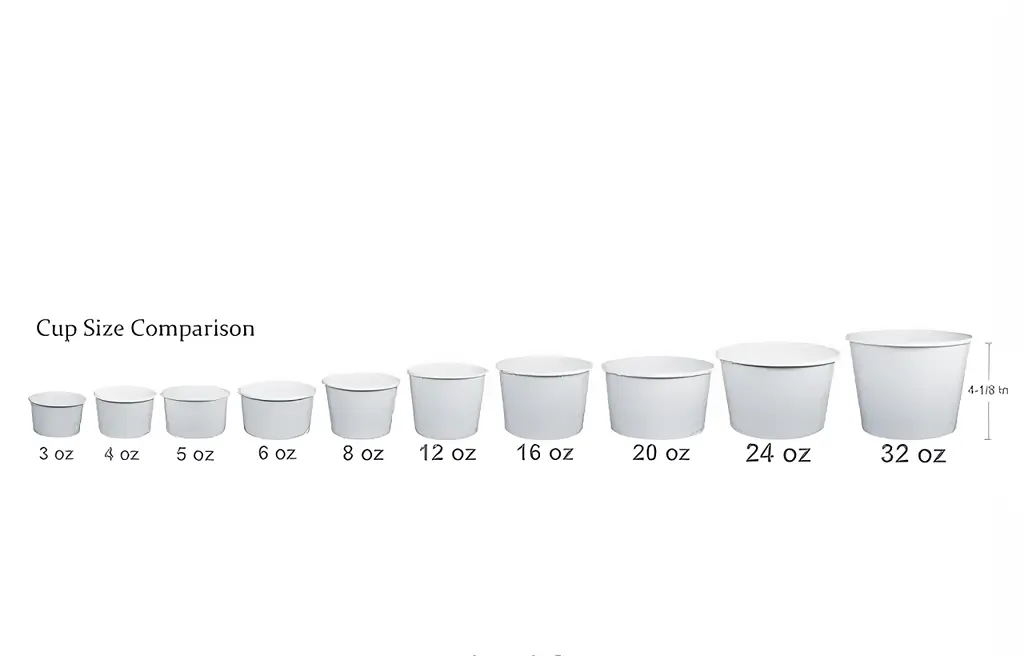
Small Cups (3–4oz): Tasting, Kids & Single Scoops
The smallest cups in your inventory are also the cheapest per unit — which means they’re easy to overlook. That’s a mistake. A well-run tasting program using 3 oz sample cups can be your highest-ROI marketing channel: 1,000 sample cups cost roughly $30–50, and at a conservative 5% conversion rate with a $6 average ticket, those cups generate $300 in revenue. The math works.
The 3 oz cup (roughly 90 ml, top diameter ~60–62mm) holds a half-scoop — perfect for letting customers try a new seasonal flavor before committing. The 4 oz cup (~120 ml, top diameter ~62–65mm) is the industry’s “standard single” — it fits one scoop neatly with just enough headroom for a small topping or a clean visual presentation. But here’s the catch: if your actual scoop is 5–6 oz (which is far more common in practice than the theoretical 4 oz), a 4 oz cup will overflow. Test your real scoop against your cup before placing a bulk order.
Lid compatibility in this size range is the wild west of cup procurement. Small-cup rim diameters vary more between manufacturers than any other size tier — a 62mm lid from Supplier A may not seal on a 64mm cup from Supplier B. Always source cups and lids from the same manufacturer, and always test a physical sample.
Medium Cups (6–8oz): The Workhorse Sizes
If your shop does any meaningful volume, one of these two sizes accounts for the majority of your cup consumption. Choosing between 6 oz and 8 oz isn’t about 2 ounces — it’s about how your menu, your portions, and your pricing interact.
The 6 oz cup (~180 ml, top diameter ~92mm) fits one generous scoop or two smaller scoops with just enough room for a drizzle of sauce. It’s the right size when your pricing is built around “a scoop plus one topping” as the standard. The 8 oz cup (~240 ml, top diameter ~92–96mm) gives you breathing room — two scoops, multiple toppings, and a visual presentation that doesn’t look squeezed. If your menu is sundae-heavy or you’re known for generous portions, 8 oz is your default.
The hidden decision most operators don’t think through: if you’re putting two 5 oz scoops into a 6 oz cup, you’re overfilling by nearly 70%. That’s not a cup problem — it’s a scoop-to-cup mismatch. Reddit’s r/icecreamery community confirms what experienced operators already know: real-world scoop sizes in independent shops tend to run 5–7 oz, not the textbook 4 oz. Match your cup to your actual scoop, not the theoretical one.
Large Cups (10–16oz): Sundaes, Sharing & Takeaway
Large cups are where presentation, structural integrity, and delivery logistics collide. These sizes aren’t your volume drivers, but they carry your highest-margin items — and your highest risk of a customer posting a photo of a collapsed sundae.
The 10 oz cup (~296 ml) is your loaded sundae workhorse. The 12 oz cup (~355 ml) handles milkshakes, floats, and delivery parfaits. The 16 oz cup (~473 ml) is for sharing portions, banana splits, and family-size takeaway orders.
For any cup over 10 oz, wall thickness becomes a non-negotiable specification. A single-wall paper cup holding 12 oz of melting ice cream and warm toppings will soften within 15–20 minutes in a delivery bag. Double-wall construction or a heavier PE coating on both sides is not a luxury at this size — it’s the difference between a five-star review and a refund request. If your cups will sit in a freezer at −40°C, double-sided PE coating is the most reliable option for maintaining structural rigidity.
Lid choice at this size tier is equally critical: dome lids give you the extra 15–25mm of height needed for whipped cream and toppings, while flat lids are more stable for delivery (less likely to pop open in transit). For milkshakes and floats, a straw-slot lid is essential. Stock at least two lid types for your large cup sizes.
03Material Choices by Cup Size: Paper, Plant-Based, and Plastic
Knowing your size is step one. Knowing what material makes sense at that size is where buying decisions get real. Most guides list “paper vs plastic vs compostable” as a generic comparison — but in practice, not every material is available or reliable at every cup size. This is the information gap that costs buyers time and money.
Before evaluating materials, use these three criteria as your self-assessment framework:
- Performance fit: Is this material available and stable at your required cup size, in your serving conditions (freezer, room temp, delivery)?
- Compliance path: Does it meet the regulatory requirements of your market — FDA for the US, LFGB for the EU, compostability standards (ASTM D6400 or EN 13432) if you’re making biodegradability claims?
- Brand narrative: Does the material reinforce or contradict the story your brand tells about itself?
Use these three questions as a material filter: Does it perform in your serving conditions? Does it meet your market’s compliance standards (FDA, LFGB, BPI)? Does it reinforce your brand story?
| Material | 3 oz | 4 oz | 6 oz | 8 oz | 10 oz | 12 oz | 16 oz | Coating Options | Key Certifications | Relative Cost |
|---|---|---|---|---|---|---|---|---|---|---|
| PE-Coated Paper (White) | ✓ | ✓ | ✓ | ✓ | ✓ | ✓ | ✓ | PE only | FDA, LFGB, FSC (with certified board) | $ (baseline) |
| PE-Coated Paper (Kraft) | ✓ | ✓ | ✓ | ✓ | ✓ | ✓ | Limited | PE only | FDA, LFGB, FSC | $ |
| PLA-Coated Paper | ✓ | ✓ | ✓ | ✓ | ✓ | Limited | Rare | PLA only (plant-based) | BPI, EN 13432, FDA, LFGB | $$ |
| Aqueous-Coated Paper | — | ✓ | ✓ | ✓ | Limited | — | — | Water-based barrier | FSC, repulpable certification | $$$ |
| Bagasse (Sugarcane Fiber) | — | ✓ | ✓ | ✓ | ✓ | — | — | None required | BPI, EN 13432, FDA | $$ |
| Bamboo Fiber | — | ✓ | ✓ | ✓ | — | — | — | None required | FSC, FDA | $$$ |
| PET Plastic (Clear) | ✓ | ✓ | ✓ | ✓ | ✓ | ✓ | ✓ | N/A | FDA, LFGB | $ |
| PP Plastic (Clear) | — | — | ✓ | ✓ | ✓ | ✓ | ✓ | N/A | FDA, LFGB, microwave-safe | $ |
✓ = Widely available. Limited = Available from select manufacturers only, longer lead times. Rare = Specialty order, may require custom mold. — = Generally not available at this size.
Paper & Plant-Based Cups: What’s Available at Each Size
Paper cups dominate the ice cream industry for good reason: they’re cost-effective, easy to print on, and customers widely accept them as the default. But “paper cup” covers three fundamentally different products.
Standard PE-coated paper is the baseline. A thin polyethylene layer on the inside prevents moisture from soaking through the paperboard. It’s available in every size from 3 oz to 16 oz, compatible with most lid systems, and costs the least per unit. The trade-off: PE is petroleum-based and not biodegradable, which matters if your market or brand positioning demands sustainability credentials.
PLA-coated paper replaces the PE lining with polylactic acid derived from corn starch — a plant-based alternative that enables industrial compostability claims (under BPI or EN 13432 certification). PLA-coated cups are widely available in the 3–12 oz range, but become harder to source at 16 oz. The reason is technical: PLA has a glass transition temperature (Tg) of approximately 55–60°C, and while this is fine for cold ice cream service, it means PLA-coated paper can become brittle at sustained freezer temperatures below −20°C (MDPI Sustainability, 2023). For most ice cream applications this isn’t a failure point, but it’s worth testing your specific product and storage conditions.
Aqueous (water-based) barrier coatings are the newest option and the most interesting from a sustainability standpoint: the cup has no plastic layer at all and can enter standard paper recycling streams without separation. The catch is availability — aqueous coatings are currently concentrated in the 4–12 oz range, and their moisture resistance in extended freezer storage is still being proven at scale.
A note on materials that deserve more attention than they get: Kraft paper cups (unbleached, natural brown) have a visual warmth that photographs beautifully on Instagram — they’re especially effective for artisanal and vintage-positioned brands in the 4–8 oz range. Above 8 oz, Kraft’s tendency to show grease marks from finger handling becomes a presentation concern. Bagasse (sugarcane fiber) and bamboo fiber cups are mold-pressed rather than die-cut, which limits their size range — typically only 4 oz, 6 oz, 8 oz, and occasionally 12 oz are available because each size requires its own dedicated mold.
Plastic & Alternative Cups: When Visibility Matters
If you serve layered parfaits, rainbow gelato, or any dessert where the visual architecture is part of the product, a clear cup isn’t a downgrade from paper — it’s the strategically correct choice. Color sells ice cream, and transparent walls are your best salesperson.
PET (polyethylene terephthalate) is the standard clear cup material: excellent clarity, available in all sizes from 3 oz to 16 oz, and rigid enough to hold its shape in a customer’s hand. PP (polypropylene) is softer and slightly cloudy but microwave-safe (PET deforms above ~70°C), making it the right choice if your product might go from freezer to microwave. PP is most commonly available in 8 oz and larger — small PP cups tend to lack the rigidity needed for a confident hand feel.
One procurement reality that catches first-time buyers off guard: custom sizes in PET or PP require a new injection mold, which costs $2,000–5,000. If you need a non-standard size in plastic, the mold amortization dominates your unit economics until you’re ordering at very high volumes.
04Custom Branding: What Cup Size Means for Your Print Design
There’s a temptation to separate “choosing cup sizes” from “designing the print” into two sequential tasks. Don’t. The size of your cup determines the canvas you have to work with — and that should influence which sizes you choose to brand.
Print area reality: A 4 oz cup has a sidewall surface area roughly the size of a business card. That’s enough for a logo and one color. Attempting a full-brand narrative with tagline, social handles, and QR code on this format produces a cluttered, illegible result — and wastes the print budget. By 8 oz, you have enough surface area for a complete visual identity: logo, brand colors, tagline, and a scannable QR code. If branding is a priority for your business (and for ice cream shops with any social media presence, it should be), your primary branded size should be 8 oz or larger.
Print method and size: Flexographic printing uses flexible plates and is cost-efficient for large-volume, 1–3 color designs — making it the default for small cups and standard runs. Offset printing delivers photo-quality CMYK reproduction and is worth the premium when you’re printing on 8 oz or larger cups where the detail can actually be seen. Don’t pay for offset on a 3 oz cup — there’s simply not enough surface area to justify the resolution.
The MOQ reality check: Custom-printed cups require a minimum order quantity (MOQ) — typically 50,000–100,000 pieces per size, with each size treated as a separate SKU. This means most independent shops can afford to brand only one or two sizes. The strategy that works: make your highest-volume size (usually 6 oz or 8 oz) your branded hero, and keep secondary sizes in unbranded stock with a branded sticker or sleeve as an affordable bridge. A well-designed single branded cup will generate more social impressions than five mediocre ones.
The lid as branding real estate: Dome lids on large cups offer a printable top surface that most brands ignore. A simple logo hot-stamped onto a dome lid is visible in every hand-held customer photo. It’s one of the lowest-cost, highest-exposure branding moves available in foodservice packaging — and almost nobody does it.
05What to Look for in an Ice Cream Cup Manufacturer
A well-chosen cup size and material mean nothing if your supplier can’t deliver consistently. This section moves from “what to buy” to “who to buy from” — because the difference between a good cup and a good cup that shows up on time, passes inspection, and holds up in service is your manufacturer.
Evaluating a cup manufacturer comes down to three pillars: compliance (certifications and quality systems), production capability (can they make what you need at your volume?), and partnership experience (what happens when something goes wrong?). Every pillar matters. A manufacturer that’s strong on two but weak on the third will eventually cost you more than the one that’s solid across all three.
Certifications, Production Standards & Quality Control
When you’re buying paper cups, certifications aren’t decoration — they’re the only independent verification you have that the product is safe, legal, and consistently made. But certifications don’t all cover the same thing, and the mistake beginners make is treating any certification as all-purpose proof.
Food contact safety comes first. For the US market, look for FDA 21 CFR compliance — this means the materials have been tested and confirmed safe for direct food contact. For the EU, the equivalent is LFGB (Lebensmittel- und Futtermittelgesetzbuch). These two standards use different testing methodologies; FDA compliance does not automatically mean LFGB compliance. If you’re importing into Europe, verify LFGB separately.
Quality management systems tell you whether the manufacturer has repeatable processes. ISO 9001 is the baseline — it certifies that a quality management system exists, but it doesn’t evaluate product safety. BRCGS (Brand Reputation Compliance Global Standard) is a higher bar: it’s a Global Food Safety Initiative (GFSI)-benchmarked standard that major QSR chains require of their packaging suppliers. Within BRCGS, the grade matters — AA is the highest, and the audit frequency and rigor between AA and B differ substantially. Don’t settle for “has BRC” — ask which grade.
Environmental and sourcing certifications matter if your brand makes sustainability claims. FSC (Forest Stewardship Council) certification traces the paperboard back to responsibly managed forests. BPI certification (or EN 13432 in Europe) verifies industrial compostability for PLA-coated cups. ISO 14001 covers environmental management systems — useful as a signal of organizational commitment, but not a product-level guarantee.
Beyond certifications, one operational question reveals more about quality than any certificate on the wall: “How often do you run in-line QC checks?” Industry best practice is hourly. If the answer is “once per shift” or vague, that’s a red flag regardless of what certifications they hold. Also ask about traceability: does each cup carry a production date, time, and batch code printed on the bottom? If a defect is discovered, can they isolate which production run it came from? The manufacturers who can answer “yes, to the hour” are operating at a fundamentally different quality level from those who can’t.
The strongest suppliers carry certifications across all three pillars — food safety, quality management, and environmental sourcing — rather than excelling in just one. A paper ice cream cup manufacturer with full certifications spanning BRCGS, FDA, LFGB, FSC, and ISO 9001/14001 has invested in compliance infrastructure that a supplier holding only FDA and ISO 9001 has not. These gaps in certification coverage often mirror differences in QC frequency, traceability systems, and the ability to serve markets with different regulatory demands. When you’re comparing suppliers, the certification portfolio tells you more about operational maturity than a price sheet ever will.
Lead Times, MOQ & Partnership: Beyond the Spec Sheet
The spec sheet tells you what the cup looks like. It doesn’t tell you whether it’ll arrive when you need it, whether the supplier will work with you when your order is small, or what happens if a batch has a defect. These are the questions that determine whether you’re buying from a vendor or building a supply relationship.
Lead time: The industry standard for custom-printed paper cups is 3–6 weeks from design approval to shipment. Be skeptical of promises significantly faster than this — “two weeks” on a custom print order usually means one of two things: either the cups are blank stock (no printing), or corners are being cut on QC. Factor ocean freight into your timeline: China to US West Coast is approximately 15–20 days, to Europe approximately 30–35 days, and to the Middle East approximately 20–25 days. Door-to-door, your realistic timeline from order to receipt is 6–10 weeks — plan seasonal inventory accordingly.
MOQ flexibility: The standard minimum order quantity in paper cup manufacturing is 50,000–100,000 pieces per size. But here’s a procurement insight that many first-time buyers don’t know: some manufacturers will accommodate a smaller trial order — as low as 10,000 pieces — if the customer covers the freight cost. A manufacturer willing to do a small trial run before you commit to container volumes is signaling confidence in their product and respect for your procurement process. Ask about this upfront; it’s one of the fastest ways to filter serious manufacturing partners from order-takers.
Sample process: The cadence of sampling tells you everything about operational competence. After you submit your artwork, you should receive a digital proof within one working day. A physical pre-production sample should ship within 48 hours. If a manufacturer takes three days to produce a digital proof, their design-to-production pipeline is unlikely to meet your delivery deadlines.
After-sale support: What happens when — not if — there’s a quality issue? A reasonable warranty on paper cups is one year. A reasonable claims process: the customer provides video or photo evidence of the defect (leak, structural failure, print error) and receives a resolution — typically a remake or credit — within 30 days, without needing to return the defective product. If the claims process requires you to ship defective cups back at your expense before any resolution, factor that friction into your supplier evaluation. It’s a signal about how they handle problems.
Value-added services: The best manufacturers offer services that reduce your operational burden — one month of free warehousing so you can order in volume without managing local storage, an in-house design team that can optimize your artwork for print without charging a separate design fee, and 24/7 communication availability across time zones. These aren’t deal-breakers if absent, but their presence distinguishes a manufacturing partner from a transaction processor.
06Making the Right Choice for Your Business
You now have the dimensions, the material options, the branding strategy, and the manufacturer evaluation framework. With that much information, it’s tempting to keep researching and never decide. Here’s how to cut through and move forward.
The right cup size isn’t the most popular size in the industry. It’s the size that makes your specific product look its best at the price your customers are happy to pay. Start with these three questions:
- What is my highest-volume menu item, and what cup size does it actually need? Not the theoretical size — test your real scoop, your real toppings, in a physical sample. Lock in this one size first. It’ll account for 70–80% of your cup spend.
- What certifications does my target market require? FDA for the US, LFGB for the EU, BPI or EN 13432 if you’re claiming compostability. This filter alone will eliminate most of the supplier pool and make your decision easier.
- Am I buying cups, or am I building a supply relationship? If you’re ordering 10,000 cups once, buy on price. If you’re building a business that will order cups every quarter for the next five years, invest the time to qualify a manufacturer on all three pillars — compliance, production capability, and partnership experience. The extra 10–15% you might pay for a fully certified, QC-intensive manufacturer will pay for itself the first time you avoid a batch rejection or a delivery delay during peak season.
The right cup doesn’t just hold ice cream. It holds your brand, protects your margins, and shapes the first impression that determines whether a first-time customer becomes a regular. Choose accordingly.
References
- Taylor Company. “Ice Cream Overrun Adjustments.” 2025. taylorproducts.net
- MDPI Sustainability. “The Potential of Bio-Based Polylactic Acid (PLA) as an Alternative in Food Packaging.” 2023. mdpi.com
- Silver Edge Packaging. “What Are the Right Paper Cup and Bucket Sizes, and How Do You Choose?” 2025. silveredgepackaging.com
- Foodservice Packaging Institute. “Leadership & About.” fpi.org


 English
  German
  Spanish
  Italian
  Dutch
Dutch  French
  Portuguese
  Russian
  Arabic
  Korean