

Choosing the right paper cup size for your café or restaurant might seem like a straightforward task—just pick a few standard ounce measurements and you’re good to go, right? Unfortunately, the reality is a bit more complex. The number on the label only tells a fraction of the story. Between rim diameters, usable fill volumes, and the physical shape of the cup, selecting the perfect dimensions impacts everything from customer satisfaction to your bottom line. Whether you are serving a delicate four-ounce espresso or a massive twenty-four-ounce iced bubble tea, understanding the true mechanics of cup sizing is essential. This guide will walk you through exactly what you need to know to make the smartest purchasing decisions for your beverage business.

What “Paper Cup Size” Actually Means — Beyond the Number on the Label
When most people see a paper cup labeled “12 oz,” they assume the cup simply holds 12 ounces of liquid. In practice, paper cup size is a combination of three separate things: the labeled capacity, the usable fill volume, and the cup’s physical dimensions. These three measurements do not always agree with each other — and understanding why is the first step to making smarter purchasing decisions.
The labeled capacity — what you see printed on the cup or the product listing — refers to the maximum volume when filled to the brim. But in real-world service, nobody fills a cup to the rim. Hot drinks need headroom for foam and safe handling. Cold drinks need space for ice, which can occupy 30% to 50% of the cup’s interior before a single drop of liquid is poured. As a result, the actual serving volume is almost always smaller than what the label suggests.
Then there are the physical dimensions: top diameter, bottom diameter, and height. Two cups with the same labeled capacity can look and behave completely differently. A 12 oz hot cup typically has a 90 mm rim and stands about 112 mm tall — tall and narrow, optimized for heat retention and comfortable sipping. A 12 oz cold cup often uses a wider 98 mm rim and a shorter, broader body, designed to accommodate ice and wider straws. Side by side, the cold cup looks larger even though both hold the exact same volume. Smart buyers evaluate both capacity and dimensions before committing to a cup. The ounce number on the label only tells a third of the story.
Standard Paper Cup Sizes — Reference Chart (oz, ml, and Inches)
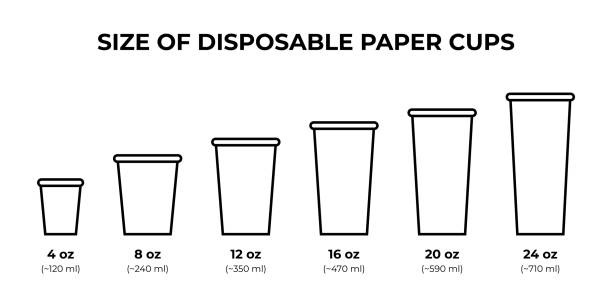
The paper cup industry has largely settled on a standardized size range, from tiny 4 oz espresso cups to oversized 24 oz smoothie cups. The table below maps each standard size to its metric equivalent and typical physical dimensions. Note that the 90 mm rim diameter appears across four different capacities — this is the single most important number to remember, as it means one lid size can serve your 10 oz, 12 oz, 16 oz, and 20 oz hot cups interchangeably.
| Size (oz) | Capacity (ml) | Top Diam (mm) | Bottom Diam (mm) | Height (mm) | Typical Use |
|---|---|---|---|---|---|
| 4 oz | 118 | 62 | 46 | 60 | Espresso, tasting samples |
| 6 oz | 177 | 73 | 51 | 80 | Flat white, small coffee |
| 8 oz | 237 | 80 | 56 | 92 | Standard small coffee, tea |
| 10 oz | 296 | 90 | 60 | 95 | Short wide cup, small latte |
| 12 oz | 355 | 90 | 60 | 112 | Standard medium, latte, cappuccino |
| 16 oz | 473 | 90 | 60 | 135 | Standard large, travel coffee |
| 20 oz (Hot) | 591 | 90 | 62 | 160 | Extra-large coffee |
| 20 oz (Cold) | 591 | 98 | 65 | 145 | Soft drinks, iced beverages |
| 24 oz | 710 | 104 | 68 | 175 | Smoothies, bubble tea, milk tea |
Dimensions are industry-typical values. Individual manufacturers may vary slightly.
Matching Paper Cup Sizes to Beverage Types — A Practical Framework
The right cup size isn’t about what “feels right” — it’s about three measurable factors: what you’re pouring, how hot or cold it needs to stay, and what portion your customer expects for the price they’re paying. Each beverage category maps to a size decision differently.
Espresso and Tasting Portions (2 oz–4 oz)
Espresso demands the smallest paper cup in your range for a reason that goes beyond simple capacity. A single shot of espresso yields roughly 30 ml of liquid, and even a double shot only reaches about 60 ml. Pour that into an 8 oz cup and the crema — the golden foam layer that signals a properly extracted shot — spreads paper-thin across a wide surface, collapsing within seconds. In a 4 oz cup with a 62 mm rim, the same crema sits thick and creamy, creating the visual fullness that customers associate with quality. Specialty coffee shops use the smallest cups for their straight espresso for exactly this reason: not to be stingy, but because the cup size directly shapes how the customer perceives the drink before they even taste it. For tasting events and product sampling, the 4 oz size carries the added psychological benefit of scarcity — a small portion implies something worth savoring.
Standard Coffee and Tea (8 oz–12 oz)
This is the volume range that covers the majority of daily coffee and tea service worldwide. An 8 oz cup works perfectly for drip coffee served black or tea without milk — the liquid volume fills the cup to a comfortable level without needing extra room for foam or additives. When milk enters the equation, the calculation shifts: a standard latte uses roughly 8 oz of milk plus a double shot of espresso, which fits neatly into a 12 oz cup with room left for a modest foam cap.
One often-overlooked size in this range is the 10 oz cup. It shares the same 90 mm rim diameter as the 12 oz, meaning it uses the exact same lids, yet it delivers a noticeably more generous visual presence than the 8 oz for only about 10% more material cost. For cafés wanting to differentiate their “regular” size without jumping to a full 12 oz — and without adding a new lid SKU to their inventory — the 10 oz cup is a quiet but effective upgrade.
Specialty Coffee Drinks — Cappuccino, Latte, Flat White (8 oz–16 oz)
Specialty coffee drinks impose an additional variable on cup sizing: foam volume. A properly made cappuccino is roughly 30–40% milk foam by volume, which means an 8 oz cappuccino cup only contains about 5–6 oz of actual liquid. If you switched from an 8 oz cappuccino cup to an 8 oz flat white cup — where the foam layer is much thinner — the same size cup would feel underfilled. This is why cafés that serve multiple specialty drinks often maintain two or three cup sizes within this range rather than trying to make one “standard” work for everything.
The third-wave coffee movement has also introduced a cultural dimension to sizing that goes beyond pure functionality. In specialty coffee culture, smaller cups signal confidence: an 8 oz flat white communicates that the espresso itself is good enough to carry the drink without needing a larger volume of milk to mask it. A 12 oz latte from a chain like Starbucks signals abundance and value. Neither approach is wrong — but the cup size you choose broadcasts a message about what kind of coffee experience you’re selling.
Cold Drinks, Smoothies, and Large-Format Beverages (16 oz–24 oz)
Cold beverages are where the gap between labeled capacity and actual serving volume becomes impossible to ignore. A cup filled with standard ice cubes loses roughly 30% of its interior volume before any liquid goes in; if the customer asks for extra ice, that figure can reach 50%. This means a 16 oz cold cup with standard ice holds only about 10–11 oz of actual beverage. To deliver what the customer perceives as a full drink, cold beverage operators almost always need to go one size up from their hot drink equivalents.
Bubble tea and smoothie shops face an additional requirement: the cup must hold not just liquid and ice but solid toppings — tapioca pearls, jelly, fruit chunks — that occupy substantial volume at the bottom. The 24 oz cup with a 104 mm rim has become the de facto standard in this segment. It provides enough total volume to hold toppings, ice, and a satisfying amount of drink, while the wide rim accepts both sealed film lids and oversized straws without compromise.
Cup Dimensions That Matter — Rim Diameter, Height, and Bottom Width
Ask any barista what ruins a shift faster than a broken espresso machine, and the answer is often surprising: lids that don’t fit. The ounce number on your cup means nothing if the rim diameter is wrong. Three physical dimensions control your daily operations more than the capacity label ever will.
Rim Diameter — The Lid Compatibility Gatekeeper
Rim diameter is the most operationally consequential dimension on a paper cup. If the rim doesn’t match the lid, you get leaks, spills, customer complaints, and wasted product — regardless of whether the cup holds 8 oz or 20 oz. The industry has largely converged around a few standard rim sizes: 62 mm for 4 oz, 80 mm for 6–8 oz, 90 mm for 10–20 oz hot cups, 98 mm for cold cups in the 16–20 oz range, and 104 mm for 24 oz jumbo cups.
The 90 mm rim is the workhorse of the industry — it covers four different capacities (10 oz, 12 oz, 16 oz, and 20 oz hot) with a single lid SKU. For a café or QSR operator, this means you can stock one lid type and serve everything from a small latte to an extra-large brewed coffee without thinking about lid matching. The practical tolerance on rim diameter is tight: a deviation of more than 0.5 mm from the lid specification can cause a loose fit that leaks or an overly tight fit that frustrates staff during rush hour. When evaluating a new supplier, ask for the exact rim diameter specification, not just the ounce capacity — it’s the number that will actually determine whether your lids work.
Single size only
4 sizes, 1 lid
Wide straw ready
Cup Height and Bottom Diameter — Stability, Stacking, and Hand Feel
Height and bottom diameter govern how a cup behaves in the real world: in customers’ hands, in car cup holders, on delivery motorcycles, and stacked in storage. A taller cup with a narrow base — like a 20 oz hot cup standing 160 mm tall with a 62 mm bottom — has a high center of gravity that makes it prone to tipping, particularly during takeaway transport. Most standard vehicle cup holders have a slot depth of roughly 70 mm. That means nearly 90 mm of the 160 mm cup extends above the holder’s grip point — a sudden stop can lever the cup out entirely.
The bottom diameter also determines whether the cup fits into standard cup carrier trays, which typically have a base slot of 60–65 mm. A cup with a 68 mm bottom diameter will jam or not seat properly, forcing staff to handle it separately — a small friction multiplied across hundreds of orders per day. The taper ratio — the relationship between top and bottom diameter — also affects stacking density. A gentler taper, where the top and bottom diameters are closer together, lets more cups nest tightly in a shipping carton. But too gentle a taper compromises grip ergonomics. Every dimension is a tradeoff, and the best cup for your operation is the one where those tradeoffs align with your specific service style.
How Wall Type Interacts with Size — Single, Double, Ripple, and Embossed
The wall construction of a paper cup changes its effective interior dimensions. A double-wall cup adds an inner liner and an outer shell with an insulating air gap between them, which reduces the usable interior diameter by 2–3 mm compared to a single-wall cup of the same labeled capacity. The result: the cup holds roughly 3–5% less liquid than its single-wall equivalent. This is rarely noticeable at 12 oz — a difference of about 15 ml — but becomes significant at 20 oz, where the loss approaches a full ounce.
From a cost perspective, the wall type decision interacts with cup size in a non-obvious way. For small cups (4–12 oz), a double-wall construction often eliminates the need for a separate cup sleeve, simplifying inventory and reducing the per-drink serving cost — the cup costs more but the total system cost is lower. For large cups (16–24 oz), the math reverses: single-wall cups plus sleeves typically beat double-wall on unit economics because the sleeve cost per large cup is lower than the premium for double-wall construction at that volume. The practical takeaway: if you’re switching from single-wall to double-wall for small cups, you can keep the same labeled size. If you’re making the same switch for large cups, consider bumping up one size to compensate for the interior diameter loss.
How Cup Size Affects Your Costs — Procurement, Shipping, and Storage Economics
Most café owners pick a cup size by asking “what feels right for my latte?” The smarter question is: “How many of these cups can I fit in a 40-foot container, and what does that do to my per-cup landed cost?” The size you choose doesn’t just affect your menu — it ripples through your entire supply chain.
Size vs. Per-Unit Cost — Why Smaller Isn’t Always Cheaper
The intuition that a smaller cup should cost less per unit breaks down when you examine how paper cup manufacturing costs are actually structured. Raw materials — paperboard, coating, ink — account for roughly 55% of the total manufacturing cost. Printing plates, cutting dies, and machine setup are fixed costs: the same plate cost applies whether you order 10,000 cups or 100,000. Packaging materials and labor make up the remainder.
When you spread a $200 printing plate across 10,000 4 oz cups, the plate adds $0.02 per cup. Across 100,000 12 oz cups, it adds $0.002. The 12 oz and 16 oz sizes also benefit from being the industry’s highest-volume SKUs — paper mills and cup factories optimize their sheet layouts around these sizes, achieving the lowest material waste rates. The result is that 12 oz and 16 oz cups often have a lower per-unit cost than 6 oz or 8 oz cups despite using more raw material per piece, simply because they run at higher volumes with better material utilization. For businesses placing their first custom cup order, this means the “standard” sizes are genuinely cheaper — not just more common, but materially more cost-effective to produce.
Container Loading Math — How Cup Dimensions Determine Freight Cost
The most overlooked consequence of cup size selection may be its impact on ocean freight — and freight can easily represent 15–25% of the total landed cost for imported paper cups. The key variable is packing density: how many cups can fit in a standard 40-foot high-cube container, which has roughly 67.6 cubic meters of internal volume.
A 4 oz cup nests densely — you can pack roughly 2.8 to 3.2 million cups into a single 40HQ, depending on the exact dimensions and carton configuration. A 16 oz cup, being physically larger, packs only about 1.2 to 1.5 million cups into the same container. So an order of one million 16 oz cups fills roughly two-thirds of a container, while one million 4 oz cups fills only about one-third. The freight cost per thousand cups for the 16 oz size is roughly double that of the 4 oz. When comparing quotes from two different suppliers, check first whether both are quoting the same cup size — a $0.01 per-unit price advantage on a 16 oz cup can vanish entirely if the comparison was built against a 4 oz supplier’s freight estimate.
High packing density, low freight per unit
Lower density, ~2× freight cost per thousand
Inventory and Storage — Why Fewer Sizes Means Lower Total Cost
Every additional cup size in your inventory adds a lid SKU, potentially a sleeve SKU, a storage location, and a minimum order quantity commitment from your supplier. For a mid-sized café chain running four cup sizes across two different rim diameters, the SKU count might look like this: four cup sizes, two lid types, two sleeve types — eight inventory lines to manage, each with its own reorder point and storage footprint.
A simple consolidation strategy can dramatically reduce this complexity: standardize all hot cups on the 90 mm rim (covering 10 oz through 20 oz), and all cold cups on a single wider rim diameter. With this approach, the same lid serves every hot drink on your menu, and the same sleeve fits every cup. The inventory shrinks from eight lines to perhaps four. The working capital tied up in packaging inventory drops proportionally, and the risk of running out of the one lid that only fits your 8 oz cup disappears entirely.
Finding a manufacturer that offers the full 4 oz to 24 oz range under one roof simplifies this further: instead of managing separate suppliers for small espresso cups and large smoothie cups — each with its own MOQ, lead time, and shipping schedule — you consolidate to one production partner. YoonPak, for example, manufactures across the entire size spectrum with flexible minimum order quantities starting at 50,000 pieces per size, and offers a free one-month warehousing period that lets you stage inventory and ship in batches rather than taking delivery of your entire order at once. This kind of full-range, single-supplier approach turns cup size selection from a procurement headache into a straightforward SKU-rationalization exercise.

Paper Cup Sizes Across Different Markets — US, Europe, and Asia Preferences
Paper cup sizing is not globally uniform. What counts as a “regular” coffee in one market can be a “large” in another, and the unit system used to describe cup sizes varies by region in ways that affect how customers perceive value.
In North America, cups are labeled and marketed primarily in fluid ounces, and the standard size ladder runs 8 oz / 12 oz / 16 oz / 20 oz. The 12 oz is the psychological anchor — it’s what most customers picture when they order a “medium.” Cold drinks typically run one step larger, with 20–24 oz being common. Single-wall cups with separate sleeves dominate the hot drink segment because they offer the lowest per-unit cost at North American order volumes.
European markets think in milliliters and skew consistently smaller. A standard coffee-to-go in much of continental Europe is 200–300 ml (roughly 7–10 oz), and the 400 ml (approximately 14 oz) size that would be considered “regular” in the US is often the largest option on a European café menu. Environmental regulation also shapes sizing: the EU’s Single-Use Plastics Directive and various national packaging laws have accelerated adoption of PLA-coated and aqueous-coated cups, which are slightly more expensive than PE-coated alternatives — providing an additional incentive for cafés to serve smaller, more profitable portions.
In Asia and the Middle East, the picture is more fragmented. Southeast Asian markets, driven by the explosive growth of bubble tea and specialty cold beverage chains, have made 22–24 oz the standard large format. Japan and South Korea favor smaller, more refined portions — 7–12 oz for hot coffee — reflecting a café culture that prioritizes quality perception over volume. Middle Eastern markets, particularly in the premium coffee segment, lean toward double-wall insulated cups that communicate quality and handle the region’s preference for very hot beverages served in climate-controlled indoor environments.
For importers and distributors buying across regions, the practical implication is straightforward: before placing an order, confirm the target market’s default size ladder. A cup size that flies off the shelf in one market can sit untouched in a warehouse in another — and the cost of getting this wrong isn’t just the inventory carrying charge. It’s the missed opportunity of not having the right product when a buyer in that market is ready to place an order.







 English
  German
  Spanish
  Italian
  Dutch
Dutch  French
  Portuguese
  Russian
  Arabic
  Korean