

Stop Cake Disasters: How to Choose Grease-Resistant Disposable Cake Boxes
For bakery owners, catering services, and food distributors, the moment a cake leaves the kitchen is the moment of highest vulnerability. A meticulously crafted tiered cake, representing hours of labor and premium ingredients, is suddenly at the mercy of its packaging. The reality of B2B food operations is harsh: choosing the wrong disposable cake boxes doesn’t just result in a minor inconvenience; it leads to smeared frosting, compromised structural integrity, bottom blowouts from grease seepage, and ultimately, disastrous customer experiences. In this comprehensive guide, we strip away the marketing fluff to examine the exact material science, structural engineering, and Total Cost of Ownership (TCO) metrics you must understand to secure commercial-grade, grease-resistant packaging that protects both your product and your brand reputation.
The Hidden Cost of Flimsy Disposable Cake Boxes in Bakery Businesses
There is a pervasive cognitive bias in bulk packaging procurement: viewing the disposable cake box merely as an unavoidable overhead expense rather than a critical risk management tool. Purchasing managers often default to the lowest cost-per-unit, entirely ignoring the catastrophic downstream costs of packaging failures. When packaging is treated as a commodity rather than an engineered solution, the business assumes unnecessary operational risks that directly erode profit margins.
Let us examine the basic mathematics of a packaging failure. Imagine saving $0.15 on a thinner, uncoated cake box. If the moisture from a rich buttercream or the oil from a sponge cake seeps into the untreated cardboard base during a 45-minute delivery, the structural integrity of the box plummets. The base sags, the cake shifts, and the intricate piping work crashes into the sidewall. A custom cake that took three hours to decorate is ruined in three seconds.
The immediate financial loss is the full refund of a $50 to $150 cake. However, the true damage is the Customer Acquisition Cost (CAC) wasted, the negative online review that deters future business, and the permanent loss of that customer’s Lifetime Value (LTV). According to the National Restaurant Association (NRA) State of the Restaurant Industry Report regarding off-premise dining and delivery, packaging-related temperature and structural failures are among the top three drivers of order refunds and brand defection. When you reframe disposable cake boxes as an insurance policy for your high-margin products, the imperative for engineered quality becomes undeniable.
Decoding Bakery Packaging Materials: What Actually Works?
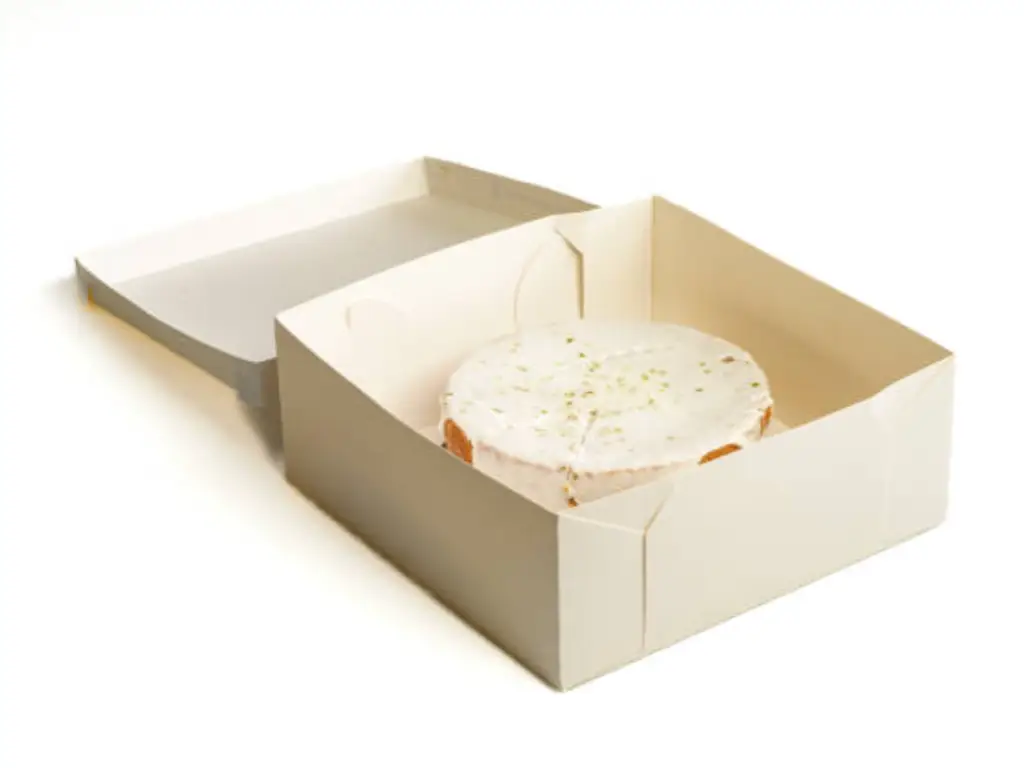
Selecting the right material is not about aesthetics; it is about thermodynamics, moisture vapor transmission rates (MVTR), and supply chain compliance. The physical environment inside a closed cake box is a micro-climate. Below, we dissect the dominant materials in the commercial bakery space and their physical boundaries.
Clear PET Plastic vs Traditional Cardboard
The debate between full-visibility plastic and traditional paperboard hinges on the specific operational environment of your bakery. Here is the technical breakdown of how they perform across critical B2B dimensions:
| Comparison Dimension | Clear PET Plastic (Polyethylene Terephthalate) | Traditional Cardboard / Paperboard |
|---|---|---|
| Visibility & Merchandising | Maximum 360-degree visibility. Ideal for retail displays and high-end wedding cakes where visual impact justifies a premium price. | Limited to top or side window cutouts. Relies on external branding/printing to convey quality before opening. |
| Moisture Resistance | Naturally impervious to moisture and grease. However, highly susceptible to Fogging when transitioning from walk-in coolers to room temperature. | Highly absorbent unless treated. Excellent at breathing, which prevents condensation buildup that can ruin fondant or sugar work. |
| Structural Rigidity | Relies on thermoformed ridges and interlocking channels. Can become brittle and crack in extreme cold chain logistics. | Superior stacking strength (Box Compression Test) due to rigid corner posts and thicker caliper material. |
| Thermal Insulation | Poor insulator. Heat transfers rapidly, endangering buttercream and delicate ganache during summer transport. | Natural insulator. Protects temperature-sensitive frostings from rapid ambient temperature spikes. |
For high-end event planning, a premium PET enclosure with a specialized anti-fog coating is unparalleled for visual merchandising. Conversely, for long-distance transport in varying climates, a robust, windowed cardboard box provides the necessary thermal buffer and structural peace of mind.
The Mechanics of Grease-Resistant Coatings
A common grievance among bakers is discovering that a cake box, left overnight in the refrigerator, has developed dark, unsightly grease stains spreading across its base. This occurs because standard cardboard acts like a wick, absorbing the lipids present in butter, cream cheese, and oils. To combat this, commercial-grade boxes require physical barrier coatings rather than superficial treatments.
The efficacy of these coatings is largely determined by their GSM (Grams per Square Meter). A low-grade box might feature a light surface calendering or a negligible spray that holds up for an hour. For standard bakery packaging, a coating of 12-15 GSM is recommended. However, for heavy buttercream, oil-based sponges, or high-grease applications, B2B commercial standards demand a physical extrusion coating of 18-20+ GSM, capable of passing the 48-hour heavy grease penetration test without a single point of failure.
Supply Chain Advantage: Engineering Zero-Leak Performance
Achieving absolute grease resistance requires stringent manufacturing tolerances. Drawing on over 24 years of experience supplying international food chains like Burger King, Tim Hortons, and ILLY, Yoonpak engineers disposable cake boxes with 100% leak-proof PE (Polyethylene) or plant-based PLA (Polylactic Acid) coatings tailored precisely to the required GSM thresholds.
True reliability isn’t just a claim; it is a measurable metric. By enforcing hourly QC checks throughout the production cycle—from raw paperboard caliper to final automated leak testing—Yoonpak executes a strict “Zero-Defect” delivery policy, discarding all intermediate production if a single failure is detected. For wholesale distributors and large bakeries, this means absolute risk mitigation. Furthermore, they back this engineering with a frictionless 30-day resolution protocol: if any leakage occurs, simply provide video evidence, and a 1:1 replacement or remake is triggered without the logistical nightmare of returning defective units.
Sustainability and Eco-Friendly Packaging Compliance
As regulatory frameworks in Europe and North America tighten around single-use plastics, B2B buyers must navigate the complexities of sustainable compliance without compromising on product safety. Transitioning to eco-friendly options is no longer optional for large chains; it is a prerequisite for market access.
The foundation of sustainable paper packaging is the FSC (Forest Stewardship Council) certification, ensuring that the raw wood pulp is sourced from responsibly managed forests rather than old-growth timber. However, the true engineering challenge lies in the grease-resistant lining. Traditional PE (Polyethylene) is petroleum-based and complicates the recycling process. The industry standard alternative is PLA (Polylactic Acid), a bioplastic derived from corn starch or sugarcane bagasse, which meets stringent BPI and DIN compostability standards.
While PLA is an excellent ecological solution, it is critical to understand its material boundaries to prevent operational disasters. PLA has a Glass Transition Temperature (Tg) of approximately 50°C to 60°C (122°F – 140°F). It performs flawlessly in cold-chain logistics and refrigerated bakery environments. However, if a wholesale distributor stores flat-packed PLA-lined boxes in an un-airconditioned warehouse or shipping container during peak summer months, the coating can soften, causing the stacked boxes to fuse together or yellow. Professional procurement requires matching the material not just to the eco-legislation, but to the reality of your storage infrastructure.
The Ultimate Cake Box Size Matching Matrix
One of the most frequent operational errors that destroys cake decorations happens not during transport, but during the extraction of the cake from the box. Buying a box that exactly matches the diameter of the cake board leaves zero clearance for the baker’s hands or for intricate piping work extending past the cake’s base. A tight fit creates a vacuum effect, dragging the icing along the inner walls as the cake is lifted.
The commercial baking industry relies on the “2-Inch Rule”: the internal dimensions of the box must be at least two inches wider and two inches taller than the physical dimensions of the fully decorated cake. This rule acts as a necessary buffer zone against sudden stops in delivery vehicles.
| Cake Type & Profile | Actual Cake Size (w/ Board) | Recommended Minimum Box Dimension | Clearance & Engineering Rationale |
|---|---|---|---|
| Standard Round Layer Cake | 8″ Diameter x 4″ Height (on 10″ Board) | 10″ x 10″ x 6″ | Accommodates the rigid 10″ drum board perfectly to prevent lateral sliding; gives 2″ overhead for top piping. |
| Tall / Barrel Cake (Modern Style) | 6″ Diameter x 8″ Height (on 8″ Board) | 8″ x 8″ x 10″ or 10″ x 10″ x 12″ | Requires a designated “Tall” box. Forcing a tall cake into a standard box crushes the top tier. |
| 1/4 Sheet Cake (Corporate/Catering) | 9″ x 13″ x 3″ (on 10×14″ Board) | 14″ x 10″ x 4″ | Standard sheet sizing. Lateral clearance is critical for removing the heavy cake without digging fingers into the icing border. |
| Tiered Wedding Cake (2-3 Tiers) | Varies x 12″+ Height | 12″ x 12″ x 16″ (Heavy Duty) | Crucial: Must account for the invisible central support dowel protruding from the top tier. Requires heavy-corrugated base. |
Structural Engineering for Safe Cake Transportation
When you are transporting a multi-tiered cake weighing upwards of 15 pounds, the cardboard box is no longer just a wrapper; it must function as a load-bearing exoskeleton. Understanding the structural mechanics of your packaging prevents catastrophic collapses in transit. The difference between a successful delivery and an insurance claim often comes down to board thickness and corner geometry.
Corner Locks and Base Stability
The base of the cake box is the foundation of your risk management. A standard single-wall, lightweight cardboard base will bow under the concentrated weight of a dense fondant cake. When the base bows, the cake shifts, the center of gravity is lost, and the structural integrity of the tiers is compromised.
Commercial packaging utilizes specific tab-and-lock mechanics. The most efficient design is the “Auto-popup” structure combined with a double-sided whiteboard base. Auto-popup boxes utilize pre-glued, tensioned corners that snap into a rigid square the moment the box is opened. This not only ensures perfectly 90-degree load-bearing corners but also shaves critical seconds off back-of-house assembly time during peak operational hours. For heavy-duty applications, substituting a flat paperboard base for a B-flute corrugated board insert ensures zero deflection during lifting.
Window Designs That Don’t Compromise Rigidity
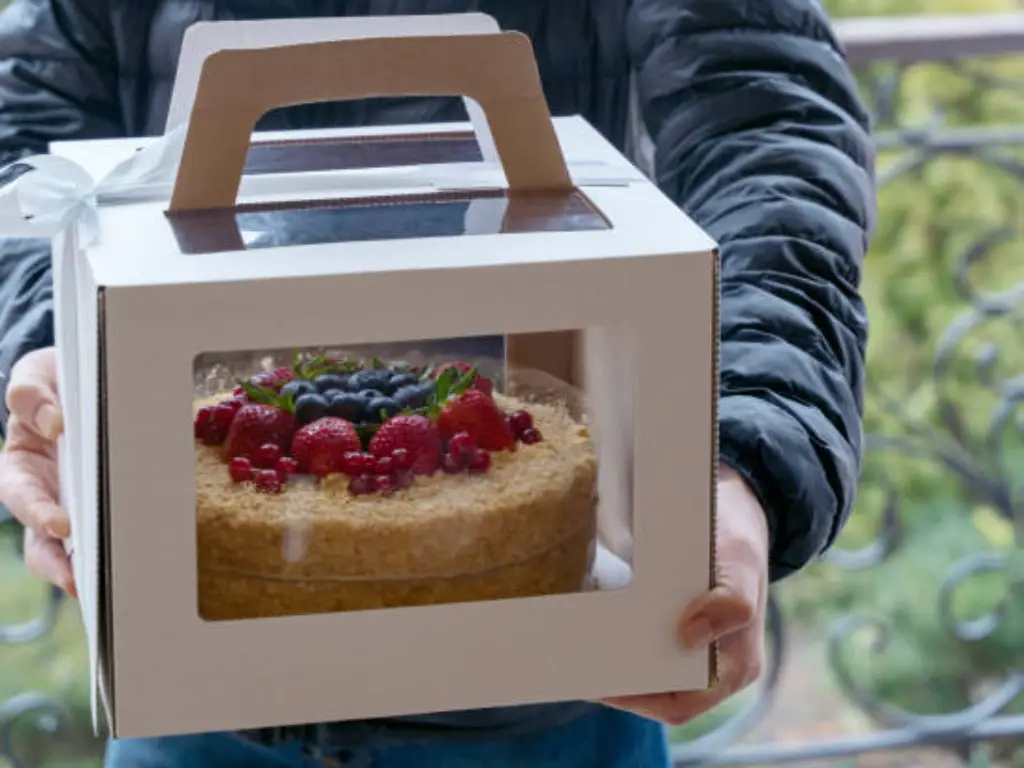
Bakeries want large transparent windows to showcase their products, but physics dictates that cutting a massive hole in a piece of cardboard destroys its tension and compressive strength. In structural engineering, a box’s Stacking Strength—measured by the Box Compression Test (BCT)—relies almost entirely on its four vertical corner posts, not the center of the top lid.
However, excessive top cutouts can cause the entire lid to warp inward, jeopardizing the frosting below. To safely incorporate viewing windows, manufacturers must adhere to strict parameters: the window area should not exceed 60% of the lid’s total surface area. Furthermore, the structural loss must be offset by an increase in the cardboard’s caliper (thickness) around the perimeter, and the window film itself must be a high-tension PET film (typically 0.08mm to 0.1mm thick) glued edge-to-edge to recreate surface tension and prevent the lid from caving in.
Navigating Bulk Orders and Total Cost of Ownership (TCO)
Moving from the technical specifications to the boardroom, purchasing disposable cake boxes at scale requires a shift from looking at unit price to evaluating the Total Cost of Ownership (TCO). In the B2B sector, hidden costs rapidly consume thin margins if supply chain logistics, design fees, and operational efficiency are ignored.
The Truth About Custom Design and Sample Fees
Many procurement officers fall into the trap of seeking out suppliers who promise “100% Free Custom Design and Sampling.” In commercial manufacturing, true structural engineering, custom design, and load-testing are resource-intensive services. Suppliers who offer unlimited free sampling inevitably recoup those costs by quietly downgrading the paper caliper, thinning the grease-resistant coating, or skipping vital QC steps during the mass production phase.
True B2B customization is a rigorous engineering service. Drawing on decades of experience serving highly demanding global chains, Yoonpak operates on a transparent, professional model: premium custom tooling and sampling require reasonable upfront investment, ensuring that the exact physics and branding requirements are locked in before thousands of units are cut. By providing digital proofs within 1 working day and physical samples dispatched within 48 hours, they enable buyers to accurately validate weight capacities and coating performance, thereby preventing catastrophic losses during the bulk run. Coupled with a high-efficiency production cycle delivering standard orders in 3 to 6 weeks (consistently 7 days faster than the industry average), this professional approach guarantees supply chain stability.
Hidden Operational Costs: Storage & Assembly Labor
Two of the most frequently ignored expenses in bakery operations are storage real estate and labor time. Cake boxes are voluminous. If a supplier cannot provide high-compression flat-packing, you are essentially paying to ship and store empty air.
Calculating your storage volume is critical. An inefficiently packed pallet takes up premium back-of-house space that could be used for revenue-generating equipment. Furthermore, assembly time is a direct labor cost. A cheap box that requires complex folding and manual taping can take a worker 45 seconds to assemble. An engineered auto-popup box takes 3 seconds. When you are paying packing staff $15 an hour, that 42-second difference across 10,000 units equates to nearly $1,750 in wasted wages.
To directly combat the inventory squeeze, top-tier manufacturers understand cash flow and space constraints. Yoonpak, for instance, provides up to 1 month of free warehousing for large orders, allowing distributors and large bakeries to draw down stock flexibly without suffocating their own facility spaces.
Logistics and Freight Economics
A significant portion of your Total Cost of Ownership is tied up in international freight and volumetric weight. Because paper packaging is lightweight but high-volume, ocean freight costs can disproportionately impact the final landed price.
To drastically drive down the landed cost per unit, wholesale distributors must calculate the load rate of a container based on the factory’s packaging density. Utilizing a 40’HQ (High Cube) full container load is strongly recommended, as it maximizes vertical space utilization compared to standard 20’GP containers. By partnering with a manufacturer that engineers high-density carton packing and precise palletization, you can increase the total units per container by up to 15%. This optimization slashes the amortized freight cost per box, shields your procurement budget from fluctuating shipping rates, and significantly pads your profit margins.
Final Thoughts: Securing Your Supply Chain
Purchasing disposable cake boxes is an exercise in brand protection. The journey from the baker’s bench to the consumer’s table is fraught with physical hazards, temperature fluctuations, and moisture threats. By demanding physical barriers like verified PLA/PE coatings with specific GSM metrics, insisting on structurally sound corner mechanics, and partnering with transparent, commercial-grade manufacturers, you eliminate the variables that lead to product loss.
Stop accepting smeared frosting and bottom blowouts as the cost of doing business. Upgrade your packaging specifications, calculate your true TCO inclusive of freight and labor, and ensure that every culinary creation arrives exactly as intended.

 English
  German
  Spanish
  Italian
  Dutch
Dutch  French