

Types of Cake Boxes — The Complete Guide to Materials, Structures, and Choosing the Right One
Baking a cake requires precision, patience, and an artistic touch. Yet, all that hard work can be ruined in seconds if the final masterpiece isn’t packaged correctly. A cake box is far more than just a simple container; it is the crucial bridge between your kitchen and your customer’s celebration. Whether you are transporting a heavy, tiered wedding cake or displaying delicately piped cupcakes on a bakery shelf, selecting the appropriate packaging is absolutely essential. The right material and structure not only protect your creation from physical damage but also elevate your brand’s presentation. Let’s explore how to choose the perfect cake box.
01 Why the Right Cake Box Matters
You spent four hours on a wedding cake. The layers are level, the buttercream is smooth, the sugar flowers look real enough to fool a florist. Then the client opens the box and the top tier is smeared against the lid.
The problem was not your baking. It was the box.
Studies suggest roughly 30% of cakes show signs of mishandling after delivery — and that number climbs higher when the wrong packaging meets the wrong cake type or transport distance. A cake box does three things no baker can afford to ignore: it protects your work from physical damage during transit, it presents your brand before the lid even comes off, and it preserves freshness by regulating moisture and blocking contaminants. Different box types solve different combinations of these three jobs. Understanding which type fits your specific cake — and your specific business — turns packaging from a stressful afterthought into a reliable system.
02 Cake Box Types by Material
Material is the first dimension that defines a cake box. It determines cost, weight capacity, visual appeal, and environmental footprint. Before diving into individual materials, hold this framework in mind: every box material forces a trade-off among four variables — cost, strength, visibility, and eco-credentials. No single material wins all four.
Cardboard and Paperboard — The Everyday Standard
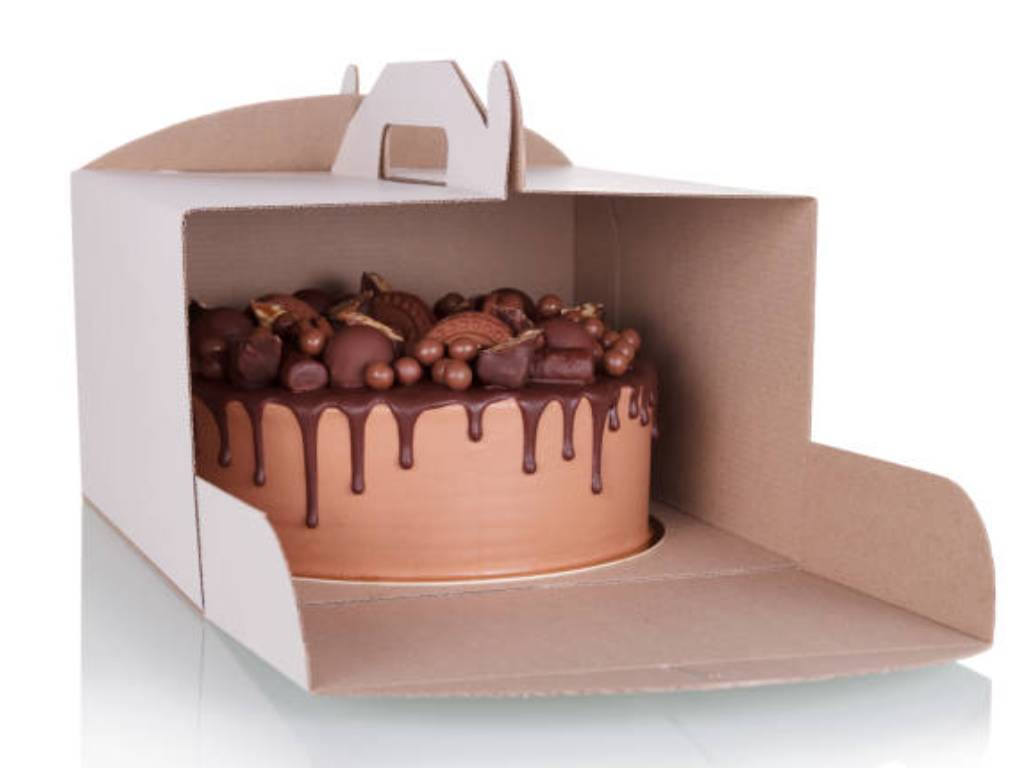
The vast majority of cake boxes you encounter are made from paperboard — specifically duplex board, a two-layer material with a white printing surface on one side and a grey or kraft backing on the other. Typical grammage ranges from 250 to 400 GSM: 250 GSM works for cupcakes and small pastries, while a 10-inch birthday cake needs at least 350 GSM to keep the base from bowing when lifted.
Paperboard boxes are lightweight, fold flat for storage, and accept CMYK flexographic or offset printing with strong color fidelity. They are the most economical option by a wide margin — ideal for bakeries running on volume where unit packaging cost matters directly. The trade-off: they offer limited crush resistance for heavy or tiered cakes, and standard paperboard absorbs ambient moisture over time, which can soften the structure in humid environments.
For food safety, paperboard intended for direct or indirect food contact in the U.S. must comply with FDA 21 CFR 176.170, which regulates substances used in paper and paperboard components that contact aqueous and fatty foods (FDA via eCFR). In Europe, the parallel framework is EC 1935/2004.
Grammage: 250–400 GSM · Most common material for bakery packaging · FDA 21 CFR 176.170 compliant (food contact)
Corrugated Cardboard — Heavy-Duty Protection
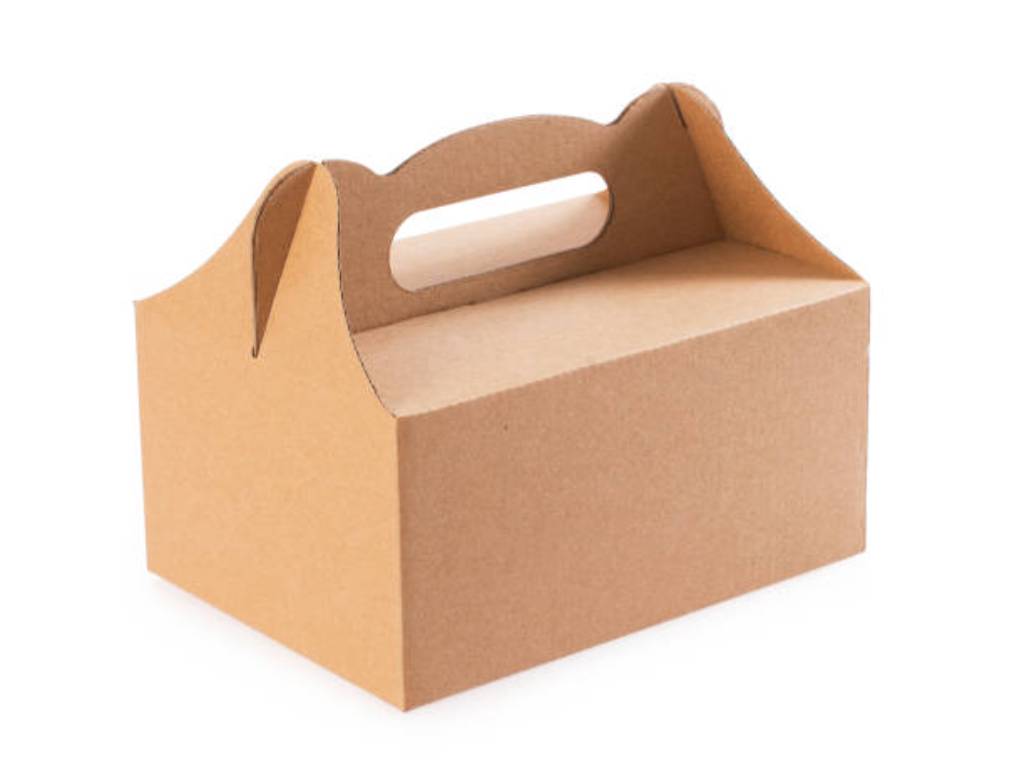
When a cake weighs more than three kilograms or needs to survive a cross-city delivery, paperboard is not enough. Corrugated cardboard takes over. Its strength comes from the flute — a wavy inner layer sandwiched between two flat linerboards.
For cake boxes, the most common profile is E-flute, with a thickness of approximately 1.5 mm (noissue, 2022). E-flute gives you an excellent printing surface plus enough crush resistance for standard tiered cakes. For three-tier wedding cakes exceeding 10 kg, B-flute (approximately 3 mm) or even double-wall construction becomes necessary. The cost premium over standard paperboard ranges from 1.5× to 2.5×, proportional to the flute profile and wall count.
One practical consideration: corrugated boxes take up significantly more storage space than flat paperboard. If you only need heavy-duty packaging for 10% of your orders, stocking a small quantity of assembled corrugated boxes in the most common wedding-cake sizes works better than trying to cover every possible dimension.
Clear Plastic (PET/PP) — Visibility First
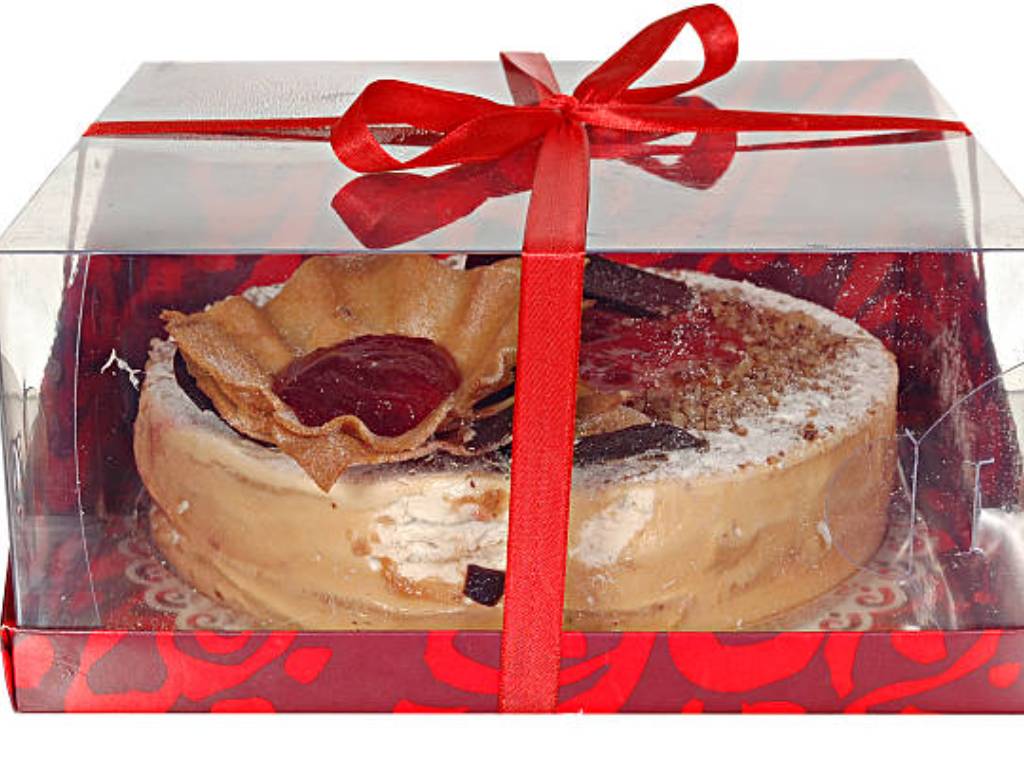
Transparent cake boxes serve a fundamentally different purpose: they sell with sight. A clear box on a refrigerated display shelf lets the product speak for itself — the strawberries on top, the glossy ganache, the neat layering.
Two plastics dominate this category. PET (polyethylene terephthalate) offers superior clarity — optically near glass — but begins to deform above 60°C, so it works strictly for cold or room-temperature products. PP (polypropylene) has slightly lower transparency but handles microwave reheating and hot-fill applications. Both are durable, stackable, and common in supermarket and convenience-store channels.
The environmental trade-off is real: neither PET nor PP biodegrades in any meaningful timeframe. They are recyclable in municipal streams where facilities exist, but the recycling rate for post-consumer plastic packaging stays below 15% globally. Any “recyclable” claim should be read with that number in mind.
Kraft and Recycled Paperboard — The Eco Baseline
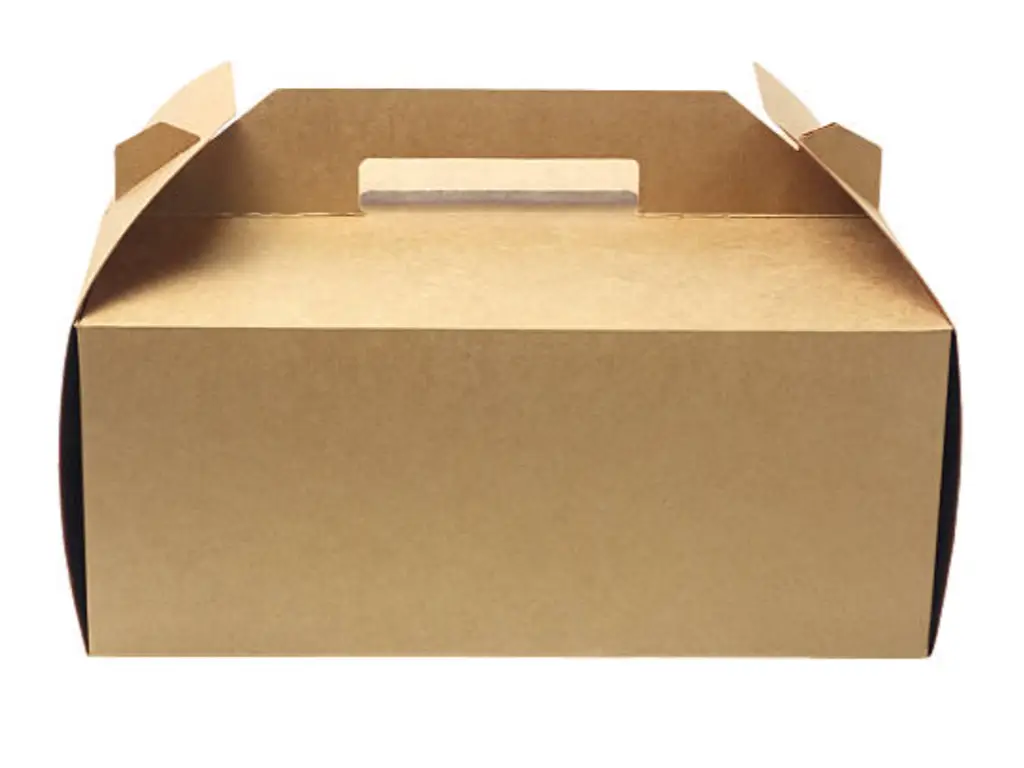
Kraft paperboard — unbleached, natural brown — communicates “earthy” and “artisanal” before a single word of branding appears. The kraft (sulfate) pulping process produces a stronger sheet than recycled alternatives at equivalent grammage. The visual limitation matters: printing on dark kraft stock requires opaque white underprinting to make colors pop, adding a production step and modest cost.
Recycled paperboard uses post-consumer fiber. It wins on virgin material displacement, but each recycling cycle shortens the wood fibers, reducing strength incrementally. For a bakery that leads with sustainability messaging, the choice between FSC-certified virgin kraft and high-post-consumer recycled board often comes down to which story the brand wants to tell: responsible forestry or circular economy.
PLA and Bagasse — Plant-Based, Not Petroleum
The newest entrants to cake box materials come from renewable feedstocks rather than fossil fuels. PLA (polylactic acid) comes from fermenting corn starch into lactic acid, then polymerizing it into a clear, rigid plastic that looks nearly identical to PET. Bagasse is the fibrous residue left after sugarcane juice extraction — thermoformed under heat and pressure into sturdy, opaque containers with a natural off-white color.
The critical distinction: both materials are certified industrially compostable under ASTM D6400 (enforced by the Biodegradable Products Institute in North America) and EN 13432 (the European equivalent), but neither breaks down in a backyard compost pile. Industrial composting needs sustained temperatures of 55–60°C, controlled humidity, and specific microbial inoculation — conditions that exist in fewer than 5% of municipal waste facilities globally. In a standard landfill, PLA behaves similarly to conventional plastic in terms of persistence. The label “compostable” is accurate, but it carries an asterisk your customers deserve to understand.
Cost-wise, PLA runs 20–40% above PET depending on order volume. Bagasse is more competitive — roughly on par with corrugated paperboard — making it the more accessible plant-based option for most bakeries.
03 Cake Box Types by Structure and Features
Material sets the baseline; structure defines the experience. The same 350 GSM paperboard can become a window box, a handled carry box, or a tall box for decorated cakes — and each solves a different user need.
Before reading the individual types below, ask yourself which problem you are actually solving: Is my cake too tall for a standard lid? Do customers want to see the cake before buying? Am I delivering 50 kilometers across town?
Window Boxes — Selling with Visibility
A window box puts a transparent film — typically PET, OPP, or compostable PLA — in the lid, letting the cake sell itself. Consumers assign higher trust and perceived value to products they can visually inspect before purchase. That is not marketing theory; it is why supermarket bakeries use window boxes for every item on the shelf.
The structural trade-off: cutting a window into the lid removes material that would otherwise contribute to stack strength. A window covering more than 50% of the lid surface measurably reduces crush resistance. For cakes with tall decorations, the window film also needs an anti-fog coating if the box moves between cold storage and room temperature — otherwise condensation fogs the view within seconds, defeating the purpose.
Handled Boxes — Designed for the Journey
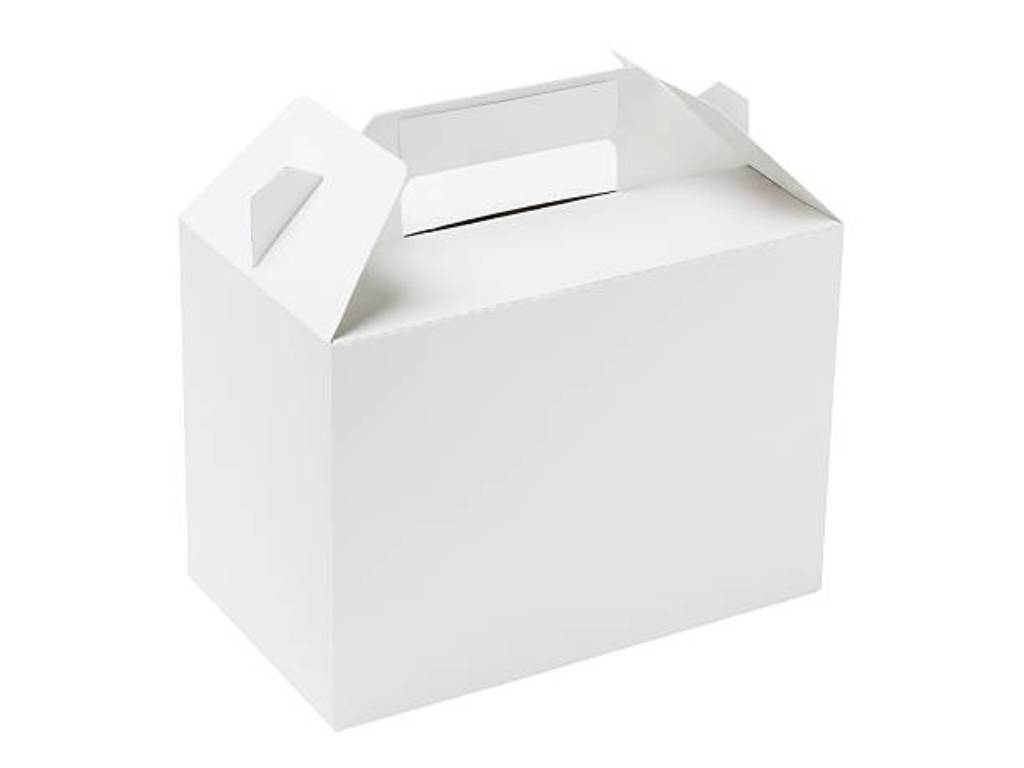
A handle transforms the carrying experience from a careful two-handed cradle to a confident one-handed grip. Most cake box handles are integrated die-cut paperboard tabs that fold up and lock, though plastic and ribbon handles appear in premium formats. Industry practice requires handles to support at least twice the expected cake weight in static load testing — a 5 kg cake demands handle integrity at 10 kg minimum.
The center-of-gravity detail matters just as much: the handle attachment points should sit slightly forward of the box’s geometric center so the box tilts naturally toward the carrier’s body rather than away from it.
Tall and Extra-Height Boxes — Room for the Crown
This category addresses Reddit’s recurring “cake box crisis” — the baker who finishes a beautifully decorated tall cake only to discover no standard box clears the topper. Standard cake boxes offer 10–12 cm of interior height. Tall boxes extend to 15–20 cm, and specialized suppliers in the professional cake-design market offer boxes up to 70 cm for elaborate sculptural cakes.
The measurement rule sounds obvious but gets violated constantly: measure from the top of the cake board to the highest point of decoration, then add 3–5 cm. The structural note: as box height increases, sidewall buckling risk rises non-linearly. Boxes exceeding 20 cm in height need corrugated or reinforced side panels rather than standard paperboard.
Tiered and Multi-Level Boxes — Stacked, Not Squished
A three-tier wedding cake does not sit inside a single cavernous box. Each tier rests on its own cake board, and the tiers are separated by dowels or pillars that transfer weight vertically through the cake’s structure — not through the box walls. The box itself is a protective shell. Its job is to enclose and shield, not to bear the cake’s internal stacking load.
Professional cake designers working with tiered cakes increasingly use modular extender systems: a base box with removable ring extensions that adjust total interior height to the specific cake. This avoids stocking four or five different fixed-height box SKUs.
Flat-Pack and Foldable Boxes — Storage That Makes Sense
For a bakery processing hundreds of boxes per month, storage efficiency is not a footnote. A pre-assembled cake box occupies roughly three to five times the shelf space of the same box stored flat. Flat-pack boxes with auto-lock bottoms — where the base folds and locks without tape or glue — cut assembly time to under 10 seconds per box while shrinking the storage footprint by roughly 75%. For high-volume operators, this single feature can free up enough shelf space to stock a wider range of sizes without expanding the storeroom.
04 Cake Box Sizing — A Quick-Reference Guide
The single most-searched question around cake boxes is “what size do I need?” The table below matches common cake formats to their recommended box dimensions. The golden rule: measure the cake board, not the cake itself. Add at least 1–2 cm of clearance on all sides, and measure total height from the board surface to the top of the highest decoration.
| Cake Type | Cake Size | Recommended Box (L × W × H) | Notes |
|---|---|---|---|
| Cupcake / Mini Cake | 4″ round (10 cm) | 6″ × 6″ × 3″ (15 × 15 × 7.5 cm) | Fits 1–2 small items |
| Standard Birthday Cake | 8″–9″ round (20–23 cm) | 10″ × 10″ × 5″ (25 × 25 × 13 cm) | Room for frosting and simple toppers |
| 2-Tier Cake | 10″ base (25 cm) | 14″ × 14″ × 10″ (36 × 36 × 25 cm) | Corrugated strongly recommended |
| 3-Tier Wedding Cake | 14″ base (36 cm) | 18″ × 18″ × 12″ (46 × 46 × 30 cm) | Double-wall corrugated + internal dowels |
| Quarter Sheet Cake | 9″ × 13″ (23 × 33 cm) | 14″ × 10″ × 4″ (36 × 25 × 10 cm) | Rectangular box |
| Half Sheet Cake | 11″ × 15″ (28 × 38 cm) | 18″ × 13″ × 4″ (46 × 33 × 10 cm) | Rectangular box |
| Full Sheet Cake | 18″ × 24″ (46 × 61 cm) | 26″ × 18″ × 5″ (66 × 46 × 13 cm) | Largest standard retail size |
A non-slip mat or a small dab of frosting between the cake board and the box base prevents shifting during transport — a five-second step that eliminates the most common cause of delivery damage.
05 Specialty Boxes — Cupcakes, Slices, and Seasonal Occasions
Standard cake boxes cover most scenarios, but the last 20% of needs call for purpose-built formats.
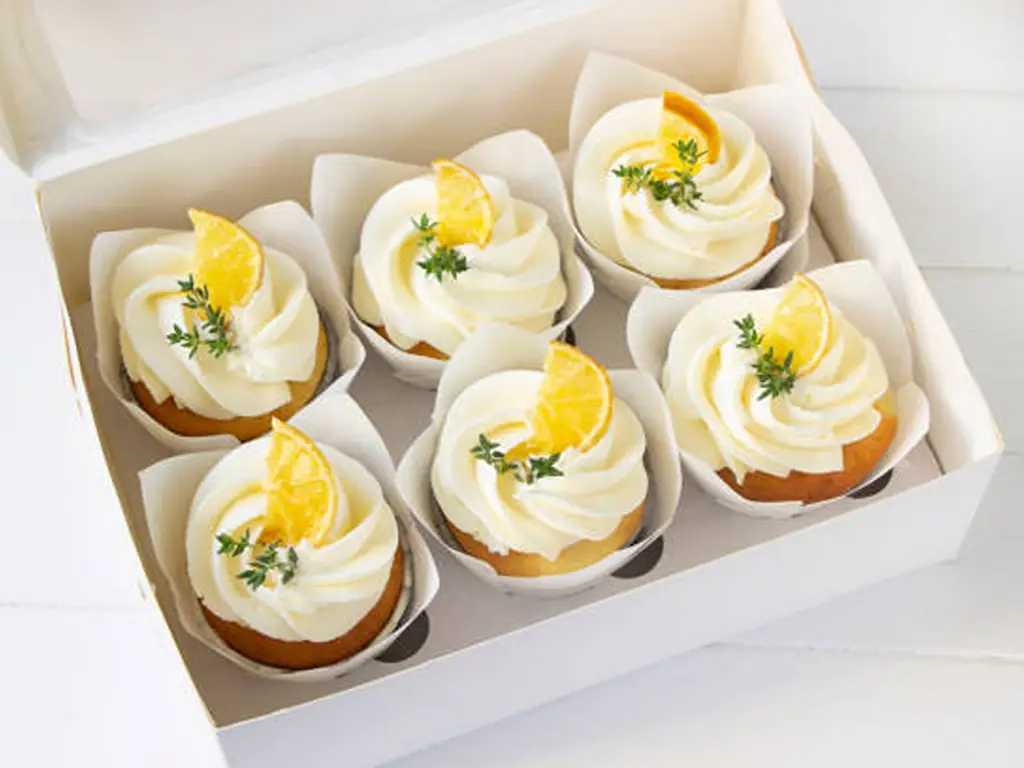
Cupcake boxes use die-cut paperboard or molded pulp inserts with individual cavities — typically 4, 6, 12, or 24 wells — that hold each cupcake upright and prevent side-to-side frosting contact. Without inserts, cupcakes in a standard box slide and smear within minutes of the first turn.
Cake slice containers are triangular, single-portion boxes designed for bakeries and cafés selling by the slice. They turn what would be a paper-plate-and-wrap affair into a clean, stackable, brandable package — and they justify a higher per-slice price point because the presentation signals value.
Macaron boxes take a different form: flat, slim, with a sliding tray or lift-out platform. Macarons are light but fragile; they need compartmentalization, not vertical strength.
Seasonal and themed boxes — Christmas red-and-green prints, Valentine’s heart-shaped formats, Lunar New Year motifs — work as marketing assets as much as packaging. A customer carrying a branded holiday box through a shopping district generates impressions. The unit premium over plain boxes is typically 15–30%, but the marketing return during peak seasons often covers it.
06 How to Choose the Right Cake Box for Your Business
Knowing the types is step one. Turning that knowledge into a purchasing decision is where most guides stop — and where the real work begins. Here is a five-point evaluation framework that moves from theory to procurement.
Start with your business stage. A home baker fulfilling five custom orders per week needs fundamentally different packaging than a regional chain moving 5,000 units a month. The home baker should stock two or three versatile sizes — a 10″ × 10″ white paperboard window box handles 80% of standard orders — and buy specialty formats per-order. The chain needs a negotiated supply agreement covering six to eight SKUs with consistent lead times and volume pricing.
Match material to transport distance. Customer pickup from a storefront: standard paperboard works. Same-city delivery via courier: step up to corrugated with internal cake board stabilization. Cross-city or intercity logistics: double-wall corrugated, individual cake boards, and cold-chain planning if your product contains perishable fillings. A box that survives a three-kilometer journey can fail catastrophically at thirty.
Align customization to brand maturity. For early-stage businesses: stock white boxes plus a branded sticker or stamp. Once you have a stable customer base and consistent order volume: single-color logo printing becomes cost-effective. Full CMYK + Pantone custom printing — your artwork, your color palette, your brand story embedded in the packaging — only makes sense at scale: per-unit cost drops sharply above 50,000 units, but the upfront plate and setup fees mean you need steady volume to justify it.
Look for a manufacturer that covers multiple box types. Managing three separate suppliers — one for paper cups, one for cake boxes, one for paper bags — costs you in weekly procurement hours, inconsistent quality, and fragmented shipping. A single source that can supply cardboard, corrugated, and eco-friendly material options across multiple box structures simplifies inventory and builds a relationship that leads to better terms over time.
Verify certifications before committing. At minimum, food-contact packaging should come with documentation confirming FDA or EU food-contact compliance for the specific materials used. If your brand markets sustainability, the certifications need to match the claims: FSC for responsible forestry, BPI or EN 13432 for compostability, ISO 9001 for quality management systems. Ask for certificate numbers, not just logos.
07 Sustainable Cake Packaging — Materials, Certifications, and Trade-Offs
Every major SERP article on cake boxes mentions “eco-friendly options” in one or two paragraphs. Few explain what the terms mean, or compare the different environmental paths against each other. If sustainability matters to your brand — or your customers — this section gives you a framework to evaluate claims instead of trusting them.
| Material | Source | Key Certifications | Compostable? | Recyclable? | Cost vs Standard | Best For |
|---|---|---|---|---|---|---|
| FSC-Certified Paperboard | Managed-forest virgin fiber | FSC, PEFC | No | Yes (paper stream) | ~Same to +10% | Brands prioritizing traceable sourcing |
| Post-Consumer Recycled Paperboard | Recovered paper waste | FSC Recycled | No | Yes (limited cycles) | ~Same | Circular-economy positioning |
| Kraft Paper | Virgin unbleached wood pulp | FSC (if certified) | No | Yes | ~Same | Rustic/natural brand aesthetic |
| PLA (Polylactic Acid) | Corn starch fermentation | BPI (ASTM D6400), DIN EN 13432 | Yes (industrial only) | No | +20–40% vs PET | Premium eco brands, cold-use |
| Bagasse | Sugarcane fiber residue | BPI, OK Compost | Yes (industrial) | No | ~Same as corrugated | Hot/cold containers, universal format |
The single most important concept to internalize: “compostable” does not mean “will biodegrade anywhere.” PLA and bagasse both require industrial composting facilities operating at 55–60°C with controlled humidity and microbial environments. In a standard landfill — where most disposable packaging ends up — these materials persist similarly to conventional materials. The BPI certification mark (ASTM D6400) confirms the material meets the technical standard for industrial compostability; it does not guarantee your local waste facility can process it. For bakeries whose customers genuinely care about composting, manufacturers offering both FSC-certified paperboard and plant-based materials like PLA and bagasse — with full certification documentation available on request — provide the most credible sustainability story. One such supplier, YoonPak, manufactures cake boxes across FSC-certified paperboard, PLA, and bagasse material lines, with products certified to BPI (ASTM D6400) and DIN EN 13432 standards. Knowing these options exist across the three major environmental paths — responsible forestry, recycled content, and industrial compostability — means your packaging choice can reflect what your specific customers value rather than a generic “green” claim.
If you are evaluating packaging suppliers for your bakery or food-service business, a manufacturer’s certification portfolio, material range, and sample responsiveness say more about reliability than catalog photos. Request physical samples in your most-used sizes before committing to volume orders.

 English
  German
  Spanish
  Italian
  Dutch
Dutch  French
  Portuguese
  Russian
  Arabic
  Korean