

Cookie Packaging Ideas That Go Beyond the Box: A Guide to Materials, Printing, and Smart Sourcing
Search “cookie packaging ideas” and you will find the same thing on every page: pretty pictures of ribbon-tied boxes, kraft paper pouches, and windowed bakery cartons. The message is always the same — make it look good. But if you run a bakery, a cookie brand, or any food business that actually sells cookies at scale, you already know that looking good is not even half the job. The packaging also needs to keep cookies fresh through shipping, survive shelf display without crushing, meet food safety standards in your market, and arrive on time when you have orders to fill.
This guide is different. It covers the formats, yes — but it also goes into the materials, printing technologies, sustainability certifications, manufacturing process, and supplier evaluation criteria that every other “cookie packaging ideas” article skips. Whether you are still hand-wrapping cookies at your kitchen table or ordering 50,000 custom boxes for a growing brand, the goal is the same: packaging that protects your product, communicates your brand, and arrives without surprises.
01Cookie Packaging Formats: A Quick Tour of Your Options
Before diving into materials and manufacturing, it helps to know what formats are available and which ones fit your business model. Think of what follows as a framework for locating your needs — not an exhaustive catalog.
Windowed paperboard boxes are the bakery standard for a reason. A cardboard box with a transparent film window lets customers see the cookies inside while the rigid structure protects them from crushing. They work well for in-store display, gift packaging, and countertop presentation. The trade-off is cost per unit — higher than bags — and the reality that the window film is typically plastic, which complicates any sustainability claims.
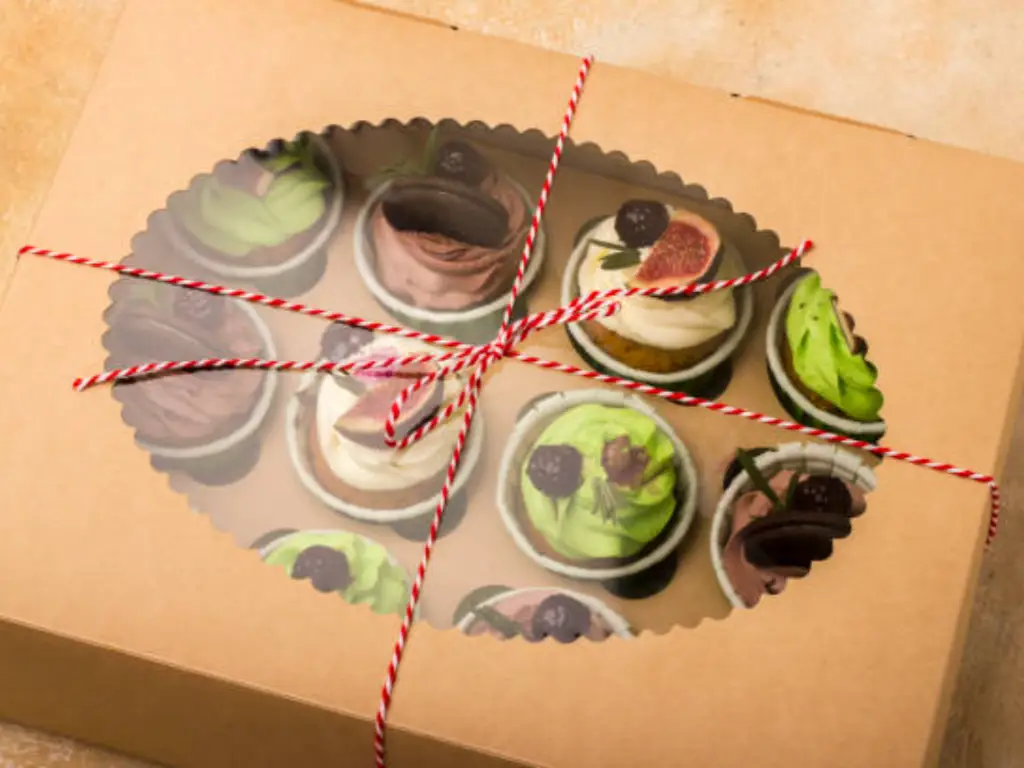
Stand-up pouches and flat bags dominate the grab-and-go and single-cookie market. They are the most economical format, easy to brand with stickers or printed film, and resealable options extend shelf life after opening. The downside: zero crush protection. A bagged cookie in a shipping box without internal cushioning will arrive as crumbs.

Kraft paper boxes have become the uniform of the artisanal cookie world — and for good reason. The unbleached brown paperboard reads as “handmade,” “natural,” and “eco-conscious” without needing a word of copy. They are affordable, recyclable, and photograph well. But kraft alone provides no barrier against moisture or grease — if your cookies are buttery, expect oil stains on the box within days unless the paperboard is coated.

Clear plastic trays with lids are the format of choice for prepackaged retail. The full visibility puts the product front and center, and the rigid tray prevents cookies from shifting. This format works especially well for decorated sugar cookies and iced designs where visual appeal drives the purchase decision. The material is almost always PET or PLA, and the sustainability difference between the two matters more than most packaging vendors will tell you — more on that in the next section.

Tin boxes and jars occupy the premium gift tier. A reusable tin signals quality before the lid comes off, justifies a higher price point, and gives customers a container they will keep — with your logo on it — for months. The per-unit cost is significantly higher, but for corporate gifting, holiday collections, and premium branding plays, the math often works.

Compartment boxes for assortments solve a specific logistics problem: how to ship a dozen different cookie varieties in one box without them arriving as a single merged cookie. Dividers — usually cardboard or molded fiber — keep each piece in place and elevate the unboxing experience. They add cost and assembly time, but for sampler packs and gift assortments, nothing else does the job.
Format is the skeleton. But the skeleton does not keep cookies fresh — the material does. That is where the next section begins.
02The Materials That Keep Cookies Fresh — and Why It Matters
Packaging material selection comes down to a single tension: barrier performance versus cost, with environmental impact layered on top. Every cookie packaging decision sits somewhere on this triangle. The section below unpacks the two dominant coating technologies and then gives you a framework for matching material to your specific cookie type.
PE-Coated Paperboard: The Industry Workhorse
If you have ever held a paper coffee cup and noticed it did not leak, you have encountered PE (polyethylene) coating. The same principle applies to cookie packaging: a thin layer of polyethylene — typically 10 to 50 microns thick, depending on the barrier requirements — is applied to the inner surface of paperboard. This creates a waterproof, oil-resistant barrier that prevents moisture ingress from the outside and grease migration from the inside.
PE-coated paperboard is the default choice for most commercial cookie packaging for three reasons. First, it provides near-total leak and grease protection — critical for butter-based cookies where oil stains telegraph poor quality within days. Second, it heat-seals well, with a sealing window between 120°C and 160°C that works across standard packaging machinery. Third, it is the most cost-effective barrier option, which is why roughly 90% of coated paper food packaging uses PE.
The limitation is straightforward: PE is petroleum-based and does not biodegrade in any meaningful timeframe. If your brand positioning centers on sustainability, PE coating creates a tension you will need to address — either by switching to a bio-based alternative or by being transparent about the trade-off. For food safety, PE coatings intended for food contact must comply with FDA 21 CFR 176.170 in the U.S. market and EU Regulation 1935/2004 in Europe, both of which set migration limits for substances that could transfer from packaging into food (FDA, eCFR, current version).
PLA and Bio-Based Barriers: The Green Alternative, Explained Honestly
PLA (polylactic acid) is the most talked-about alternative to PE, and also the most misunderstood. PLA is derived from fermented plant starch — typically corn — rather than petroleum. When used as a coating on paperboard, it creates a renewable-source barrier that is certified industrially compostable under standards like EN 13432 (Europe) and ASTM D6400 / BPI certification (United States).
What the marketing often leaves out: PLA has a glass transition temperature (Tg) of roughly 55–60°C, compared to PE’s melting range of 105–115°C. This means PLA softens at temperatures that PE shrugs off — relevant if your cookies are shipped through hot climates or displayed near a sunny window. PLA also has a significantly higher water vapor transmission rate (WVTR) than PE, which means moisture escapes (or enters) faster. For a dry, crunchy cookie this may be acceptable; for a soft, high-moisture cookie, PLA alone may cut the shelf life short (Polymer Update Academy, 2024).
- Tg / Melt: Melting range 105–115°C — stable across all baking and shipping temperatures
- WVTR: Low — excellent moisture barrier, preserves cookie texture
- Cost: Baseline (most cost-effective barrier option)
- Tg: 55–60°C — softens in heat that PE handles easily
- WVTR: Higher than PE — moisture escapes faster, shelf-life risk for soft cookies
- Cost: 20–40% more than equivalent PE-coated board
The other honest disclosure: PLA requires industrial composting facilities — the kind that maintain 58°C and controlled humidity for weeks. Your customer’s backyard compost pile will not break it down. This does not make PLA a bad choice; it makes it a choice whose environmental benefit depends on whether the end user has access to industrial composting infrastructure. The cost is also higher: PLA-coated paperboard typically runs 20–40% more than equivalent PE-coated board, which matters at volumes over 10,000 units.
Match the Material to the Cookie
The material decision is not theoretical — it depends on what you are actually baking. A practical matching guide:
- High-butter cookies (shortbread, butter cookies, spritz): These contain 20%+ butterfat by weight. Without a strong oil barrier, grease migrates into the paperboard within 7–14 days, creating visible stains. PE coating is the safe default; PLA works if the shelf life is short and the brand story demands it.
- Soft, high-moisture cookies (brownies, soft gingerbread, filled cookies): These have a water activity (aw) above 0.6, which means mold becomes a risk if moisture is trapped. PE-coated board with a tight seal is the standard solution. PLA’s higher WVTR becomes a real liability here — unless the packaging includes a secondary moisture barrier.
- Crisp, dry cookies (biscotti, thin crisps, shortbread thins): Water activity is typically below 0.3. Moisture protection is less critical; structural protection — preventing breakage — is the priority. Material choice matters less than box rigidity and internal padding.
- Organic or premium-positioned cookies: Material story and brand story need to match. A USDA Organic cookie in a petroleum-coated box sends a mixed message. PLA-coated kraft with FSC-certified paperboard aligns the packaging with the product’s market position — and customers in this segment tend to read the fine print.
03Printing and Branding: Turning a Box into a Silent Salesperson
Your packaging is the only part of your brand that customers touch before they taste your product. Printing quality directly shapes perceived value — a blurry logo or mismatched color registers as “cheap” faster than any price tag. This section covers what most packaging vendors’ blog posts leave out: how the printing actually gets onto the box.
Flexo vs. Offset Printing: Which One Fits Your Order?
Two printing technologies dominate custom packaging production, and the choice between them is not about which is “better” — it is about your order size, design complexity, and budget.
Flexographic (flexo) printing uses flexible rubber or photopolymer plates wrapped around rotating cylinders. Ink transfers from the plate to the substrate in a continuous roll-to-roll process. Flexo plates cost $200–500 per color to produce, making it economical for small-to-medium runs. The resolution typically reaches 48–60 lines per centimeter (L/cm) — sufficient for solid colors, bold text, and simple logos. It is the right choice for most bakery packaging runs under 50,000 units where the design does not require photographic detail.
Offset (lithographic) printing transfers ink from a metal plate to a rubber blanket, then to the substrate — an indirect process that produces sharper edges and finer detail. Offset plates cost $500–1,500 per color, and the resolution can reach 80–120 L/cm, which handles gradients, photographs, and intricate patterns that flexo cannot reproduce cleanly. The higher setup cost makes offset economical only at larger volumes — typically 50,000 units and above — where the per-unit cost advantage of faster run speeds outweighs the plate investment.
The rule of thumb: if your design is predominantly text, a logo, and a few solid-color elements, flexo will serve you well at lower cost. If your design includes product photography, detailed illustrations, or smooth color gradients, offset is the tool for the job — and the budget needs to account for it.
| Flexo Printing | Offset Printing |
|---|---|
| Resolution: 48–60 L/cm | Resolution: 80–120 L/cm |
| Best for: solid colors, text, simple logos | Best for: photos, gradients, fine detail |
| Plate cost: $200–500/color | Plate cost: $500–1,500/color |
| MOQ: 10,000–50,000 pcs | MOQ: 50,000+ pcs |
Color Fidelity: Why Your Box Might Not Match Your Screen
Every custom packaging project hits this moment: the design looked perfect on screen, but the printed box arrived in a color that is — close, but not right. This is not a manufacturing defect. It is physics.
Computer screens display color in RGB (red, green, blue) — additive light. Printing uses CMYK (cyan, magenta, yellow, black) — subtractive pigment on paper. The CMYK color space covers only about 60–70% of what an RGB screen can display. Certain vivid blues, bright greens, and intense oranges that look electric on a monitor simply cannot be reproduced with ink on paperboard.
The Pantone Matching System (PMS) solves this problem. Pantone maintains 2,161 standardized spot colors, each with a precise ink formula that produces the same result on any press, anywhere in the world. When you specify “Pantone 2995 C” for your brand blue, a professional printer mixes that exact ink rather than approximating it from CMYK — and the result is consistent across production runs, months apart.
One step you should never skip: always request a physical proof before authorizing full production. A digital proof on screen is useful for layout confirmation, but it tells you nothing about how color actually renders on your chosen paperboard. A physical proof — printed on the same substrate with the same inks that will be used for the full run — is the only reliable way to sign off on color accuracy. Any manufacturer who cannot provide one should be treated with caution.
04Sustainability Certifications Decoded: What Those Labels Actually Guarantee
Nearly every packaging supplier now claims to be “eco-friendly” or “sustainable.” These words are not regulated. Anyone can print a green leaf icon on their website without any third party ever verifying their supply chain. This section gives you the tools to separate certification from marketing — because “food-safe” and “planet-safe” are two independent things, and neither should be taken on trust.
Food Safety Certifications: What “Food-Grade” Actually Requires
“Food-grade” is not a certification. It is a claim. The actual legal standards that make a package safe for food contact are specific, publicly documented, and verifiable — if you know which numbers to ask for.
FDA 21 CFR 176.170 is the key U.S. regulation governing paper and paperboard in contact with food. It lists the substances permitted in coated and uncoated paper food-contact surfaces — including the polymers, additives, and processing aids used in manufacturing — and sets migration limits for each. A manufacturer who claims FDA compliance should be able to point to specific test results against the 176.170 standard, not just a general statement (FDA, eCFR, current version).
LFGB (Lebensmittel- und Futtermittelgesetzbuch) is the German Food and Feed Code, and in practice it is often stricter than FDA. LFGB §30 and §31 add sensory testing requirements — the packaging must not impart any detectable odor or taste to the food it contacts. This matters enormously for cookies, whose mild flavors and fat content make them susceptible to absorbing off-notes from packaging materials. A box that passes FDA but fails LFGB sensory tests will produce cookies that taste faintly of cardboard — or worse, like printing ink.
EU Regulation 1935/2004 applies to all food contact materials entering the European market. Article 3 of this regulation is the core requirement: materials must not transfer their constituents to food in quantities that endanger human health, bring about unacceptable changes in composition, or cause deterioration in organoleptic characteristics (taste, smell, texture). It is the regulatory backbone that LFGB and other national implementations build upon (European Commission, 2004).
The bottom line: ask your packaging supplier for a certificate number, not a marketing claim. A real FDA compliance letter, LFGB test report, or EU Declaration of Conformity will have a document number, a testing laboratory name (SGS, TÜV, Intertek, etc.), and a date. “We comply with all relevant standards” with none of these details is not a certification — it is a conversation-ender.
Environmental Certifications: Separating Substance from Greenwashing
The environmental side has its own parallel set of standards, and the same rule applies: if there is no third-party certificate number, the claim does not exist.
FSC (Forest Stewardship Council) certifies that the wood fiber in paper packaging comes from responsibly managed forests — not illegal logging, not old-growth clear-cutting, not conflict timber. Every FSC-certified product carries a license code (format: FSC-C######) that you can verify in real time at info.fsc.org. If a supplier says their paper is “sustainably sourced” but cannot produce an FSC code, it is a verbal assurance, not a certification.
BPI (Biodegradable Products Institute) certifies that a product will fully degrade in a commercial composting facility according to ASTM D6400 standards — essentially, 90%+ biodegradation within 180 days under controlled composting conditions. BPI certification is the only widely recognized North American standard for compostable packaging claims. Note what it does not mean: it does not mean the product will degrade in a landfill (landfills lack the oxygen and microbiology of compost facilities), and it does not mean the product will break down in the ocean.
EN 13432 is the European equivalent, and it is stricter: it requires 90%+ biodegradation within 12 weeks (not 180 days) and adds a plant toxicity test — compost produced from the degraded packaging must support plant growth without toxic effects. A product that passes EN 13432 will pass ASTM D6400; the reverse is not always true.
BSCI (Business Social Compliance Initiative) is different from the certifications above — it audits the factory, not the material. BSCI certification means the manufacturing facility has been assessed against 11 performance areas including fair wages, working hours, health and safety, and prohibition of child and forced labor. It is not an environmental standard, but for brands that care about supply chain ethics beyond materials, it is a meaningful signal.
The common thread: every credible certification has a public verification database. FSC licenses are searchable at info.fsc.org. BPI-certified products are listed at bpiworld.org. BSCI audit results are accessible through the Amfori platform. If a supplier’s certification cannot be independently verified, treat the claim accordingly.
05Behind the Scenes: How Custom Cookie Packaging Gets Manufactured
After you approve your design and place an order, a sequence of steps determines whether your boxes arrive on time, on spec, and on budget. Most “cookie packaging ideas” articles never describe this process — but it is the part that actually matters once you move past inspiration and into procurement.
-
Design review and digital proofing 1–2 working days
-
Plate making and color matching 3–10 working days
-
Printing Hourly QC checks, ΔE ≤ 2.0 tolerance
-
Die-cutting and forming Single pass for standard boxes
-
Quality control and packing AQL sampling + batch-level traceability
-
Logistics and delivery 3–6 weeks from proof approval
Each step above involves a handoff, and every handoff between separate vendors creates a potential delay. A manufacturer that controls printing, die-cutting, forming, quality control, and packing under one roof removes those coordination risks. YoonPak, a full-cycle in-house manufacturer, operates 6 printing presses, 8 die-cutters, and 86 forming machines within a single 16,000 m² facility. Standard custom orders ship within 3–6 weeks — roughly 7 days faster than the industry average — backed by hourly QC inspections and batch-level traceability that make zero-defect delivery an operational target rather than a slogan. For bakery owners and cookie brands scaling from small batches to commercial volumes, that reliability matters more than a marginal price difference on the quote (YoonPak).
06Choosing a Packaging Partner: What to Evaluate Beyond the Price Tag
After reading the sections above, you know more about materials, printing, certifications, and manufacturing than the average packaging buyer. The last step is turning that knowledge into a supplier evaluation framework — so when you compare quotes, you are comparing substance, not just prices.
| What to Evaluate | Why It Matters | What to Ask |
|---|---|---|
| Material certifications | FDA/LFGB compliance is a legal requirement for food contact — not optional | “Can you provide FDA/LFGB certificate numbers from an accredited lab (SGS, TÜV, Intertek)?” |
| Printing capability | Determines whether your design will be accurately reproduced | “Do you offer both flexo and offset? What is your physical proof process before full production?” |
| QC standards | Directly affects batch-to-batch consistency | “What is your QC inspection frequency? Do you use AQL sampling and batch-level traceability?” |
| Lead time reliability | Late packaging means you cannot ship product | “What is your standard lead time from proof approval? How do you handle rush orders?” |
| MOQ flexibility | Minimum order quantities can lock small brands out | “What is your MOQ? Is there flexibility for smaller runs — for example, 10,000 units if the buyer covers freight?” |
Price per unit matters, but it is a trailing indicator — the lowest quote often cuts corners on exactly the things that make packaging perform its job: barrier coating thickness, print registration tolerance, QC sampling frequency, and on-time delivery reliability. A box that arrives late, stained with grease, or printed in the wrong shade of blue costs far more than the few cents per unit you saved by choosing it.
If you would like to compare another manufacturer’s range, specifications, and sample availability, YoonPak offers free design support, complimentary standard samples, and digital proofs within one working day — their catalog and contact details are online (YoonPak).
References
- FDA. “21 CFR 176.170 — Components of Paper and Paperboard in Contact with Aqueous and Fatty Foods.” U.S. Code of Federal Regulations. Current version. https://www.ecfr.gov/current/title-21/chapter-I/subchapter-B/part-176/subpart-B/section-176.170
- European Commission. “Regulation (EC) No 1935/2004 on Materials and Articles Intended to Come into Contact with Food.” 2004. https://eur-lex.europa.eu/legal-content/EN/TXT/?uri=CELEX:32004R1935
- Polymer Update Academy. “Water Vapor Transmission Rate (WVTR) Testing for Plastic Films.” 2024. https://www.polymerupdateacademy.com/WeeklyInsights/Details/1382081
- YoonPak. “Custom Packaging.” https://www.yoonpak.com/custom-packaging/
- YoonPak. “Paper Cups — 5-Step Production Process.” https://www.yoonpak.com/paper-cups/
- YoonPak. “Contact & Sample Request.” https://www.yoonpak.com/contact/
- YoonPak. Homepage. https://www.yoonpak.com/

 English
  German
  Spanish
  Italian
  Dutch
Dutch  French
  Portuguese
  Russian
  Arabic
  Korean