

Paper Cup GSM: How to Choose, Verify, and Compare Cupstock Weight
What Does GSM Mean for Paper Cups?
Every paper cup order eventually comes down to one question: what GSM? The number decides the price, the feel in a customer’s hand, and whether the cup survives its first drink. But most buyers are quoting a number they can’t fully define — and suppliers know it.
GSM stands for grams per square meter. It is the weight of one square meter of the paperboard the cup is made from — not the phone network, not a quality grade. (That confusion happens more often than you’d think.) A cup printed from 250 gsm cupstock means the base paperboard weighs 250 grams per square meter before anything is added to it.
The number is easy to verify yourself. Cut a rectangle of known area from a flattened cup, weigh it on a precision scale, and divide:
Example: a 4 cm × 5 cm sample (0.002 m²) weighing 0.68 g → 0.68 ÷ 0.002 = 340 gsm (GMZ’s measurement guide uses exactly this method).
GSM = grams per square meter — the weight of one square meter of cupstock paperboard, before coating. Cupstock runs 135–400 gsm. GSM is the entry spec: real performance comes from how it combines with coating and wall structure.
Cupstock for paper cups runs from about 135 gsm (thin, low-cost vending cups) to 400 gsm (heavy premium and multi-layer constructions). Intuitively, more GSM means a heavier, stiffer, more expensive cup. Everything past that intuition is where the mistakes live — because GSM is only the entry spec. What actually determines whether a cup leaks, burns a hand, or goes soggy is how that weight interacts with the coating and the wall structure. That’s what this guide is really about.
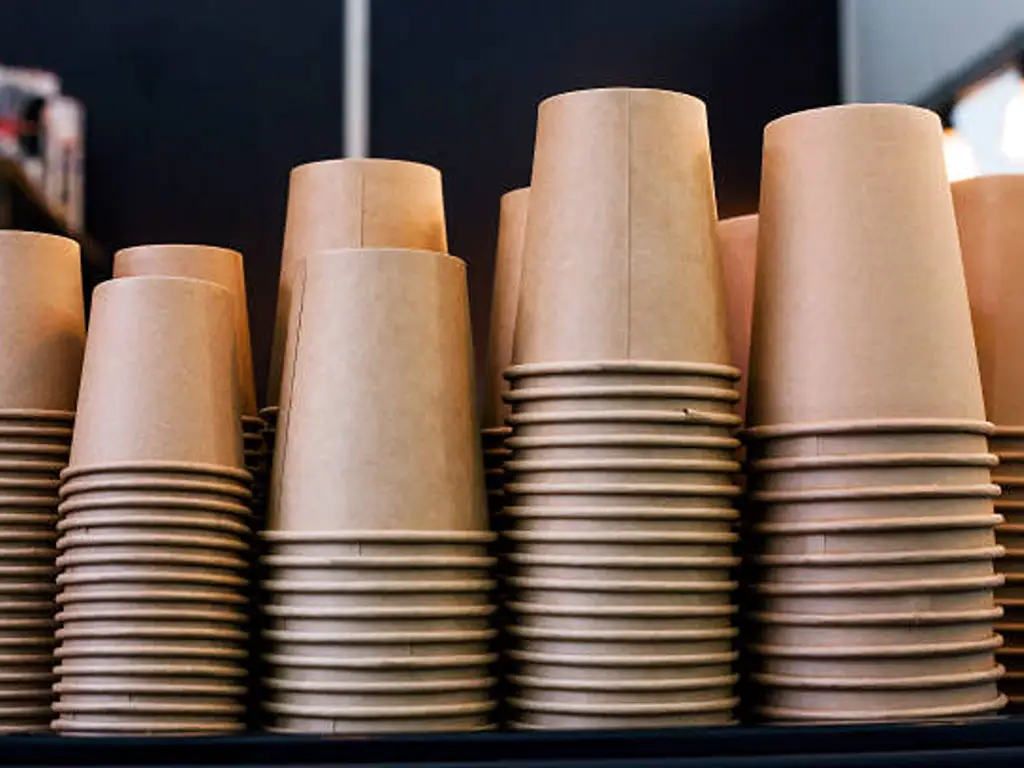
Paper Cup GSM Ranges by Size: A Quick Reference
If you only need a starting point, here’s how cup size and GSM line up across supplier guidance. Treat it as a reference, not a rulebook — the ranges below deliberately show the spread between sources, because that spread is the clue to what most guides get wrong.
| Cup capacity | Typical GSM range | Typical use |
|---|---|---|
| Small cups, 50–150 ml (2–5 oz) | 150–190 gsm | Espresso, sample cups, water cups |
| Medium, ~210 ml (7 oz) | 190–210 gsm | Hot tea, small coffee |
| Standard, ~360 ml (12 oz) | 210–250 gsm | The workhorse coffee cup |
| Large, 500 ml+ (16–20 oz) | 280–350 gsm | Takeaway coffee, cold large sizes |
| Cold drinks (all sizes) | 150–250 gsm | Soda, iced drinks — heat resistance not needed |
| Hot drinks (all sizes) | 200–300 gsm | Insulation and burn protection |
Two patterns hold across every source: bigger cup → higher GSM, and hot drinks demand more weight than cold. A 12 oz hot cup needs the stiffness to hold 360 ml of near-boiling liquid without flexing; a small cold cup can run thin because there’s no heat involved.
The ranges above are a composite of several supplier guides. One suggests light-weight starts at 135 gsm; another starts small cups at 155 gsm; a paper mill manager puts food-grade board at “220 gsm and above” (Quora discussion). All of them are “right” in their own context. The next section explains why the same question gets different answers — and why that matters when you compare quotes.
GSM Is Not Thickness (And Why It Matters)
Here’s the fact that unsettles most buyers: GSM measures weight, not thickness. Two cups can carry the same GSM number and feel completely different in the hand.
The missing variable is bulk — how much volume a paper’s fibers take up. A heavily calendered (compressed) board at 250 gsm can be thinner than a fluffy, less-compressed board at 220 gsm. The true physical thickness is called caliper, measured in microns: a 300 gsm board with typical bulk of 0.14–0.16 works out to roughly 0.42 mm (Get Bio Pak’s technical sheet runs this exact calculation). Fiber source, beating, and coating all shift the relationship.
Why this matters in the real world: a supplier can make a thinner-feeling cup feel heavier by quoting a higher GSM. More commonly, two suppliers quote the same GSM and deliver visibly different stiffness. The contradictory range tables you saw above aren’t sloppy journalism; they’re the symptom of unstated differences in paper grade, coating weight, and measurement conventions (base paper vs. finished cup).
GSM is weight, not thickness. Two cups with the same GSM can differ in real thickness (caliper, µm) because of fiber bulk and calendering. Never compare two suppliers on the GSM number alone — clarify base-paper-or-coated, paper grade, coating, and structure first.
One more force is pushing on the number itself: regulation. In Europe, recycling and packaging legislation is driving buyers toward heavier, more recyclable cupstock — 250–350 gsm is common there — while North American buyers cluster at 220–300 gsm and price-sensitive Asian markets still work comfortably at 140–220 gsm (Get Bio Pak market overview). “What’s the right GSM?” is increasingly answered by “where are you selling?”.
GSM × Coating × Structure: Three Specs That Matter
Strip a paper cup order down and only three specs survive contact with reality. The GSM number you write on a PO is just the first of them.
Start With the Base Paper GSM
Lock the base-paper number first, using the size reference above. This is the entry parameter: it sets the weight class, the price class, and the stiffness floor. What it does not do is stop leaks, insulate a hand, or survive a half-hour in a car — those jobs belong to the next two dials.
The Coating: The 13–17 gsm That Actually Stops Leaks
Liquid containment is a coating story, not a GSM story. A cup’s water resistance comes from the film applied to the board — and that film has its own weight. Factory insiders describe polyethylene (PE) lamination adding 13–15 gsm, sometimes 15–17 gsm on top of the base paper (Quora, cup factory experience); one manufacturer specifies its PE coating at 15–20 µm thickness. A “250 gsm cup” from factory A and factory B can therefore hide very different totals — and very different leak resistance.
Two failure modes follow directly. First, cold drinks punish single-PE cups: condensation forms on the outside, and over 20–30 minutes it can soften a thin cup until it collapses — this is why factory insiders insist cold drinks need double PE (Quora, paper cup manufacturing process). Second, alcohol erodes PE film: spirits in a paper cup will slowly eat through the lining and leak. If your product line touches either case, the coating spec matters more than any GSM discussion.
Structure: The Second Lever for Insulation and Strength
Wall structure is the third dial — and the one where engineering can beat raw weight.
- Single wall: the standard. ≥160 gsm board for hot drinks.
- Double wall: two layers with a 360° air gap — inner 180–230 gsm, outer 250–300 gsm. The air gap does the insulating work a heavier single wall would otherwise need, without a sleeve.
- Ripple / corrugated: a thin corrugated layer (90–120 gsm) over a base (170–190 gsm) — excellent grip and insulation at a lower combined weight.
- Single wall + sleeve: the classic cup-and-sleeve combo; the cheapest way to add heat protection.
The boundary matrix below is what a spec sheet should actually look like when you ask a supplier for one:
| Structure | Best for | Typical GSM config | Fails when |
|---|---|---|---|
| Single wall | Value hot drinks, short consumption | 160–250 gsm | Held long; hand burns; sogginess after ~15 min with hot liquid |
| Double wall | Premium coffee, to-go hold time | Inner 180–230 / outer 250–300 | Budget-sensitive orders (2× paper cost) |
| Ripple | Iced drinks, branded cups | 90–120 + 170–190 | Full-color printing (corrugation distorts graphics) |
| Single + sleeve | High-volume chains | 160–250 + paper sleeve | Sleeve adds per-unit logistics cost |
The same 250 gsm number can hide completely different cups.
Three independent dials — a real spec sheet answers all three in writing.
When a quote comes back “250 gsm,” the professional response is: which base paper, which coating, which structure? A supplier who answers all three in writing is a supplier who knows what they’re shipping.
What a Good Paper Cup Supplier Should Tell You
By this point you know the questions. Here’s what a competent supplier should answer about their standard hot cup without hesitation — and what you should walk away from if they can’t:
Five Specs a Supplier Should Answer in Writing
Fumbling any of these is a risk signal, not a minor gap: it means the person quoting you doesn’t control the specs that determine whether your cups leak, burn hands, or arrive lighter than ordered. Ask for the datasheet, the sample, and the certificate copies — all three, in writing, before price talk. A supplier who can’t produce them isn’t a supplier who can hold a spec.
Your current cup spec deserves a supplier who answers all five questions in writing.
How to Verify GSM on a Sample (And Real Failures to Avoid)
Samples are where promises meet physics. Here’s the verification routine, plus the six failure modes that make it necessary.
The Four-Step Weighing Method
The Four-Step Weighing Method
See the same method in action: video walkthrough of the four steps.
Three cautions. Cutting tolerance matters: uneven edges skew the area and the result, so cut carefully and discard ragged samples. Remember that the result includes the coating — GMZ’s own guide notes the number you get is paper plus coating, so it will read higher than the base-paper GSM the supplier quoted; compare like-for-like (GMZ). And sample size: weigh three cups from different cartons and average them; one cup proves nothing.

Six Real Failure Modes (And What to Check)
Real-world failures, gathered from coffee drinkers and shop owners, each traceable to a spec decision — and each with a checkable action:
| Failure | What happens | What to check |
|---|---|---|
| Papery, bitter taste with hot lattes | Drinkers report a “weird chemical reaction” and bitter flavor in hot milk drinks (r/Coffee) | Coating type and thickness; food-contact certification for hot use |
| Cup goes soggy and collapses | Long hold times with hot liquid weaken fibers; movie-theater cups left in cars fall apart (r/Wellthatsucks) | Base GSM vs. actual hold-time needs; single vs. double coating |
| Bottom or seam leaks | Cups leak “within a few minutes” when quality control slips (r/starbucks); overfilling makes seam leaks worse (r/LifeProTips) | Bottom disc GSM and sealing process; run a water-hold test on every sample |
| Cold drink condensation collapse | Single-PE cups soften from the outside as condensation forms | Demand double-PE for cold lines |
| Alcohol seepage | PE film erodes slowly; spirits leak through the lining | Specify a liner rated for your beverage; test with the actual product |
| Batch QC failure | One bad shift ships thousands of defective cups — a whole batch leaks before anyone notices | Ask about batch inspection frequency and traceability (date/time/serial marking) |
One boundary on all of this: a verified sample is not a verified container. Sample testing proves what one cup is; the shipment proves what a thousand cups are. That’s why batch-level controls matter — every-hour quality checks, defect quarantine (“zero-defect” lines discard everything since the last successful test), and per-cup production marking that makes a bad batch traceable to a machine and a minute. Put “how do you control the batch?” on the supplier list from the previous section; the answer tells you how much trust a single sample deserves.
The Buyer’s Math: How Importers Compare GSM Quotes
Three quotes, all “250 gsm,” prices spread 15%. Where’s the difference — brand premium, or specs?
By now the answer is obvious: it’s almost always the specs. One factory quoted base paper; another quoted the coated total. One is single-wall with a 13 gsm PE film; another is double-wall with a 25 gsm total delta. The 15% isn’t a mystery premium — it’s the coating weight, the structure, and the paper grade you didn’t ask about. You can’t compare GSM quotes by the GSM column alone; you compare them by converting every quote into the same three-piece spec (base paper + coating + structure), weighing a sample, and then comparing total cost per cup.
Do the math properly and the picture sharpens further. A ton of 160 gsm cupstock is roughly 6,250 m² of board; a 9 oz cup needs about 245–290 cm² of flat pattern, so a ton of base paper lands somewhere around 200,000–250,000 cups depending on layout efficiency (estimation worked out in detail on Quora). Every 20 gsm step up the base paper costs real money per ton; every structural upgrade (double wall, ripple) costs again. The cheap quote isn’t cheap — it’s usually the one that moved the weight from the base paper into the coating and structure line items you weren’t pricing.
So the professional routine: treat GSM as the entry parameter, not the acceptance parameter. Lock the base paper number, force the coating and structure specs into the quote, verify the sample by weighing, and only then compare price per cup landed in your market. Buyers who do this find that the “premium” supplier’s quote and the “cheap” quote converge — because they’re finally looking at the same product.
At YoonPak, we build single-wall cups from ≥160 gsm cupstock with PE coating at 15–20 µm, and every quote we send back carries the same three-piece spec — base paper GSM, coating weight, wall structure — with FDA/LFGB food-contact and FSC documentation included. Our 4–20 oz line covers espresso cups to large takeaway, in PE or PLA-coated versions, so you get a complete specification sheet instead of a single number. See the full cup specification page for what a transparent quote looks like — or send us your current spec sheet and we’ll match it line by line.
References
- GMZ. “How to Measure GSM for Paper Cups: A Simple Guide.” 2024. https://gmz.ltd/how-to-measure-gsm-for-paper-cups/
- Get Bio Pak. “Paper Cup GSM: The Ultimate Guide Selection.” 2024. https://getbiopak.com/paper-cup-gsm-the-ultimate-guide-selection/
- Quora. “Which size (GSM) of paper is used in paper cup manufacturing?” (factory-insider answers, 2017–2025). https://www.quora.com/Which-size-GSM-of-paper-is-used-in-paper-cup-manufacturing
- Quora. “What kind of paper used in making disposable paper cups?” (factory-insider answers). https://www.quora.com/What-kind-of-paper-used-in-making-disposable-paper-cups
- Dihui Paper. “Paper Cup Paper GSM and PE Coating Explained.” https://dihuipaper.com/paper-cup-paper-gsm-and-pe-coating-explained-beginner-guide/
- YouTube. “How to know the GSM of a paper cup?” https://www.youtube.com/watch?v=eUESmnfNjIs
- Reddit r/Coffee. “Paper cups ruin the taste of latte.” 2026. https://www.reddit.com/r/Coffee/comments/1qczkze/paper_cups_ruin_the_taste_of_latte/
- Reddit r/Wellthatsucks. “Left a paper cup from the movie theater in my car…” 2025. https://www.reddit.com/r/Wellthatsucks/comments/1iywzam/left_a_paper_cup_from_the_movie_theater_in_my_car/
- Reddit r/starbucks. “Anyone else notice Starbucks cups are leaking like crazy?” 2025. https://www.reddit.com/r/starbucks/comments/1oqz7y1/anyone_else_notice_starbucks_cups_are_leaking/
- Reddit r/LifeProTips. “LPT: Avoid coffee dripping from paper coffee cup…” 2014. https://www.reddit.com/r/LifeProTips/comments/38opcx/lpt_avoid_coffee_dripping_from_paper_coffee_cup/
- YoonPak. “Paper Coffee Cups Wholesale.” https://www.yoonpak.com/paper-coffee-cups-wholesale/
- YoonPak. “Contact.” https://www.yoonpak.com/contact/
Put Your Spec to the Test
Send us your current cup specification — base paper GSM, coating weight, wall structure — and we’ll match it line by line, with samples and certification documentation to back it up.
Send Your Spec Sheet



 English
  German
  Spanish
  Italian
  Dutch
Dutch  French
  Portuguese
  Russian
  Arabic
  Korean