

PET vs PP Plastic Cups: Choose by Scene, Not by Spec Sheet
“PET or PP?” is one of the most-asked questions in drink packaging — and one of the most misleading. Ask it that way and you get a spec-sheet duel: which plastic is stronger, clearer, cheaper? The better question is about your scene: cold drinks in a display case, hot tea on a winter menu, sealed cups riding in a delivery bag for forty minutes. Same material, different scenes, opposite results. That’s the question this article answers — from what these plastics are, to the shop-floor failures nobody puts in a spec sheet, to what to demand from a supplier.
What Are PET and PP Plastic Cups, Really?
PET — polyethylene terephthalate — is the plastic of the clear water bottle. Resin code #1. It is glass-like in transparency, rigid, and comfortable in the cold: iced drinks, smoothies, bubble tea, party cups. Walk into any convenience store and the clear cold-drink cups are almost certainly PET.
PP — polypropylene — is resin code #5. It is the plastic of the yogurt pot and the microwave container: translucent or foggy rather than clear, flexible rather than rigid, and notably tolerant of heat. Hot milk tea, cocoa, and other warm drinks sit in PP cups at most tea shops for a reason.
Both are food-contact safe — they meet FDA food-contact standards and are BPA-free, the two questions buyers ask most. Two honest footnotes before we go further. First, plastic cups are not only PET and PP: PS is the brittle, crack-prone cup you can shatter with a squeeze, HDPE is more common in milk bottles, and PLA is a plant-based plastic with a serious composting caveat we’ll get to. This guide focuses on the two workhorses. Second, “PET” has nothing to do with pets — it is simply the abbreviation.
PET vs PP: The Property Map in One Table
Here is the full property picture, once, in one table. Read it as a map of where each material is strong — and where it stops being strong.
| Property | PET (Code #1) | PP (Code #5) | What It Means in Real Use |
|---|---|---|---|
| Transparency | Glass-like, crystal clear | Translucent to foggy | Customers see drink layers in PET; PP hides them |
| Heat resistance | Softens around 70–80°C (175°F) | Continuous use ~82°C (180°F), softens ~110°C (230°F), melts ~160°C | Pour hot coffee in PET and the cup goes soft; PP shrugs it off |
| Rigidity | Rigid but brittle | Flexible, bounces back | PET cracks under squeeze or impact; PP deforms and returns |
| Weight | Heavier per unit | Lighter (lower density) | PP uses less material for the same cup |
| Cost | Mid-range, market quotes vary widely | Usually cheaper, but quoted 20–70% below PET depending on source | Always get written quotes — never trust rule-of-thumb pricing |
| Recycling | Code #1, widely accepted curbside | Code #5, growing but region-dependent | PET has the better recycling story on paper, with real-world caveats below |
Three rows deserve extra attention because they quietly decide most purchases.
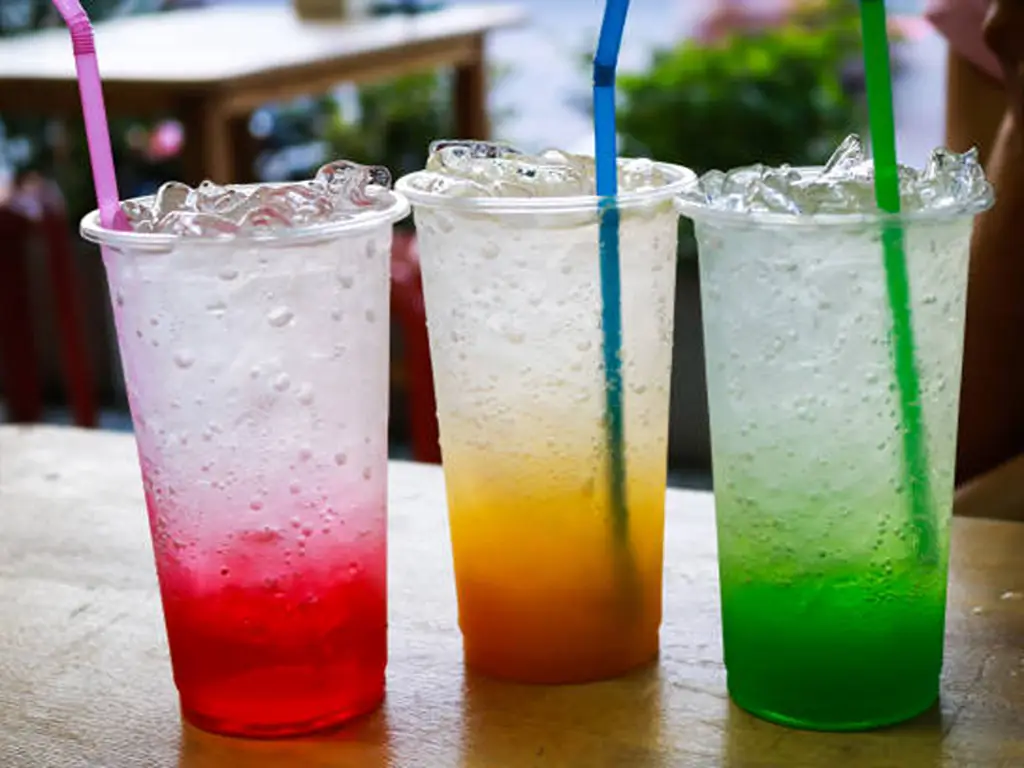
Transparency is a sales tool. A layered iced drink photographed through a PET wall sells itself; the same drink in a foggy PP cup looks flat. This is why premium cold-drink brands choose PET even though it costs more.
Heat resistance is a hard limit, not a preference. PET softens around 70–80°C — pour near-boiling tea in and the cup loses shape. PP keeps its structure at typical hot-drink temperatures, softens only above roughly 110°C, and melts around 160°C. Temperature decides your material before price ever does.
The recycling story is messier than the resin code suggests. PET is code #1 and widely collected, but in practice cups and trays are rarely recycled back into packaging — contamination and color limits push most recovered PET into fiber and other downgrades, as a life-cycle study of PET and PP trays by Sphera for Milliken notes. PP recycling is growing but region-dependent. We’ll unpack this in the next section, because it matters for your sustainability messaging.
For home use, the map is simple: cold-party drinks in PET, hot or microwaveable drinks in PP.
Cold Line, Hot Line, or Both? The Real Decision for Drink Shops
If you run or are planning a drink shop, the property map becomes a product-line decision. Work out your menu split first — the cups follow.
The cold line is PET’s stage
Cold drinks are the one category where the cup is part of the product. A fruit tea’s color gradient, a smoothie’s texture, the toppings in a bubble-tea cup — all of it is displayed, not just served. PET’s glass-like clarity is why Starbucks-style cold drinks come in PET and why high-end tea brands treat their cup as packaging with a presentation job. The premium perception is real enough to price: shop-supply guides quote around $90 per 1,000 PET cups versus about $60 for PP at the same size — a premium your cold menu can absorb, because the cup sells the drink.
The hot line is PP’s territory
Hot milk tea, cocoa, warm fruit tea — all of it belongs in PP. The heat numbers from the property map are the entire argument: PP stays structurally sound through typical serving temperatures while PET goes soft. The trade-off is presentation: PP is translucent at best, so brands that print heavily on their hot cups are printing on a foggy canvas. If your hot menu is the volume driver, PP’s lower cost per unit wins; if your cold menu is the image driver, PET’s clarity wins.
Sealing compatibility: the 95mm/98mm trap
Here is the detail no spec sheet will tell you. PP cups and PET cups are commonly made in different rim diameters — around 95mm for PP, around 98mm for PET — and sealing film and sealing machines are sized to the cup, not the material. You cannot seal a 98mm PET cup with a 95mm machine, and you cannot run PP film on PET cups. Seal-machine suppliers are explicit about this: a standard sealer handles 95mm PP cups, a universal sealer handles 98mm PET.
Check three things before you order a single cup: the rim diameter of the cup, the sealing film matched to it, and the sealer you own or plan to buy. Shops run into this trap constantly — one owner asked whether her 90mm PP cups could be sealed with paper film, which is a different sealing system entirely. A few millimeters of rim, and your whole cup-and-film system changes.
The sustainability trend deserves a straight answer here, because it is where recycled claims go to die. The resin codes are honest, the reality is not: PET cups are “recyclable” in the sense that the material is collected, but recovered cup material mostly gets downgraded into fiber rather than recycled into new cups, per the Sphera/Milliken analysis. And PLA — the “compostable” option — only composts in industrial facilities, which cover roughly 3% of the US population; without access to one, a PLA cup behaves like ordinary plastic in landfill. If sustainability is your brand promise, verify the actual disposal path in your region before choosing, and treat “compostable” claims as something to audit, not to inherit.
Why the Same Cup Works in One Shop and Fails in Another
Here is the mystery that makes shop owners question their sanity: the exact same cup material performs fine in one shop and fails in another. Seals leak, cups crack, deliveries arrive dented. The failure is real — but almost never in the material.
The failure map: leak, crack, dent
Four failures show up again and again in shop operations, and all four look like material problems until you look closer:
- Seal leaks. The cup rim’s tolerance is a few hundredths of a millimeter off, the sealing film doesn’t bond evenly, and peak-hour speed turns a micro-gap into a bag of spilled tea.
- Cracked cups. PET is the usual suspect — it is rigid, and rigidity becomes brittleness under delivery vibration, cold-brittleness in a chiller, or thermal shock when a cold cup meets a hot drink.
- Dented bodies. Cups compressed in a stacked delivery bag or truck can deform before they ever reach a customer.
- Batch drift. The same SKU from the same factory can behave differently between production runs.
Delivery is where these failures compound. Vibration, temperature swings, and stacking pressure are stresses no in-shop test reproduces — which is why cups that seem perfect at the counter fail on the road.
The real cause is batch and mold, not material
Industry postmortems on boba-cup failures reach a consistent conclusion: material choice is one factor, not the deciding one. Sealing problems persist regardless of whether the cup is PET or PP — they come from rim tolerance, mold wear between batches, and production-environment drift. Even the cheap-cup paradox resolves here: some low-priced cups have simpler molds and fewer process variables, which is why a budget cup can outperform a premium one in a given shop.
This reframes your troubleshooting. When failures appear, the first questions are not “should we switch to PP?” but: is the rim tolerance consistent across this batch? Has the mold drifted since the last order? Is the sealing machine matched to this cup’s diameter? Operator habits and sealer pressure settings are the second variable — a batch you’ve never adjusted for can pass at the counter and fail at scale.
The scene-boundary matrix
The honest selection tool is a scene matrix, not a material duel. Match your scene to the material and to what you must verify:
| Scene | Material Lean | Where It Fails | What to Verify |
|---|---|---|---|
| Cold drinks, in-shop display | PET | Hot liquid poured in; thermal shock from chiller to hot fill | Rim tolerance and film bond before scaling |
| Cold drinks, long-distance delivery | PET with caution (or PP for rough routes) | Cracking under vibration; brittleness in cold weather | Test a real delivery run, not just the counter |
| Hot drinks | PP | Long-term exposure above ~100°C can warp; freezing makes PP brittle | Rated temperature range from the supplier in writing |
| Sealed takeaway | Material + matched film/sealer system | Wrong rim diameter (95 vs 98mm) breaks the whole system | Cup-film-sealer compatibility confirmed in one spec |
| Bulk storage and stacking | Stable supplier batch control | Batch drift shows up as new failures mid-contract | Batch-to-batch QC data on request |
What to Demand From a Cup Supplier
Once you know which cups you need, the conversation with suppliers changes from “what’s your price” to a list of verifiable demands. Run through these before comparing quotes:
- MOQ structure in writing. Bulk thresholds vary wildly by material — one industry guide quotes a 50,000-piece minimum for PET cups versus 5,000 for PP, and other suppliers structure it differently. Get the volume ladder on paper, not as a rule of thumb.
- Lead time. Standard production runs in the 25–35 day range at serious cup factories; stock items ship faster. Ask which of your items are stock and which are made-to-order.
- Printing quality specs. For branded cups: CMYK plus Pantone (PMS) matching, and artwork supplied as 300dpi vector files (.ai, .pdf, .cdr) — this is the industry baseline for print fidelity.
- Packaging and carton specs. Pieces per carton, carton dimensions, and marking affect your freight cost directly.
- Cross-SKU compatibility. The cup is one component of a system — film, lids, carriers. A supplier who can specify cup-film-sealer compatibility (the 95/98mm question again) and supply the matching pieces saves you from assembling a fragile stack of mismatched components.
This last point is where a “supplier” becomes a “packaging partner.” The ability to answer the compatibility question in one spec sheet is worth more than a marginally lower unit price.
How to Verify a Supplier Before You Commit
A supplier’s claims deserve verification in a specific order — and each step is cheap compared to a bad bulk order:
- Ask for batch QC data. Request test records for at least two production runs of the same SKU. Consistency between batches is the core quality signal — it’s the difference between a predictable cost and a surprise.
- Ask about tolerances and molds. Rim tolerance and mold precision are what actually determine sealing performance. A supplier who can explain their tolerance control is talking about the right things; one who deflects hasn’t been asked before.
- Run a sealing test with your own equipment. Send samples, seal them with your film on your machine. This single test reproduces the failure mode that matters most and costs almost nothing.
- Start with a small production order before scaling, and use the volume ladder you agreed on.
- Check the certifications, not just the website. ISO 9001 (quality management), BRC (global food-safety standard), and FDA/LFGB food-contact compliance are verifiable. Traceability is a plus: batch numbers printed on cup bottoms are common practice among serious manufacturers and make complaint handling concrete.
The warning signal to treat seriously: a quote far below market with no batch data behind it. Undocumented cheapness is not a deal — it is an unverified risk that will surface as leaks, cracks, and returns after you’ve committed.
The Real Cost of a Plastic Cup
Unit price is the most quoted number in packaging and the least useful one. The real cost of a cup is:
Every failure mode from earlier in this article has a price tag attached. A seal that leaks on delivery costs the drink, the cup, the delivery refund, and a rating hit. Cracks on long delivery routes raise your loss rate enough to offset a cheaper material or supplier. And the pricing itself is unstable: shop-supply guides differ by two to three times on how much cheaper PP is than PET — the only honest way to budget is a written quote with MOQs attached, not a memorized ratio.
For distributors and wholesalers, the arithmetic points one direction. PET cups carry a higher MOQ, which raises the cost of switching suppliers — so the risk of choosing wrong is concentrated in the first order. The compensation is on the other side: the clear cold-drink line serves both display-driven brand customers and sealed-takeaway operators, two segments that keep reordering. The defensive inventory structure is a two-line portfolio: PP hot cups as the volume baseline, PET clear cups as the margin and brand line. And the supplier relationship should be judged the way the cup should be chosen — on consistency and compatibility, not on the single number in the quote.
That is how we run our own production: hourly quality checks during production, with any defect found triggering disposal of the entire run since the last successful test, and each cup bottom printed with production date, time, and serial number so every batch is traceable. If you are comparing cold-drink cup lines and want to see how our manufacturing process handles the consistency question, our production facility page walks through it — and if you’d like batch documentation and compatibility specs for your line, our team is a message away.
References
- Milliken & Company (Sphera LCA). “PET versus PP: Which plastic comes out on top in the sustainability stakes.” https://www.milliken.com/en-us/chemicals/blogs/pet-versus-pp–which-plastic-comes-out-on-top-in-the-sustainability-stakes
- BubbleTeaology. “PP or PET Cups — Choosing the Right Cup for Your Drink Shop.” https://www.bubbleteaology.com/pp-or-pet-plastic-cups/
- YST Packaging. “PET vs. PP vs. PLA Cups: The Ultimate Guide for Your Beverage Business.” https://ystpack.com/ultimate-guide-pet-vs-pp-vs-pla-cups-beverage-business/
- LOKYO Food Packaging. “Boba Tea Plastic Cups Problems and How Shops Solve Them.” https://www.lokyofoodpack.com/blog/boba-tea-plastic-cups-problems.html
- YoonPak. “Paper Cup Manufacturer.” https://www.yoonpak.com/paper-cup-manufacturer/
- YoonPak. “Contact.” https://www.yoonpak.com/contact/
- YoonPak. “Home.” https://www.yoonpak.com/


 English
  German
  Spanish
  Italian
  Dutch
Dutch  French
  Portuguese
  Russian
  Arabic
  Korean