

Food Contact Materials Regulation EU 2026: What Importers Must Demand From Suppliers
If you import paper cups, bowls, takeaway containers, bakery boxes, or carry bags into the European Union, you have probably seen three letters everywhere: FDA, LFGB, maybe BRC. What you may not have seen is a straight answer about which of those actually satisfies the EU’s food contact materials regulation, and which ones are just decoration.
This guide walks the compliance chain the way a buyer actually experiences it: what the rules are, what each certificate really proves, which documents you should demand before you order, and why 2026 just changed the game.
EU Food Contact Rules in 60 Seconds: What Actually Applies to Your Packaging
Two different sets of EU packaging rules get constantly mixed up, and the confusion is costly. Food contact rules (often searched as “eu food packaging regulations” when people mean safety) govern whether chemicals can migrate from packaging into food. The Packaging and Packaging Waste Regulation (PPWR, Regulation (EU) 2025/40) governs what happens to packaging after use: recyclability, recycled content, producer fees. Both apply to every item you import. They are different laws with different obligations. A cup, a clamshell, or a bakery box can be fully food-safe and still fail PPWR, or vice versa.
On the safety side, the EU’s food contact materials regulation is built in layers:
Every business in the chain, from manufacturer to importer to distributor to food operator, must comply with the framework and with whichever specific rules cover their material. And here is the most counter-intuitive fact for anyone sourcing paper-based food packaging (cups, bowls, food boxes, buckets, trays, bags): paper itself has no harmonised EU food contact regulation. Harmonised EU rules exist for plastics, recycled plastics, active and intelligent packaging, and regenerated cellulose film, but not for paper and board. Paper-based packaging therefore answers to the framework regulation plus national laws (German LFGB and the BfR Recommendations being the de facto reference across Europe) — and to the plastic rules for its coating, because the coating is plastic.
One boundary worth stating early: “biodegradable,” “plastic-free,” and “compostable” are marketing claims. Compliance is a legal status. A package can be legally compliant and carry none of those labels, or carry all of them and still need its paperwork.
“Paper itself has no harmonised EU food contact regulation. The coating is where the compliance paperwork lives.”
Paper, Coating, Ink: Why Each Material Answers to a Different Rulebook
A printed paper cup — and equally a printed lunch box, bakery carton, or greaseproof bag — is not one material. It is three, and each answers to a different rulebook. This is the single most useful distinction when you are checking a supplier’s documents, because most compliance failures trace back to one layer being tested while another was ignored.
- The paper base — no EU-wide material rule. It must satisfy the general safety duty of Regulation (EC) 1935/2004 and the national rules of your destination market. In Germany, that means the LFGB framework and the BfR Recommendations for paper and board; the Netherlands, Belgium, France and Italy have their own national provisions.
- The coating — PE (polyethylene), PLA (polylactic acid), or water-based dispersions. PE and PLA are plastics, so the coating layer falls under Regulation (EU) 10/2011, with its migration limits and its written declaration of compliance. This is the layer that determines most of the compliance paperwork on any coated paper package.
- The inks — no EU-wide rule for printing inks. Compliance rests on low-migration ink formulations plus good manufacturing practice (Regulation (EC) 2023/2006 requires GMP across the whole production chain), and on national references like the German Printing Ink Regulation’s positive lists.
| Layer | What governs it | What it means for you |
|---|---|---|
| Paper base | Framework 1935/2004 + national rules (e.g., German LFGB, BfR Recommendations) | Check the destination market’s national requirements, not just “EU compliant” |
| Coating (PE / PLA) | Regulation (EU) 10/2011 (plastics) | Demand the written declaration of compliance + migration testing |
| Inks | No EU rule | GMP 2023/2006 + low-migration inks; ask for food-grade ink statements — nothing else is available |
A word on coatings, because “eco” claims make this murky: PE, PLA, and water-based coatings are all legally valid options. Choosing between them is a business decision about cost, compostability claims, and end-of-life recycling, not a compliance decision. A PLA-coated item is not “more compliant” than a PE-coated one; it carries different environmental claims and often a different price.

FDA Certificate vs EU Compliance: Why “Food-Grade” Is Not a Passport
Here is where most first-time importers lose money. A supplier shows you an FDA certificate — or an LFGB one — and you assume the product is cleared for the EU. It is not that simple.
What each document actually proves
| Document | Issued under | Proves | Does not prove |
|---|---|---|---|
| FDA food-contact statement | US FDA (21 CFR) | Material is acceptable for food contact under US rules | Any EU obligation |
| LFGB test report / BfR Recommendation | German national law | Material meets German food contact requirements (a valid member-state reference) | An “EU certification” |
| EU DoC under 10/2011 | Issued by the business operator | The material complies with 10/2011 and 1935/2004 for the declared use | Physical safety of every batch |
The United States and the EU run separate food contact regimes. An FDA clearance is legally meaningful in the US market and meaningless in the EU — the EU does not recognise it as compliance evidence. The German LFGB route is different: it is a genuine national law in an EU member state, so a solid LFGB test report is real, useful evidence for the German market and a common reference across Europe for paper and board. But it is a national reference, not an “EU certification”; no such thing exists.
What the EU actually requires from the coating layer is a Declaration of Compliance (DoC): a written statement, mandated by Article 15 of Regulation (EU) 10/2011, issued at every stage of the chain except retail, by the business operator placing the material on the market. It must be renewed whenever the composition or production changes enough to affect migration. Your supplier’s FDA folder will not produce one.
The 2026 shift: PFAS is now a hard date
The second part of this answer is that the rules just moved. Under PPWR (EU) 2025/40, Article 5(5), food-contact packaging containing PFAS above strict limits may no longer be placed on the EU market from 12 August 2026, and there is no stock-exhaustion period. Packaging placed on the market before that date stays legal; anything new after it is not. The limits are 25 ppb for any individual PFAS, 250 ppb for the sum, or 50 ppm total fluorine, and they apply to the whole packaging unit, including inks, coatings, and adhesives. Imports count as “placed on the market” at release for free circulation.
“FDA food-grade” was never an EU passport, and from 12 August 2026 PFAS above 25 ppb (individual) / 250 ppb (sum) / 50 ppm (total fluorine) will disqualify food-contact packaging outright. There is no transition period. The Commission currently recommends testing total fluorine first — if the packaging passes the 50 ppm fluorine screen, it is presumed compliant.
What this means in practice: importers are now receiving PFAS questionnaires from their EU buyers and passing them down to suppliers. The pattern is no longer “nice to have” documentation; it is becoming a contractual condition. Manufacturers across industries report distributors sending full substance-data requests, with non-compliant suppliers dropped; several describe the resulting documentation work as simply the cost of doing business with the EU.
PFAS above 25 ppb (individual) / 250 ppb (sum) / 50 ppm (total fluorine) disqualifies food-contact packaging placed on the EU market from this date. No transition period. PPWR (EU) 2025/40 · Art. 5(5).
The Compliance Documents to Demand From Every Supplier (Before You Order)
Everything above collapses into one practical question: what should be in your inbox before you commit to a purchase order? Four documents. Learn them as one set — they are the compliance evidence chain.
The four-part evidence chain
DoC first. A Declaration of Compliance is the single most important document in this list: it is the one the law actually requires. But a DoC is only as good as the chain behind it, so treat it as the starting point, not the finish line.
Migration test reports. The DoC asserts compliance; the test report demonstrates it. The key parameter is the overall migration limit of 10 mg per dm² of food contact surface (Regulation (EU) 10/2011, Article 12). The report must match your use: a cold-drink cup tested only under cold-contact conditions is not evidence for a hot-fill or hot-greasy application, and vice versa. Check the simulants, temperatures, and durations against your actual product.
Material structure. The coating is the compliance-critical layer, so the statement must be specific: PE, PLA, or water-based, not “food-grade coating.” This is the document that stops you discovering at customs that the “PLA-lined” cups or boxes you ordered have a PE liner.
Substance data. Since the PPWR PFAS restriction applies to the whole packaging unit (coatings, inks, adhesives), a supplier who answers “N/A” on PFAS without a test basis is not answering. The Commission’s current recommended screening approach starts with a total-fluorine test: below 50 ppm, the packaging is presumed compliant.
When each document is not enough
| Document | Covers | Issued by | Fails when |
|---|---|---|---|
| DoC | Legal declaration of compliance for declared use | Business operator (manufacturer or importer) | Composition or production changed since issuance; no renewal |
| Migration test report | OML 10 mg/dm² + SMLs under test conditions | Accredited laboratory | Test conditions (simulant / temperature / duration) don’t match your use |
| Material structure statement | Coating type, grammage, paper source, inks | Manufacturer | Describes a different product than the batch delivered |
| Substance data | PFAS and restricted substances across the whole unit | Manufacturer (or importer) | Answered “N/A” with no test basis; only covers the coating, not inks |
Apply the same logic by product: hot-drink cups, soup bowls, fried-food boxes and buckets, and greaseproof bags all carry tougher contact conditions — heat, fat, or both — than a cold-drink cup, so their reports must reflect those conditions. A cold-cup report cannot validate a hot-soup bowl, and neither of them can validate a box of hot fried chicken.
Who Can Actually Produce These Documents? How to Vet a Supplier
Not every seller can deliver the four-part chain, and the difference is structural. A trading company reselling packaging can pass along a DoC from its factory, or it cannot, in which case the chain stops with them and you become the person explaining that to an EU buyer. A private-label brand commissioning production holds the compliance responsibility for what it sells, which means it must assemble the chain from its own factory. And a source factory with in-house production is the only link in the chain that can produce every document from the same batch of material, which is why EU importers keep pushing their questions back to the source.
That traceability is not optional decoration. Regulation (EC) 1935/2004, Article 17, obliges every operator in the chain to maintain systems that identify where a material came from and where it went, precisely so responsibility can be attributed and products recalled. A supplier that cannot reconstruct a batch’s journey cannot honour Article 17 for you, because you are the one who will be asked.
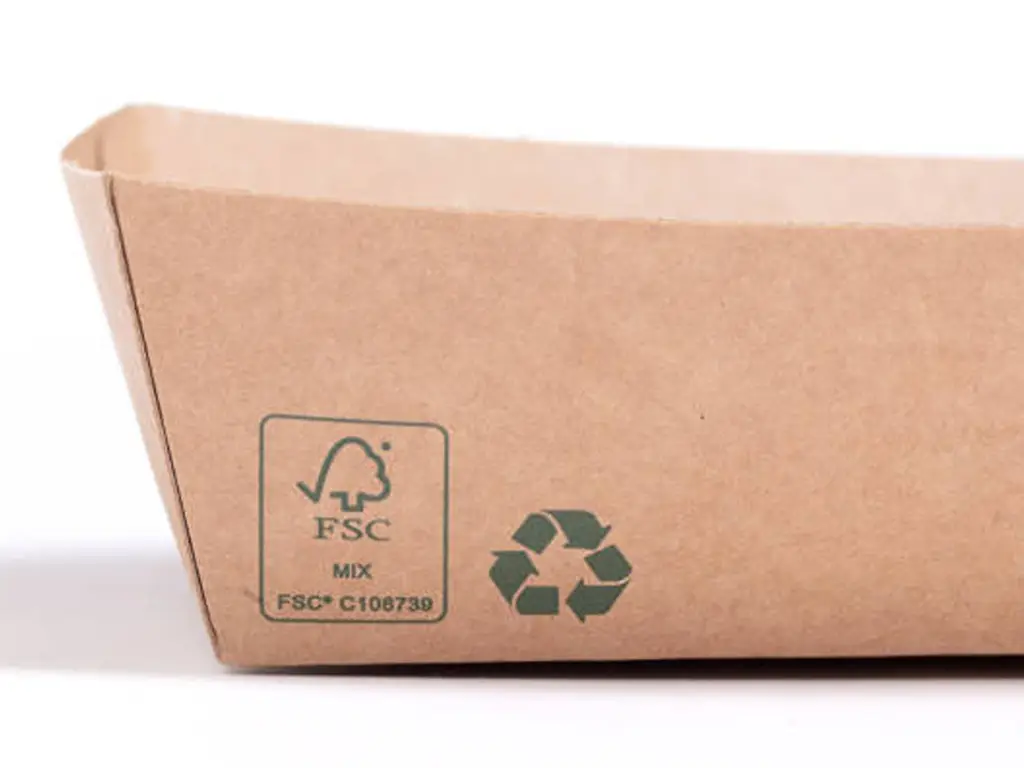
At YoonPak, we make the cups, bowls, takeaway containers, bakery boxes, food buckets, trays and paper bags you order on our own production floor (printing, die-cutting, forming and packing in-house), and our materials come from ISO and BSCI certified mills including SUN PAPER and Stora Enso. The facility holds ISO 9001 and ISO 14001, plus BRC, BSCI, FDA, LFGB, FSC, BPI and DIN across its products and systems. The documents on our certified paper packaging production pages and our materials and certifications overview are ours to stand behind, not a reseller’s photocopy. We can’t hand you a piece of paper for a batch we didn’t make; we’d rather you saw the test reports for the batch you’re actually buying.
Three verification actions cost you nothing and prevent most surprises: ask for sample documents before the samples themselves; confirm the migration test report comes from an accredited (ISO 17025) laboratory; and require documents to be delivered with the contract, batch-numbered, not “available on request” after payment.
Where Compliance Documents Break: Red Flags That Cost You
Documents arrive, and they still fail. Here are the four most common ways a compliance file falls apart, and the concrete check for each.
- Document-batch mismatch. The DoC describes a different article than the one on your dock. Check: batch numbers on the documents must match the batch numbers printed on the cartons, and on the items themselves where the manufacturer offers per-batch marking.
- Test conditions don’t match your use. The report was run for cold beverage contact, and you are selling hot soup bowls or fried-food boxes. Check: simulant, temperature and duration in the report against your intended use.
- Wrong or expired certificates. An LFGB report presented as an “EU certification”; a certificate past its validity. Check: the issuing body, the standard cited, and the date, and remember no EU-wide certificate exists.
- Substance data answered in prose. “No PFAS” on a questionnaire without a test basis is an opinion, not data. Check: the response points to a test method; under the Commission’s current guidance, a total-fluorine result below 50 ppm.
Paperwork can never be your only check. Documents are the starting point; sensory checks at receiving — smell, oil resistance, print migration on a greasy sample — are still your responsibility as the operator placing the packaging on the market.
One boundary, stated plainly: complete paperwork does not make a product good. It makes a product legally attributable. The packaging itself still has to survive your own receiving inspection.
The Business Case: Make Compliance Paperwork a Supplier Filter, Not an Afterthought
Step back and this becomes an arithmetic problem, not a legal one. The compliance evidence chain costs money at exactly one of two moments: before the order or after the order. Before the order it is a few emails, a document review, maybe a test report you commission yourself. After the order it is failed customs releases, a buyer’s PFAS questionnaire you cannot answer, a distributor who cancels a contract over missing substance data, or a recall that Article 17 traceability exists to make possible.
Every piece of this article has argued the same thing: the chain runs from the framework regulation to the DoC to the test report to the batch on your dock. Once you accept that, the commercial logic follows on its own. Put document completeness in your top three supplier criteria — before price. Price comparison only means something when you are comparing like for like: same coating structure, same test conditions, same ability to deliver the four documents. Comparing a fully-documented quotation against one that is “FDA certified” and hoping for the best is not price shopping; it is gambling the difference on the least transparent part of the deal.
The same logic tells you where not to over-invest. If your end market is the United States, an FDA clearance is the right target and an EU DoC is excess weight. If you ship into Germany, an LFGB report plus BfR-referenced testing is the working standard. The four-part chain is the answer for EU-bound food packaging; scale it to the market you actually sell into. That is not an excuse to skip verification; it is the definition of verification done correctly: documents matched to destination.
And if you are the one who has to assemble that chain from a supplier’s answers, remember the sequence from earlier in this guide: DoC, migration report, material structure, substance data. Four documents. One batch. Any supplier who can produce all four for the batch you are buying has done the work; anyone who cannot, will make you do it.
Ask us for the Declaration of Compliance, migration test reports, and material structure statements on the packaging you’re quoting — the evidence chain in this article, in your hands before you commit.
Request Compliance FilesReferences
- European Commission. “Food Contact Materials — Food Safety.” food.ec.europa.eu
- Commission Regulation (EU) No 10/2011 on plastic materials and articles intended to come into contact with food (Articles 11, 12, 15, 16; Annex IV). legislation.gov.uk
- Regulation (EC) No 1935/2004 on materials and articles intended to come into contact with food (Article 17 — traceability). legislation.gov.uk
- European Commission. “European Commission Publishes Final PPWR Guidance in Advance of August 2026 Application Date.” PackagingLaw, 2026. packaginglaw.com
- CCCI. “Compliance with Regulation (EU) 2025/40 on Packaging and Packaging Waste (PPWR) — PFAS restriction (Article 5(5)).” ccci.org.cy
- Eurofins. “Paper and Board Packaging Testing — Food Contact Materials; EU Legal Compliance.” eurofins.com
- knoell. “Germany’s BfR Revises Food Contact Paper and Board Recommendations (BfR Recommendation XXXVI).” knoell.com
- YoonPak. “Custom Printed Paper Cups — Certified Production.” yoonpak.com
- YoonPak. “Going Green — Materials and Certifications.” yoonpak.com
- YoonPak. “Home — Custom Paper Food Packaging.” yoonpak.com






 English
  German
  Spanish
  Italian
  Dutch
Dutch  French
  Portuguese
  Russian
  Arabic
  Korean