

Paper Bowl Sizes: What the Numbers Really Mean (and How to Choose)
What “Paper Bowl Size” Actually Means
A “16 oz paper bowl” is not one thing. It is a 473 ml bowl if you read the number in US customary units: 1 US fluid ounce is defined as exactly 29.5735 ml (NIST Handbook 44), so 16 oz comes to 473 ml (NIST, 2024). But walk into most European takeaway suppliers and the same size is printed “500 ml,” because their bowls are made on metric molds that round the label up (PandaPak, 2026). Both are describing the same bowl, and both are telling the truth about their own numbering system.
That is the first thing to understand about paper bowl sizes: the number on the pack is a label from a mold, not a universal constant. Once you accept that, the rest of choosing sizes becomes straightforward. You will meet two systems, US ounces (imperial tooling) and millilitres (metric tooling), and a single bowl can legitimately carry either number.
One boundary to clear before we go further: a paper bowl is wide and shallow, built for food eaten with a utensil: soup, salad, poke, noodles. A paper cup is tall and narrow, built for drinks. The exception is the 8 oz paper soup cup, a tall format that competes directly with small bowls for side-soup duty. Rectangular bowls (650 ml and up) exist for space-efficient takeout, but round bowls are the overwhelming mainstream. This guide covers round bowls.
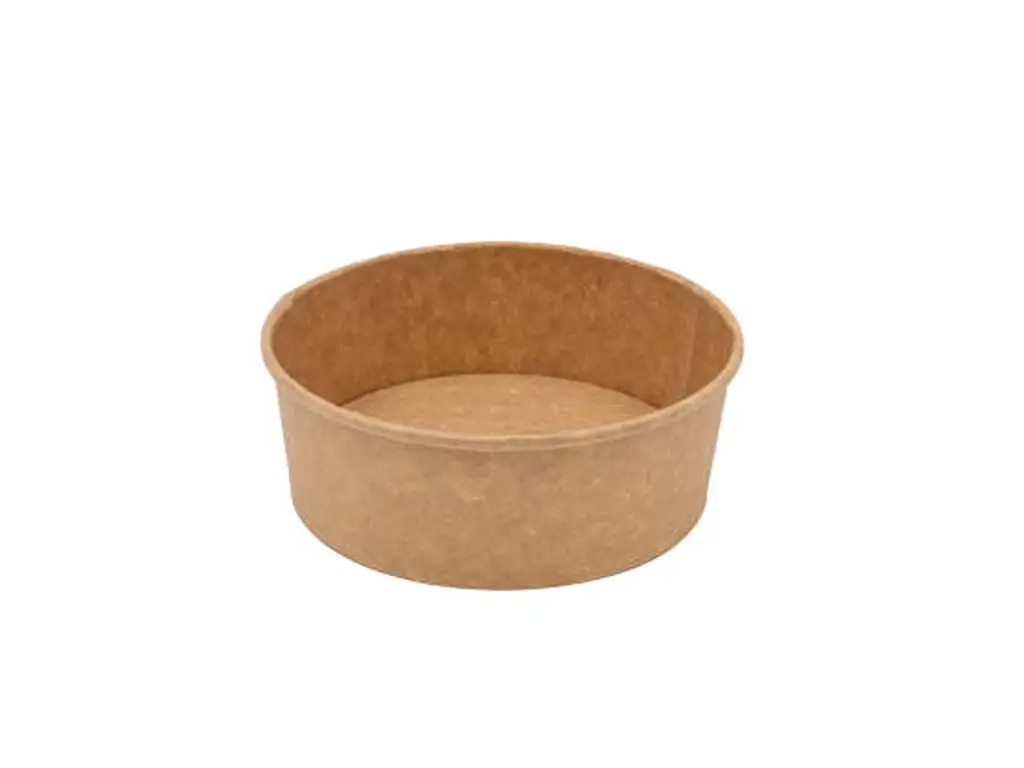
The Paper Bowl Size Chart: 8 oz to 40 oz
Standard sizes have settled into a ladder from about 8 oz (240 ml) up to 40 oz (1,180 ml). The table below cross-references the two numbering systems with typical dimensions and uses. Treat dimensions as approximate. Manufacturers report 1–5 mm of variance between their own molds, so the table gets you to the right family and the spec sheet gets you to the exact bowl.
| Size | Capacity | Top diameter | Height | Typical use | Note |
|---|---|---|---|---|---|
| 8 oz | ≈240 ml | ≈90 mm | 40–50 mm | Sides, dips, single-scoop ice cream | Standard small tier |
| 12 oz | ≈355 ml | ≈115 mm | ≈50 mm | Small salads, snacks, congee | Most common single size worldwide (over 35% of global paper bowl sales per an industry report cited by Bioleader, 2024) |
| 16 oz | ≈473 ml (US) / 500 ml (EU) | 115–150 mm | 50–60 mm | Soup, single ramen, yogurt bowls | The takeout workhorse |
| 20 oz | ≈590 ml | 150 mm | ≈60 mm | Large soups, noodle portions | Common in US retail packs |
| 24 oz | ≈720 ml (US) / 750 ml (EU) | 150 mm | 60–75 mm | Main salads, curry-and-rice | Main-meal tier |
| 26 oz | ≈770 ml | 150 mm | ≈65 mm | Poke, rice and grain bowls | Asian-tooling standard, absent from most US charts |
| 32 oz | ≈950 ml | 150–165 mm | ≈75 mm | Large salads, ramen, catering | Large tier |
| 40 oz | ≈1180 ml | 165–185 mm | ≈70 mm | Family sharing, pho | Sharing format |
A few notes on reading this chart. First, the two columns that matter most are top diameter and capacity. Height is mostly a function of whether the bowl is a shallow salad format or a deep soup format. Second, the “same” size from two manufacturers can carry different top diameters. A 16 oz bowl is stocked with a 115 mm rim by some factories and a 150 mm rim by others (Lokyofoodpack, 2026). That difference matters more than any capacity number, and we will come back to it in the next section. Third, most operations find that two or three sizes cover 80% or more of their menu (PandaPak, 2026). You do not need the whole ladder.
Which Paper Bowl Size Fits Which Dish
Matching a bowl to a dish is not about whether the food fits. It is about whether the bowl still works when the food is inside it: with a lid on, in a delivery bag, for 30 minutes. Three rules decide that.
Headroom: the 1.5–2× rule and the 80–90% reality
Rule one: capacity should be roughly 1.5–2 times the actual portion volume (PandaPak, 2026). A 500 ml bowl holding a 250 ml starter soup is not wasteful. The empty space above the liquid is what stops the lid from touching the food and keeps the soup from sloshing during transport.
Rule two: the printed capacity is “to the brim,” and usable fill is only about 80–90% of it (Lokyofoodpack, 2026). A “32 oz” bowl will not hold 32 oz of ramen with a lid on. Budget for that gap when you match menu portions to sizes.
Portion fit in two numbers
1.5–2×bowl capacity vs actual portion volume (headroom for spill-proof delivery)
80–90%usable fill vs printed “to the brim” capacity
Source: supplier spec guidance (PandaPak 2026; Lokyofoodpack 2026)
Rule three: when the portion is under half the bowl’s capacity, you are in the wrong size tier. A salad that fills 30% of a 32 oz bowl reads as a skimpy portion to the customer. That is exactly how the “jumbo bowl, same salad” complaints on chains’ subreddits start.
Mapping your menu to sizes
Working down from the chart:
- 8–12 oz: sides, dips, desserts, kids’ meals. Fruit cups, yogurt, single-scoop ice cream, side salads. This tier is cost-efficient and should be chosen per unit price, not per volume: an 8 oz bowl holding a side of fries is the cheapest way to serve it.
- 16 oz: the single-portion workhorse: soup, ramen, congee, yogurt bowls, pasta salads. It balances portion size with portability, which is why it dominates takeout.
- 24–26 oz: main-meal bowls: poke, grain bowls, curry-and-rice, large salads. The 24 oz (US) and 26 oz (Asian-tooling) sizes are the same job in two numbering systems.
- 32 oz and up: sharing and liquid-heavy formats: ramen with high broth content needs the headroom; family-size salads and catering portions belong here.
Hot soup changes one thing: if the bowl will carry hot liquid, spec the double-wall version or check the coating’s heat ceiling. PLA-lined bowls run into a practical limit around 85°C (Lokyofoodpack, 2026). And do not skip the physical test. The cheapest way to find the wrong bowl is a real portion in a real bowl on a real delivery run. It is the same test that surfaces the sogging complaints customers post about cheap paper bowls: thin lining, hot food, 30 minutes of steam.
The lean range rule
Start from your menu, not from a catalogue. List every dish you serve in a bowl, note the portion, and map each to the smallest size that passes the headroom rule. Most operators land on two or three sizes. Resist adding a size for a dish that sells in single digits per day. Every extra size adds storage footprint, ordering complexity, and minimum-order exposure. Review the range when the menu changes, not before: a seasonal check twice a year is enough to stop dead sizes accumulating.
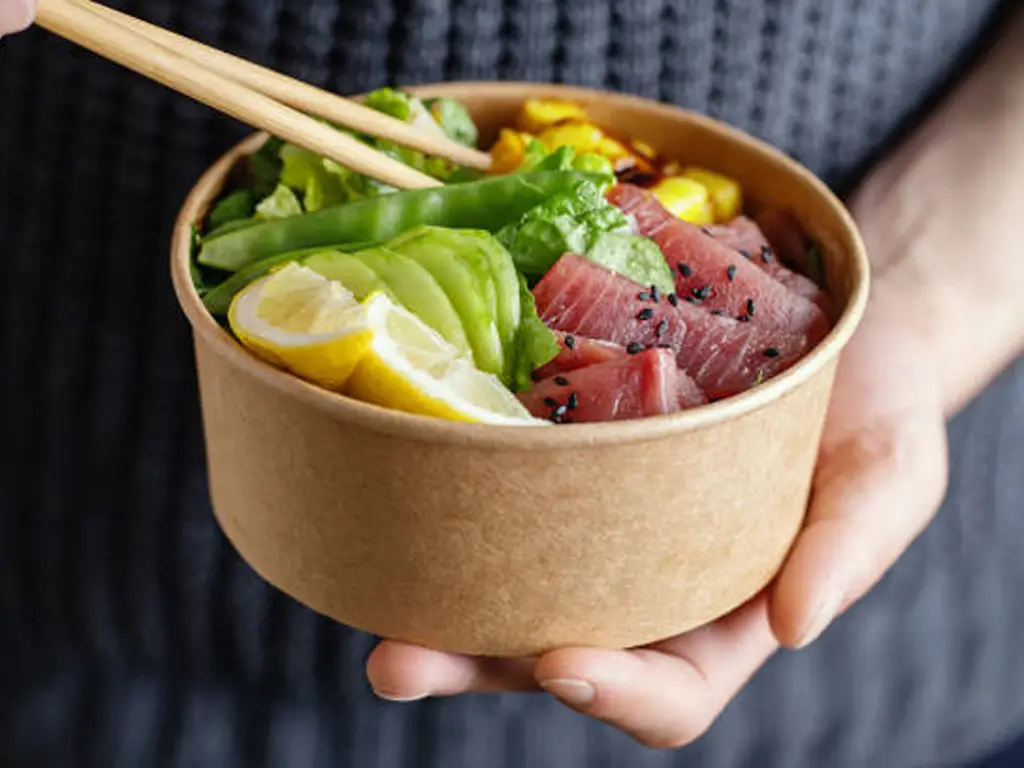
Beyond Capacity: Rim, Lids & Specs That Decide Fit
Capacity gets you 80% of the way. The last 20% is where orders go wrong, and it is decided by three things the size chart does not show you.
The rim decides the lid — not the capacity
Here is the fact that costs importers real money: the same 16 oz bowl can have a 115 mm rim or a 150 mm rim (Lokyofoodpack, 2026). Capacity does not determine rim diameter — the manufacturer’s mold does.
The same 16 oz bowl can have a 115 mm rim or a 150 mm rim. Capacity does not decide the rim — the manufacturer’s mold does.
Ask for the rim before you buy lids, not the capacity.
Lids fit rims, not volumes. So a “size” is only half a product until you know its rim family. That cuts both ways: it is how you get stuck with 50,000 bowls that take no standard lid you can buy. It is also how you get a genuine efficiency, because rim families often span multiple capacities. A 150 mm rim covers 500 ml, 750 ml and 1,000 ml bowls in both PandaPak’s UK range (PandaPak, 2026) and in standard Asian-tooling catalogues, and a 26 oz and 32 oz pair frequently share one lid (Lokyofoodpack, 2026). One lid SKU serving three capacities is the difference between managing three lid lines and managing one.
Board weight and wall: the second column of the spec sheet
Paper bowls are made from coated paperboard, typically 250–350 gsm (Lokyofoodpack, 2026); UK-market standard kraft bowls sit around 280–300 gsm (PandaPak, 2026). The coating is what stops liquid soaking through: single-sided PE for dry and warm food, double-sided PE or PLA for hot, saucy food.
Board weight and wall construction are where “the same size” stops being the same product. A 16 oz bowl at 280 gsm with a double-sided PE coating will sit through a curry delivery intact; a thinner single-coated version of the same size will go soggy on the same run. If your menu leans toward stews, curries or noodle soups, ask for the gsm and the coating structure explicitly, and ask whether the bowl is single-wall (one layer) or double-wall (an outer layer with an air gap that insulates hot soup without a sleeve).
What to demand from a supplier’s spec sheet
When you compare suppliers, three checks filter out most of the problems:
- Ask for a rim × capacity matrix, not a capacity list. A supplier that can show you which rims cover which capacities is telling you their mold family is coherent. A supplier that can only list “sizes” is telling you their rims are whatever they are. Your lid purchasing will discover them one bad order at a time.
- Ask for a lid sample to fit the actual bowl. Numbers agree on paper; lids either click or they do not. Test the lid on the bowl, not on the spec sheet.
- Run a real delivery simulation. Fill the bowl with the hottest, oiliest thing on your menu, lid it, and give it 30 minutes in a bag. The sogging complaints customers post about cheap paper bowls are all this test catching it too late.
The rim family matrix below shows how the standard families line up, and where each one stops working:
| Rim family | Capacities typically covered | Lid sharing | Where it fails |
|---|---|---|---|
| ≈90 mm | 8–10 oz | Own lid | Too small for mains; no family beyond 10 oz |
| ≈115 mm | 12 oz | Own lid | Single-size family — lid rationalization gains start above this |
| 150 mm | 16 / 20 / 24–26 / 32 oz | One lid covers three capacities (e.g. 500 / 750 / 1,000 ml) | Cannot cover 1100+ ml deep bowls — 40 oz sharing needs the next family |
| 165 mm | 1100–1300 ml deep bowls | Covers the deep soup tier | Own lid; check bowl depth vs lid dome for tall contents |
| 185 mm | 1500 ml / 40 oz sharing | Large-format family | Own lid; storage and stacking footprint grows fast |
Finding a Supplier: What a Size Chart Should Tell You
Three questions settle most supplier comparisons, in order:
- Can they produce a rim × capacity matrix? This is the single most useful document a bowl supplier can send you. It tells you their mold family, their lid ecosystem, and whether your menu maps onto their range cleanly, all in one table.
- Does the sample match the spec sheet? Spec sheets are marketing until a physical sample confirms them. Order samples of every size you plan to stock, and check the printed dimensions against the sheet with a ruler. This is also the moment to verify the lid fit, since lids are quoted separately and priced as if they fit.
- Are MOQ, lead time and printing costs stated in writing? Custom-printed bowls carry a minimum order quantity because each design needs its own print setup; industry-typical custom runs start around 10,000–50,000 pieces per size (Lokyofoodpack, 2026). Get the number in writing per size, not per “order.”
One honest caveat: factory-direct suppliers (longer lead times, container economics, lower unit cost) and local distributors (fast restock, smaller orders, higher unit cost) solve different problems. Neither is “better”. The right answer depends on whether your business is volume-driven or velocity-driven. What matters is that the supplier states MOQ, lead time and freight expectations up front, so the tradeoff is your decision rather than their surprise.
Spec your bowl range against a rim × capacity matrix
Send us your menu and target markets — free standard samples ship within 48 hours, digital proofs within one working day.
Request bowl samples & a quoteCommon Paper Bowl Mistakes (and How to Avoid Them)
Every costly bowl ordering failure we see fits one of five patterns. Each has a checkable fix:
- Buying by capacity list instead of rim family. You end up with lids that fit nothing. Fix: ask for the rim × capacity matrix before the first order. That one question prevents the inventory disaster; nothing after it repairs one.
- Trusting printed capacity as usable capacity. Customers complain the “large” soup is small, because the bowl was filled to a safe level that is well below the label. Fix: fill a sample with water to the realistic fill line and measure what your portion actually is.
- Assuming the same size means the same bowl across suppliers. Two “16 oz” bowls can differ by 35 mm of rim diameter. Fix: get the physical sample and the printed rim dimension from every supplier you compare, and never swap suppliers on a size name alone.
- Marketing “compostable” without the certificate. Compostable and recyclable are not interchangeable, and the claim needs a matching certificate (BPI in the US/Canada, EN 13432 in the EU). Fix: ask for the certificate number in writing before you put the claim on a bowl.
- Stocking six sizes where three would do. Every extra size multiplies storage, lid lines and MOQ exposure. Fix: start from the menu, map portions to the smallest passing size, and add sizes only when a dish demonstrably needs one.
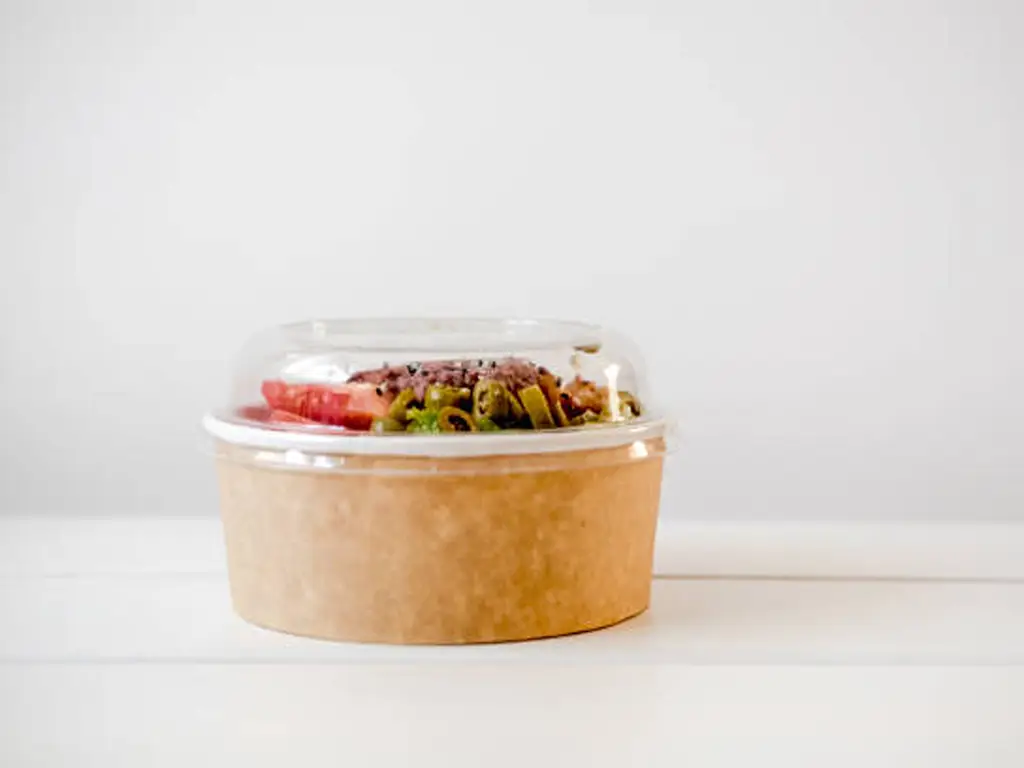
The Business View: Designing a Bowl Range That Stocks Clean
If you are importing or distributing, the size chart is not a product list; it is a stock-design problem. The same facts that made the chart confusing for a consumer become the tools you use to keep inventory lean.
Design the range by rim family, not by capacity
The rim family is the unit of inventory, because the rim decides the lid, and the lid is a second SKU you carry for every rim you stock. A range built on one 150 mm family, say 500 ml, 750 ml and 1,000 ml bowls, needs exactly one lid line to cover three capacities. A range built by picking “sizes” across families needs one lid line per rim, and the lid warehouse grows with every bowl you add. So the discipline is: choose capacities within families, and choose families before you choose anything else.
Cross-market numbering and the procurement constraints
The oz/ml split is a mold-family fact, not a paperwork nuisance. A bowl stamped “16 oz ≈ 473 ml” comes from imperial tooling; the same physical bowl stamped “500 ml” comes from metric tooling. If you sell into both the US and EU markets, a metric-mold supplier lets one SKU carry both labels; an imperial-mold supplier forces a separate SKU for each market. Ask which system your supplier’s molds are built on before you design the range.
Two procurement constraints shape the range too. Minimum order quantities are per size, so the more sizes you stock, the more MOQs you are committing to. That is another reason lean ranges win: three sizes funded by three MOQs beat six sizes funded by six. And lead time matters more than the price difference between suppliers when you are importing a range. Standard production runs typically land in 3–6 weeks after design approval, so a range change costs you a quarter of a year of lead time if you get the family structure wrong the first time.
Here is what that looks like at YoonPak: our paper bowl range runs from 500 ml to 1,500 ml across three rim families, and the 150 mm rim covers the 500 ml, 750 ml and 1,000 ml bowls with one shared lid (our paper bowl range). Custom runs start at 10,000 pieces per item when you arrange freight; you get a digital proof within one working day and samples within 48 hours. If you are building a range that has to stock clean in two markets, that is the conversation to have with us.
Design a bowl range that stocks clean in two markets
Talk to our packaging team about rim families, MOQ structures and cross-market labelling — we respond within one working day.
Contact our packaging teamReferences
- NIST. “NIST Handbook 44 Appendix C: General Tables of Units of Measurement.” 2024. https://www.nist.gov/document/nist-hb-44-2024-appendix-c-general-tables-units-measurement
- PandaPak. “Paper Bowl Sizes: Complete Guide to Dimensions and Uses.” 2026. https://pandapak.ai/blog/paper-bowl-size.html
- Lokyofoodpack. “The B2B Guide to Custom Paper Bowls: Sizes, Coatings & Certifications.” 2026. https://www.lokyofoodpack.com/blog/custom-paper-bowls-guide.html
- Bioleader Packaging. “8oz vs 12oz vs 16oz vs 24oz vs 32oz Paper Salad Bowls.” 2025. https://www.bioleaderpack.com/8oz-12oz-16oz-24oz-32oz-paper-salad-bowls-which-size-fits-your-restaurant-best/ (the 35% figure for 12 oz is a secondary citation of Datainsights Market, 2024, as reported by Bioleader)
- YoonPak. “Wholesale Disposable Paper Bowls.” https://www.yoonpak.com/product-category/paper-bowls/
- YoonPak. “Sustainable Kraft Paper Salad Bowls — Round, FDA-Approved, Multi-Capacity.” https://www.yoonpak.com/product-item/sustainable-kraft-paper-salad-bowls-round-fda-approved-multi-capacity-takeout-bowls-for-all-dishesfood-grade/
- YoonPak. “Contact.” https://www.yoonpak.com/contact/
- YoonPak. “Home.” https://www.yoonpak.com/

 English
  German
  Spanish
  Italian
  Dutch
Dutch  French
  Portuguese
  Russian
  Arabic
  Korean