

Bakery Box Sizes, Explained: How to Match the Right Box to Cakes, Donuts and Pastries
What “Bakery Box Size” Actually Means
When a bakery box is labeled 8″ × 8″ × 2.5″, the three numbers look like a simple fact. They are not. The label is a promise about how much product the box was designed to hold, and the gap between that promise and your actual product is where most sizing mistakes happen.
The three numbers are length × width × depth (L × W × D). The width axis is the opening axis. It decides whether the box opens lengthwise or widthwise, and that choice sets how the box sits on a shelf and which side customers see first. The depth is the dimension people most often get wrong. It has to clear not just your product’s height, but everything that sticks up: a frosting swirl, a glaze drip, a topper.
Two more things make the label less reliable than it looks. First, “nominal size” is not the same as inside space: paperboard is measured in thousandths of an inch, and a folded box with double walls quietly eats a quarter-inch of interior width. Second, the box industry lives in two measurement languages: inches in North America, centimeters in Europe. The same physical box can be sold as “4″ square” on one site and “16 × 11 × 5 cm” on another.
Keep one sentence in mind for everything that follows: a box size only means something relative to the product going inside it.
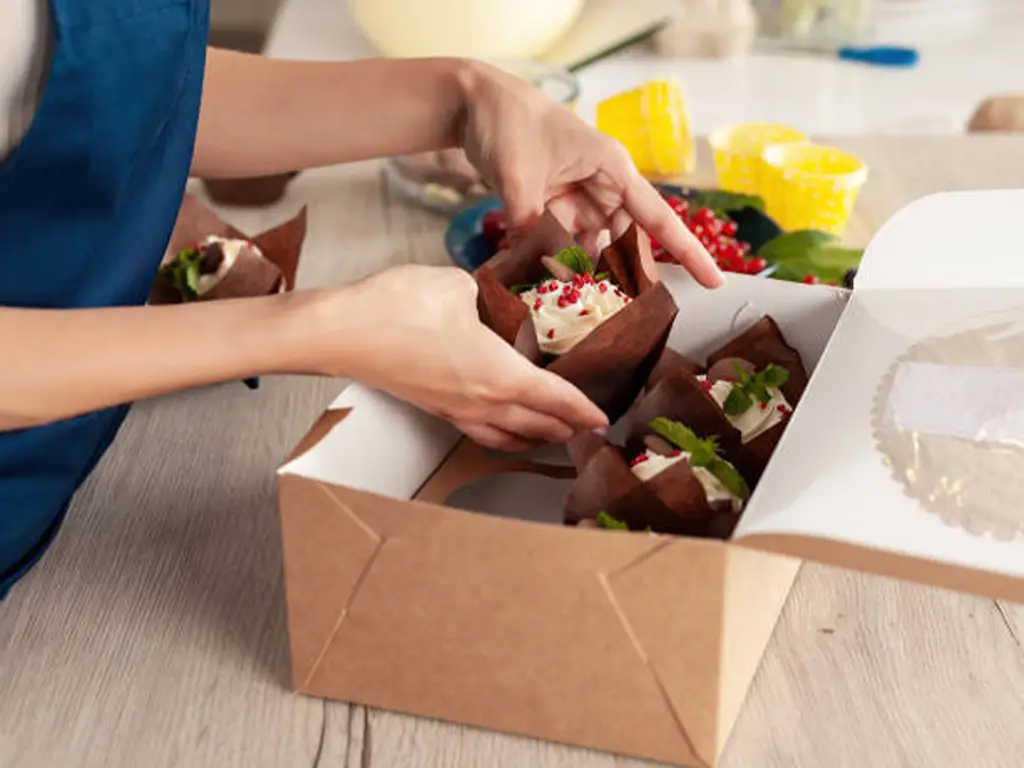
The Bakery Box Family: Types and Structures
Bakery boxes look like one category, but they are five product families with different geometries. The family tells you which dimension does the heavy lifting, and that is the first step of sizing.
| Family | Shape | What the size centers on | Notes |
|---|---|---|---|
| Cake box | Tall, square or rectangular | Diameter + height | often two-piece or with supports |
| Pastry box | Low, rectangular, one-piece fold | Length × width | shallow 2–3″ depth, the classic window box |
| Donut box | Flat, rectangular, by count | Count grid (6 or 12) sets L × W | pop-up / lock & tab construction |
| Cupcake box | Square, with internal tray | Count (1 / 6 / 12 / 24) | the tray does the sizing work |
| Cookie box | Low, square, often windowed | Width and depth vs diameter | smallest depth of all |
Construction is a second axis. One-piece fold boxes (pop-up or lock & tab) ship flat and set up in seconds. Clamshells hinge open like a lunch box. Tray-and-box combinations separate the product holder from the lid, and two-piece boxes (base + lid) are the cake standard when height varies. Windowed boxes sell the product at the counter; solid boxes protect it for transport. Material follows the job: kraft for a rustic bakery, white SBS for print quality, corrugated when stacking matters, bagasse when the brand promises compostable packaging.
Why “Standard” Sizes Never Match
Search for “standard bakery box sizes” and no two suppliers give you the same numbers. That is not a typo problem. It is structural, and knowing why saves you from buying the wrong box on authority alone.
Cake boxes: add one inch or two?
The most quoted rule — “add an inch to the cake diameter” — comes from Packaging Bee’s size guide, which pairs a 6″ round cake with an 8 × 8 × 4″ box, an 8″ cake with 10 × 10 × 5″, and a 12″ cake with 14 × 14 × 6″ (Packaging Bee). NYCake’s guide says the same thing with a wider tolerance: an 8″ cake gets an 11″ or 12″ box, two to four inches of margin (NYCake). And Georgette Packaging, a custom printer, lists a “small cake box” of 8 × 8 × 7.3″ for a 6″ cake, with three inches of depth where Packaging Bee gives two (Georgette Packaging). Same cake, three very different boxes. The reason: depth is set by cake height plus supports, and suppliers name boxes after their own product line, not after an industry convention.
Donut boxes: the five-size mystery
A dozen-donut box, one of the most standardized products in foodservice, currently exists in at least five geometries on the market:
| Supplier | Size | Format |
|---|---|---|
| Georgette Packaging | 17 × 12.5 × 3″ | Dozen |
| FC Meyer (Amazon) | 16 × 12 × 2.5″ | Dozen |
| PaperMart | 16 × 11.25 × 2.375″ | Dozen |
| Georgette Packaging | 12.5 × 8.5 × 3″ | Half-dozen |
| BRP Box Shop | 11.5 × 8.25 × 2.5″ | Half-dozen |
That spread is not sloppy manufacturing. It is the geometry of the donut: a 3–3.5″ ring, arranged on a grid. Twelve donuts can sit in a 4 × 3 grid (wide box), a 3 × 4 grid (deep box), or a 2 × 6 strip (long, narrow box), and each grid produces a different L × W. Half-dozen listings add another trap: some are boxes, some are trays. A “13.5 × 10 × 3″ half-dozen” is a tray with no lid.
Pastry boxes: inches vs centimeters
Pastry boxes have no standard size naming at all. The same class of box is sold as “4″ square” in North America and “16 × 11 × 5 cm” in Europe, and “small / medium / large” means completely different things at different suppliers. The label is never the spec; the product is.
One dozen box. Five different geometries — the same product name, five suppliers, five sizes.
Treat “standard size” as a marketing phrase. No supplier is wrong; each names its own product line. Measure your product, then buy.
How to Match a Box to Your Product: A Five-Step Fit Check
The five steps below turn “which box do I buy?” into arithmetic. Take your product through the chain once, and the correct box stops being a guess.
Step 1: Measure the finished product
Measure the product as it leaves your hands, baked, decorated, iced. A baked 8″ cake spreads to about 7.5″ (bakers report the shrink on r/Baking), so measure that, not the pan. For rounds, diameter plus height is the spec; for square pans, measure both sides; for anything decorated, add the topper height.
Step 2: Pick the conversion method
Four products, four formulas. Cakes take diameter + 1–2″ (tighter tolerance when undecorated, wider when decorated), with box height = cake height + 1″. Pan batches run on the diagonal: a 9 × 13″ tray of lemon bars needs a box that clears roughly 11″ on the shorter side, which is exactly the size home bakers report being unable to find (r/Baking). Donuts run on grid math: grid width (3–3.5″ per donut) times grid count decides both dimensions. Cupcakes and cookies go count-based, 1 / 6 / 12 / 24, with the tray inside the box doing the real sizing work.
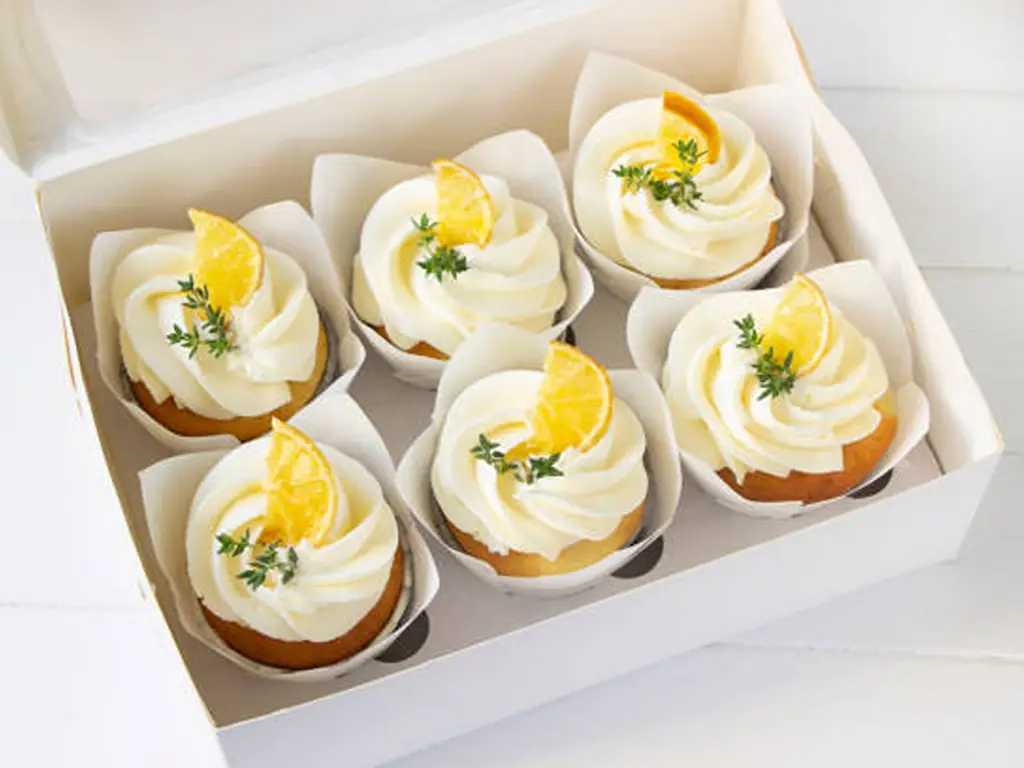
Step 3: Lay out the grid
For donuts and cupcakes, the grid is the box. Twelve donuts: a 4 × 3 grid gives a roughly 14–17″ long box; a 3 × 4 grid gives a squarer footprint. Before choosing, measure your actual product. Oversized rings (3.5″+) or glaze-heavy donuts need grid slack or a tray, because a 2.5″ deep box with glazed donuts is a lid-sticking failure waiting to happen.
Step 4: Set the depth
Depth is the dimension people get wrong most often. Cake: height + 1″. A 5″ tall cake with a topper needs 7″+, which is why “tall cake boxes” exist. Pastries: stack height × layers. Glazed donuts: 2.5″ is the floor; deeper is safer for anything iced. When in doubt, size up: a box one inch too deep looks fine; one inch too shallow is a crushed product.
Step 5: Check the boundary matrix
| Conversion method | Works for | Stops working when |
|---|---|---|
| Diameter + 1–2″ | Round cakes, pies | Tall or multi-tier cakes — switch to depth-first sizing |
| Pan-diagonal math | Sheet pans, brownies, bars | Fragile or round items — add a tray or two-piece box |
| Grid layout | Donuts, cupcakes, cookies | Oversized or glazed items — add grid slack or use a tray |
| Count-based (6 / 12 / 24) | Counter sales | Mixed-SKU orders at scale — consider custom sizing |
Two real-world failures show why this matters. Cookie boxes jump from 4 × 4 × 2.5″ to 9 × 5.5 × 2.5″ with nothing between them, and bakers report both being wrong for a 10-cookie order (r/Baking). And orientation: a baker rebuilding a Krispy Kreme-style half-dozen box found every commercial box opens widthwise when the original opens lengthwise (r/Baking). Both failures are fixed by measuring first.
Buying Scale: Stock, Wholesale, or Custom?
Once the size is settled, the buying question is scale. Three tiers, three different games:
| Retail stock | Wholesale stock | OEM custom | |
|---|---|---|---|
| Volume | 50–500 pcs | 1,000+ pcs | 10,000+ pcs |
| Price per box | Highest | Drops sharply at case volume | Lowest at scale, plus setup |
| Size choice | Whatever the shelf has | Supplier’s catalog | Your exact spec |
| Lead time | Days | Days to weeks | Weeks (tooling + production) |
| Branding | None | Stock print only | Full print, structure, material |
Retail stock is for testing a product or covering a weekend. Wholesale stock is where most shops live, with one trade-off: you buy from the supplier’s catalog, which is precisely where the size contradictions in the previous section come from. You are trusting one supplier’s naming convention. Custom (OEM) is what makes the box follow the product: exact dimensions, your print, your window placement, your tray. The real question is the threshold: custom only makes sense once your volume justifies the MOQ and you can wait for production. The honest rule between tiers: never pay retail prices for a product you have already validated.
Receiving and Verifying Your Boxes
A box order is not done when it arrives. Five checks, five minutes, and they save a month of complaints:
Five checks on arrival
Measure the inside — pull three boxes from the first carton and measure L × W × D; paperboard tolerance is typically ±1/8–1/4″, and a consistent quarter-inch shortfall means the supplier’s nominal size is not your inside size.
Fit-test a real product — put your actual cake, donut or cookie in the box; if it only fits “sort of”, it does not fit.
Stack test — stack five full cartons and look for collapse; corrugated handles stacking, single-wall paperboard does not.
Grease test — leave an oily product on the box bottom for 30 minutes and check for soak-through.
Batch check — two cartons of the same SKU should measure identically; if they do not, every future order is a gamble.
This is your own final checkpoint, not a substitute for supplier QC. Reputable suppliers run AQL sampling before shipment, but nobody catches a sizing mismatch faster than you will at the loading dock.
The Business View: Buy the Matrix, Not the Single Size
For distributors, wholesalers and chain buyers, the size question is not “which box” but “which system.”
The math of the matrix
What you actually sell is not a box size; it is coverage. From a 4 × 4 × 2.5″ cookie box to a 26 × 18 × 5″ full-sheet cake box, every size in between is a slot on your shelf that a customer will come looking for. A stockout at one size is not a lost box sale; it is a customer walking out with their order. The size contradictions from the donut section are your margin opportunity: because no supplier’s “standard” is universal, the buyer who does the conversion math himself stops paying someone else to translate sizes.
What to put on the supplier checklist
When you evaluate a packaging supplier, the conversion logic becomes a checklist:
- How many of the matrix’s slots can they actually fill, from mini cupcake to full sheet?
- What is the MOQ for a size they do not stock, and how fast are the proof and the sample?
- Do repeat orders measure identically?
- Can they date- or batch-code production so a bad run is findable?
The matrix math
4 × 4 × 2.5″to 26 × 18 × 5″ — the matrix span, from cookie box to full-sheet cake box
1 missing size= 1 lost customer order
4 checksspan, custom threshold, consistency, traceability — the supplier evaluation list
When the matrix is the buying unit, the supplier conversation changes: ask about span, not price per box. At YoonPak, we build food boxes across the bakery range — from mini cupcake boxes to sizable loaf formats — and when your product falls between stock sizes, custom dimensions are the norm: multi-SKU orders from 50,000 pieces (100,000 per single item; from 10,000 where freight terms work), digital proofs within one working day, standard samples out within 48 hours. See the range on our custom packaging services page.
Build a bakery box range that fits your actual products
Send us your product dimensions and volumes — digital proofs within one working day, standard samples within 48 hours.
Request bakery box samples & a quoteReferences
- Reddit r/Baking. “Cake Box and Cake Round Size?” 2024. reddit.com
- Reddit r/Baking. “What Size Box Do You Use for Cookie Boxes?” 2023. reddit.com
- Reddit r/Baking. “Bakery Boxes.” 2025. reddit.com
- Reddit r/Baking. “Krispy Kreme Half Dozen Donut Box.” 2021. reddit.com


 English
  German
  Spanish
  Italian
  Dutch
Dutch  French
  Portuguese
  Russian
  Arabic
  Korean