

Grease Resistant Packaging: What Actually Holds Up to Hot, Greasy Takeout
What Is Grease Resistant Packaging? (And Why “Greaseproof” Gets Confusing)
Grease resistant packaging is designed to stop oils and fats from soaking through or staining the material — keeping the food presentable, the packaging intact, and customers’ hands clean. The term covers everything from a plain bakery sheet to a coated takeout box, and that breadth is exactly where the confusion starts.
The first thing to untangle is the vocabulary. Grease-resistant and grease-proof are used interchangeably by sellers, but they are not the same promise. Proof is a stronger claim, and in practice few everyday materials earn it — which matters the moment you put a hot, oil-heavy meal in a closed bag.
Resistant isn’t proof. Light to moderate oils are handled well; very hot or heavy grease can still soak through (noissue, 2025).
Second, there are two fundamentally different ways a paper becomes grease-resistant, and they behave differently:
- Dense fiber. The paper is passed through heavy rollers (supercalendering) that compress the fibers until the pores are too small for oil molecules to pass. This is how classic greaseproof paper works — no coating at all.
- Coating or lamination. A layer — PE, PLA, wax, or silicone — sits on the surface as a barrier. Coated papers and paperboards can hold up to heavier oils, but what they’re made of changes everything else about them: recyclability, compostability, and heat tolerance.
The naming mess you’ll run into at every retailer resolves to four materials:
| Name | How it resists grease | Heat tolerance | Watch out |
|---|---|---|---|
| Greaseproof paper | Dense calendered fiber, no coating | Room temperature to warm | Fine for wrapping, weak for hot heavy oil |
| Parchment paper | Dense fiber, often with silicone | Up to ~220°C / 425°F | Baking-friendly, pricier than greaseproof |
| Baking paper | Silicone-coated non-stick | Up to ~220°C / 425°F | Optimized for baking, not for bags |
| Wax paper | Thin wax coating | Low — wax melts with heat | Never in microwave or oven, recycling disputed |
In short: greaseproof (UK usage) and parchment (US usage) are often the same physical material under two names, baking paper is the silicone-coated cousin for the oven, and wax paper is the odd one out — cold storage only. Once the naming is clear, the real question begins: how much oil is your food actually carrying?
Grease Resistance Is a Ladder: Light, Medium, and Heavy — Where Does Your Food Sit?
Every packaging failure you’ve ever seen — the grease spot on the bottom of the bag, the soggy box, the stained counter — is a mismatch between two things: how oily and how hot the food is, and how much grease resistance the packaging was built for. Treat grease resistance as a ladder with three rungs, and most of the guesswork disappears.
Light-oil foods: when plain greaseproof paper is enough
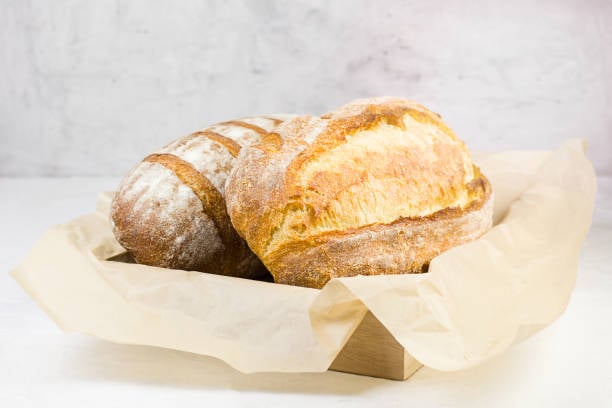
Pastries, bread, cookies, muffins, cold sandwiches. These foods carry a little surface oil and sit at room temperature for a short time. Plain greaseproof paper — or parchment in the oven — handles this comfortably, and this is the one rung where material choice barely matters. Any of the four papers above will perform acceptably, which is why this segment of the market is intensely price-competitive. The failure boundary: the moment the item is hot, wrapped tight, and sitting in a delivery bag, it has left this rung.
Medium-oil foods: where the split happens
Burgers, sandwiches, fried items eaten quickly, salads with vinaigrette. Here the paper’s structure starts to matter. A dense greaseproof sheet holds for the 10–15 minutes of counter or short delivery time; a coated paper or a lined bag holds longer and survives being squeezed. This is the rung where operators improvise: deli paper inside a box, an extra sheet under the burger. Those improvisations work, but they patch a packaging choice made without the oil level in mind.
Heavy-oil foods: the steam problem
Fried chicken, loaded fries, anything hot and oily that travels in a closed container for 15 minutes or more. This is where most real-world failures happen, and the culprit is usually not what people expect. One restaurant owner who moved burger-and-chip combos to sugarcane (bagasse) boxes described the result: “anything with grease or sauce turns the bottom into soggy mush after like 10 mins in a delivery bag” (r/restaurateur, 2026). The follow-up in the thread is the insight that matters: “the steam is what kills it more than the oil.”
THE STEAM PROBLEM
10 minutes
Steam kills faster than oil.
“Anything with grease or sauce turns the bottom into soggy mush after like 10 mins in a delivery bag.” — a restaurant owner, on uncoated bio boxes
That single sentence explains more than any product spec sheet. In a closed bag, hot food releases steam; steam softens the fibers of an uncoated container from the inside; oil then wicks through the softened structure. Grease resistance, water resistance, and steam resistance are three different properties, and a box that handles one may fail on another. This is also why bagasse — an excellent fiber for many uses — fails so fast in exactly this scenario: strong against moderate moisture, unprepared for a sealed, steaming, oil-loaded bag.
| Level | Example foods | What usually works | Where it fails | Upgrade signal |
|---|---|---|---|---|
| Light | Pastries, bread, cookies | Greaseproof paper, parchment | Hot, wrapped, sealed | Seeing grease spots at all |
| Medium | Burgers, fried snacks, vinaigrette salads | Dense paper, coated sheets, lined bags | Long delivery, stacking pressure | Leaking after 15+ minutes |
| Heavy | Fried chicken, loaded fries, hot meals in bags | Coated paperboard, PE/PLA-lined containers | Steam + oil + long delivery | Soggy bottom, stained bags, customer complaints |
Steam is the deciding factor on the heavy rung: a coated paperboard or a PE- or PLA-lined container holds the structure where uncoated fiber and bagasse collapse. The distinction matters because the upgrade path is not “buy stronger paper” — it is “move to a container that resists steam and oil together.”
Should You Upgrade? Three Signals It’s Time to Rethink Your Grease Packaging
If your current packaging mostly works, the natural reaction is to leave it alone. Three things currently in motion make that a risky default.
Signal 1: The compliance map is being rewritten
In February 2024, the FDA announced that grease-proofing agents containing PFAS (“forever chemicals”) are no longer being sold for food-contact use in the United States, completing a voluntary phase-out that began in 2020 (FDA, 2024). In January 2025, the FDA further determined that 35 food-contact notifications related to PFAS grease-proofers are no longer effective. The practical consequence: any grease-resistant packaging that relied on fluorochemical treatment has been quietly disappearing from the market, and what replaces it is not always equivalent. If your supplier cannot tell you, in writing, which chemistry their “grease resistant” coating uses, that silence is a compliance risk you are carrying.
Signal 2: Bio packaging is facing its real-world exam
The bagasse story above is not an isolated anecdote — it is the market testing eco claims against physics. PLA-lined and heavy lined paperboard options hold up to hot grease far better than uncoated bio fiber, which is why the useful question is not “is it eco?” but “eco and what lining?” BPI- or DIN-certified compostable does not mean steam-proof. The operators in the thread above settled on a practical rule: “Deli paper helps a bit, but it won’t save the wrong box.”
Eco is a material claim, not a performance claim.
Bagasse is compostable and collapses under steam; PLA-lined paperboard is certified compostable and holds hot oil. Ask for the lining — the eco label alone tells you nothing about the grease.
Signal 3: The failure bill is bigger than the upgrade
A leaky bag is not a packaging problem, it is a chain reaction: stained delivery bags, driver complaints, refunds, negative reviews, and reorders of packaging that already failed. Grease soaking through bags and containers is common enough in food delivery that driver forums treat it as a category of complaint (r/doordash_drivers, 2021). The arithmetic is simple: one upgrade costs a few cents per unit; one failure costs the order, the review, and the repeat customer.
None of this means every business must rush to the heaviest packaging. A bakery selling cold pastries over the counter genuinely does not need coated containers — the light rung is fine, and staying there is not a failure. The upgrade decision belongs to anyone selling hot, oily food that travels in a closed container. If that is you, the next section is the actual selection process.
2020 — PFAS grease-proofing agents begin a voluntary US phase-out
February 2024 — FDA: PFAS grease-proofers no longer sold for US food contact
January 2025 — 35 PFAS food-contact notifications declared no longer effective
How to Choose: A Scene-by-Scene Matrix and the 10-Minute Test
Selection starts from the menu and the delivery reality, not from a catalogue. Work through the matrix with your actual dishes:
| Scenario | Workable materials | Failure boundary | Confirm with supplier |
|---|---|---|---|
| Hot fried items in delivery | Coated paperboard boxes, PE/PLA-lined containers | >20 min sealed, acidic sauces | Coating type (PE vs PLA), leak test report |
| Soup & saucy bowls | PE/PLA-coated paper bowls, lids | Thin uncoated board, careless stacking | Bowl gsm, side-seal integrity, lid fit |
| Burgers & sandwiches | Lined bags, coated wraps | Heavy sauce load, long hold | Coating written guarantee, oil-solvent ink |
| Bakery counter items | Greaseproof paper, plain bags | Hot items wrapped tight | Paper grade (gsm), print ink food-grade |
| Ice cream & chilled dairy | Coated cups, cold-safe board | Melting cream, condensation | Cold-use certification, freezer safety |
| Salads with dressing | Coated bowls, leakproof lids | Dressing pooling, long transport | Seam sealing, lid lock strength |
The matrix strips the decision to two questions per item: how much steam and oil will it face, and does the container’s weakest point (bottom, seams, lid) survive that? Seams are the first failure point on most containers — a fully coated board still leaks if the side seam is weak, so seam quality is a question to ask explicitly, not a detail to assume.
Then comes the part no catalogue answers: testing. The delivery-bag reality is different from the supplier demo, and the industry has an informal standard for this:
The 10-Minute Test
Use your real food — your burger, your fries, your sauce — not water or oil alone.
Package it in the exact container you would ship.
Close it in a real delivery bag and let it sit 15–20 minutes.
Check the bottom, the seams, and the outside of the bag for spots and softening.
As one operator put it: “The test I wish I’d done sooner was exactly what you said — actual food, actual bag, actual wait time. Not whatever the supplier demo shows you” (r/restaurateur, 2026). The test costs nothing but 20 minutes and exposes most of the failures that surface only after a bulk order lands. When you evaluate samples, run this test before you talk about price.
Test before you commit.
Put the 10-minute test to work on our samples — standard samples ship free within 48 hours.
Request free samplesWhat to Demand from a Grease-Resistant Packaging Supplier
Once the test has narrowed the material, the supplier side has its own checklist. Every item below should be answerable in writing:
The 7-Question Supplier Audit
Which coating chemistry, and can you commit to it in writing (PE, PLA, or other)?
What are the exact gsm / board weight and coating weight for this SKU?
Can you share a leak or grease-resistance test report for this product?
Are your inks food-grade (soy or water-based), and do they migrate into food?
Which food-contact certifications apply — FDA, LFGB, or EU FCM — with numbers we can verify?
What is the QC check frequency, and is there batch traceability (date, time, serial)?
If a batch leaks, what is the claim process — and do we have to ship returns back?
A few specifics help separate real answers from sales language. Certifications to look for on paper packaging: FDA and LFGB for food contact, ISO 9001 and ISO 14001 for management systems, BRC or BSCI for social and safety audits, FSC for fiber sourcing, and BPI or DIN if compostability is part of the offer. Production parameters worth asking about: coating type and weight, paper gsm, seam-sealing method, and print ink grade — soy and water-based inks are the food-safe standard, with low migration and no flavor transfer. Sample turnarounds and digital proofs are process signals: a supplier that can send a digital proof within one working day and standard samples within 48 hours is running a production pipeline, not a reselling operation.
One boundary to keep in mind: a sample that survives the 10-minute test is not a guarantee for the whole batch. Ask about inspection frequency and traceability — cups and containers printed with production date, time, and serial numbers are a meaningful difference from anonymous stock.
The Business Angle: How Importers and Distributors Should Stock Grease-Resistant Lines
For importers and distributors, the ladder structure from earlier maps directly onto inventory strategy. The light rung — greaseproof paper, plain bakery bags — is where performance differences are smallest and price comparison is easiest; it is the commodity layer, and it will always be a volume play. The heavy rung — coated paperboard boxes, PE/PLA-lined containers for hot, oily takeout — is where materials actually differ under failure conditions. That is where margin lives, because the buyer cannot compare a product that works against a product that collapses by price alone.
The compliance shift multiplies the advantage. With PFAS chemistry gone from the US market and EU buyers increasingly checking compostability and food-contact credentials, certification is becoming a selection criterion rather than a footnote — and it is verifiable. Compliance is where margins survive, so the evidence should be public before the sales call. YoonPak’s FDA and LFGB food-contact approvals, ISO 9001 and ISO 14001 certifications, BRC, BSCI, FSC, and the BPI and DIN compostability marks are all listed on the materials and certifications page on our site — checkable before you order, not after. Ask any supplier for the same list. If it takes three follow-up emails to get it, that response time tells you more than the certificates do.
There is one more asset distributors can build that no catalogue price can match: testing as a service. The 10-minute test is free to run and nobody in the chain does it systematically — not the food operator, not the importer. A distributor that tests every new SKU with real food before it enters the catalogue, and shares the results with buyers, removes the exact fear that drives purchasing decisions (“ordered 500 units” and then discovered the mush). That trust converts once and compounds on every reorder.
The structural conclusion is straightforward: stock the light rung for volume and the heavy rung for margin, make certification visible, and make testing part of the offer. The grease ladder organizes the products; the test validates them; compliance protects the whole position.
Spec your grease-resistant packaging with a factory that stands behind the test.
PE/PLA-coated cups, bowls and containers, custom-printed, with FDA, LFGB, BRC and compostability certifications you can verify before you order.
Talk to our packaging teamReferences
- U.S. Food and Drug Administration. “FDA Announces PFAS Used in Grease-Proofing Agents for Food Packaging No Longer Being Sold in the U.S.” February 2024. https://www.fda.gov/food/hfp-constituent-updates/fda-announces-pfas-used-grease-proofing-agents-food-packaging-no-longer-being-sold-us
- noissue. “What is ‘Grease-Resistant’?” September 2025. https://help.noissue.co/hc/en-us/articles/51025209073945-What-is-Grease-Resistant
- Foopak. “Greaseproof Paper for Businesses: Why It’s a Smart Choice.” April 2025. https://www.foopak.com/greaseproof-paper-for-businesses-why-its-a-smart-choice/
- r/restaurateur. “What bio packaging actually survives hot greasy food without leaking.” August 2026. https://www.reddit.com/r/restaurateur/comments/1vddcw0/what_bio_packaging_actually_survives_hot_greasy/
- r/doordash_drivers. “This should be the standard for bagging food at EVERY restaurant.” 2021. https://www.reddit.com/r/doordash_drivers/comments/mhcg91/this_should_be_the_standard_for_bagging_food_at/
- YoonPak. “Going Green — Materials & Sustainability.” https://www.yoonpak.com/going-green/
- YoonPak. Homepage. https://www.yoonpak.com/



 English
  German
  Spanish
  Italian
  Dutch
Dutch  French
  Portuguese
  Russian
  Arabic
  Korean