

Pint vs Quart: A Food Service Operator's Guide to Container Sizes, Costs, and Smart Sourcing
When running a food service business, the container sizes you choose might seem like a minor detail, but they hold immense power over your daily operations. The debate between using a pint versus a quart goes far beyond the simple fact that one quart equals two pints. This single sizing decision directly impacts your food costs, customer satisfaction scores, and overall brand perception. Whether you are serving hot coffees, hearty main-course soups, or family-style takeout dishes, selecting the right container ensures you avoid unnecessary plate waste and protect your profit margins. In this guide, we break down the practical differences, hidden costs, and smart sourcing strategies to help you make the most profitable packaging choices for your menu.

01 — What's the Difference Between a Pint and a Quart?
Here is the one fact you need: 1 quart equals 2 pints. Everything else flows from this.
A US liquid pint holds 16 fluid ounces, or about 473 milliliters. A US liquid quart holds 32 fluid ounces, roughly 946 milliliters (NIST, 2024). Four cups make a quart. Two cups make a pint.
| Unit | Fluid Ounces | Cups | Milliliters |
|---|---|---|---|
| 1 Pint | 16 fl oz | 2 cups | 473 ml |
| 1 Quart | 32 fl oz | 4 cups | 946 ml |
But knowing the math is the easy part. The question every food service operator actually needs answered is: which size belongs on your menu, and what does that choice cost you?
Think of it this way: a pint is a medium coffee. Familiar, individual, complete in itself. A quart is a large soup serving — substantial, shareable, built for a meal rather than a moment. If you run a cafe, a deli, a delivery kitchen, or a catering business, this single sizing decision ripples through your food cost, your customer satisfaction scores, and your brand perception.
02 — US vs UK Measurement Standards: Why a Pint Isn't Always a Pint
If you source containers internationally — and most food businesses do — there is a trap hiding in the word "pint."
| Unit | US Customary | Imperial (UK) | Metric |
|---|---|---|---|
| 1 Pint | 16 fl oz (473 ml) | 20 fl oz (568 ml) | 473–568 ml |
| 1 Quart | 32 fl oz (946 ml) | 40 fl oz (1,136 ml) | 946–1,136 ml |
An Imperial pint is roughly 20% larger than a US pint. The same gap applies to quarts. The difference traces back to 1824, when Britain reformed its measurement system around a new gallon definition — one based on 10 pounds of distilled water. The United States kept the pre-revolution wine gallon standard.
Why this matters for your business: if you order "pint containers" from a UK-based supplier without clarifying the standard, you might receive cups that hold 568 ml instead of 473 ml. That is a 20% larger pour for every coffee, every soup, every side dish. Multiplied across thousands of servings, the cost discrepancy is real. Always confirm which measurement system your supplier uses. For export orders, insist on dual labeling — "473 ml / 1 US Pint," for example.
03 — Which Size for Which Food? A Practical Container Guide
Before you choose between pint and quart, answer three questions about each item on your menu:
- What is the food type? Liquid (coffee, soup), semi-solid (stew, curry), or solid (salad, rice bowl)?
- What is the consumption context? Single diner, shared meal, or takeaway?
- What is the customer's price expectation? A $6 item and a $16 item demand different perceived volume.
With those variables in mind, here is how pint and quart map to real menu categories:
| Food Type | Pint (16 oz) Best For | Quart (32 oz) Best For | Recommendation |
|---|---|---|---|
| Coffee & Tea | Standard hot drinks / single-serve lattes | Large iced drinks / shared cold brew | Pint is the default; quart only for iced or sharing |
| Soup | Side soup paired with a sandwich | Main-course soup / takeout soup as a full meal | Pint if it is a side; quart if it is the main event |
| Ice Cream | Single-serve retail cup | Family-size or catering scoop tub | Pint for retail; quart for foodservice |
| Chinese Takeout (Rice & Noodles) | Single-portion side dish | Two-person main dish / family-style share | Pint = solo lunch; quart = dinner for two |
| Salad | Side salad or appetizer portion | Entree salad as a standalone meal | Pint for sides; quart for main-course salads |
| Sauces & Dips | Individual condiment portion | Party-size sharing container | Pint almost always wins here |
| Prepared Meals & Deli | Single-person lunch | Family dinner for 2–3 people | Let your customer demographic decide |
One note on real-world capacity: a "16 oz" pint container typically holds about 14 to 15 ounces of actual food once you account for headspace — the gap that prevents spills during transport. When calculating portion costs, use fillable volume, not nominal volume.
04 — What Pint vs Quart Really Costs Your Business
Container sizing is not just a portion decision. It is a margin decision.
Per-Unit Cost: What You Pay for Each Container
A standard printed pint paper cup runs roughly $0.06 to $0.12 per unit at wholesale volume. A quart container costs about $0.09 to $0.18 per unit — 50 to 75 percent more per piece. But because a quart holds twice the volume, the cost per ounce of capacity is actually lower on the quart.
Here is the calculation that matters: if you serve 1,000 customers a week and save $0.03 per container by choosing the right size, that is $1,560 a year. For a multi-location operation serving 10,000 a week, the difference crosses five figures.
Bulk Ordering: How Order Volume Changes the Math
Container pricing shifts dramatically with order quantity. A 20-foot shipping container holds roughly 300,000 to 400,000 standard paper cups. A 40-foot high-cube container fits about 700,000 to 900,000. Full container load (FCL) shipping from a manufacturer to your warehouse can cut per-unit landed cost by 25 to 40 percent compared to less-than-container-load (LCL) shipments. But you need the storage space and the cash flow to place orders of that size.
This is why some manufacturers offer free warehousing: you order a full container at the lowest unit price, and they hold the stock, shipping it to you in batches as needed.
The Hidden Costs of Choosing the Wrong Size
The price of the container itself is not the whole story. Three hidden costs hit harder.
Food waste. When a quart container holds more than a customer can finish, the excess goes in the trash. Plate waste accounts for nearly 70 percent of restaurant food waste (ReFED, 2025). Oversized takeout portions are a direct contributor. Every unfinished ounce is food cost with zero revenue.
Customer churn. A customer who feels shortchanged does not complain. They just do not come back. Portion dissatisfaction consistently ranks among the top three reasons diners switch away from a restaurant. The pint container that looks too small for a $14.99 entree is silently costing you repeat business.
Inventory bloat. Ordering the wrong size means stock sitting in your storage room. If you switch your menu seasonally, a pallet of quart containers ordered for a summer salad program becomes dead capital in October.
05 — Sustainable Packaging by Size: Materials, Certifications, and Real Impact
Sustainability in food packaging is not just about the material label. It is about whether the material actually performs at the size you have chosen.
Common pint and quart container materials break down as follows:
| Material | Best Application | Heat Tolerance | Eco Credential |
|---|---|---|---|
| PE-lined paper | Hot drinks, hot soups, oily foods | ~90–100°C (194–212°F) | Recyclable where facilities exist; not compostable |
| PLA-lined paper | Cold drinks, room-temp foods, salads | ~60–70°C (140–158°F) | Commercially compostable (BPI-certified) |
| Bagasse (sugarcane fiber) | Hot and cold foods, microwave-safe | High heat tolerance | Compostable; made from agricultural byproduct |
| Unbleached kraft paper | Dry or low-moisture foods, bakery items | Varies by coating | Recyclable; natural look; lower processing footprint |
A critical detail: PLA-lined cups cannot handle boiling-hot liquids. Pour a 195°F latte into a PLA-lined pint cup, and the lining begins to soften. That is not a material failure. It is a material mismatch. PE lining is the correct choice for hot beverages. PLA is ideal for cold drinks and room-temperature foods. Match the material to the menu item, not to the marketing claim.
When evaluating any container, look for these certifications on the supplier's documentation: FDA 21 CFR 176.170 for food-contact paper safety (eCFR), FSC for responsibly sourced paperboard, BPI for compostability claims, and BRCGS for manufacturing hygiene and food safety management. A supplier that cannot produce these certificates on request is a risk, not a bargain.
06 — How to Choose: A Decision Framework for Food Service Operators
No two food businesses make the same pint-versus-quart decision. But the decision process itself follows a consistent logic. Start with your business type.
Coffee Shop & Cafe: Cup Sizes That Match Your Menu
The coffee industry has settled on a de facto cup-size gradient: Short (8 oz), Tall (12 oz), Grande (16 oz — one pint), and Venti (20 oz hot, 24 oz cold). Notice that the industry standard "large" hot drink sits right at the pint mark. Cold drinks push past it toward quart territory.
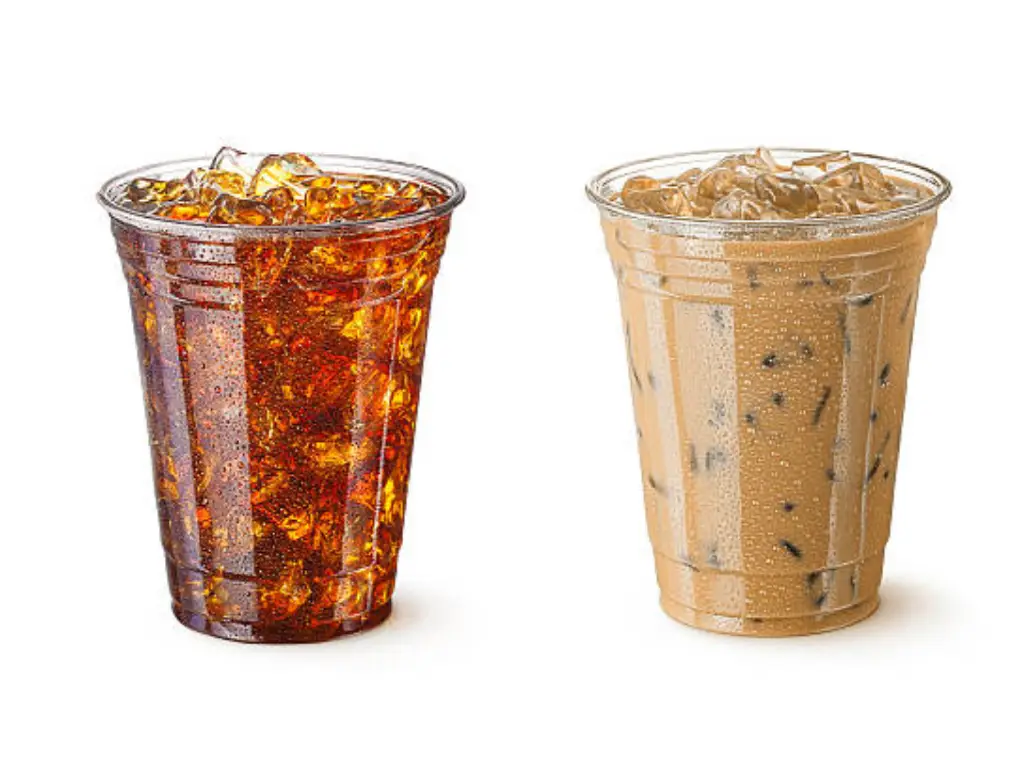
For a cafe menu, the pint is your workhorse: hot lattes, cappuccinos, drip coffee, and single-serve cold brew all fit here. Reserve quart-range containers (20 to 24 oz) for iced drinks. Ice displaces volume, so a 24 oz iced latte delivers roughly the same amount of actual beverage as a 16 oz hot latte. If your cafe also sells soups or grain bowls as lunch add-ons, a quart container lets you offer a "large upgrade" for $2 to $3 more. The incremental container cost is a few cents, and the perceived value jump is substantial.
Fast Casual & Delivery Kitchen: Portioning for Profit
Delivery changes the container equation. A takeout container must survive 30 to 45 minutes in transit, hold temperature reasonably well, and arrive without leaks. If it fails any of these, the customer blames you — not the delivery driver.
For delivery kitchens, a practical rule of thumb: entrees in quarts, sides in pints. A rice bowl, pasta dish, or stir-fry as a standalone meal belongs in a 32 oz quart container. Pair it with a pint-sized soup or salad side, and the customer unboxes a complete meal that feels generous. For soup sold as a main dish, a quart container with a tight-sealing lid is non-negotiable. Soup leaks are the number one cause of delivery complaints.
A note on temperature: hot food in a paper container loses roughly 15 to 25 degrees Fahrenheit over a 30-minute delivery window. The exact drop depends on ambient temperature and container wall thickness. Double-wall insulation helps — it preserves about 8 to 12 degrees more than single-wall — but it also raises the per-unit cost. Balance insulation with margin.
Catering & Events: Scaling from Pint to Quart to Bulk
Catering operates on a different logic altogether. The question is not "pint or quart" but "how many of each, and in what ratio?"
For a catered event, plan on roughly 1 to 1.5 pounds of total food per guest. The main course accounts for about 12 to 16 ounces of that total — right in the sweet spot between three-quarters of a quart and a full quart. Sides run 4 to 8 ounces per person, which maps neatly to a pint or half-pint container.
A practical ratio for a 100-person event: 70 quart containers for mains, 100 pint containers for sides and desserts, and 30 extra quarts for seconds and sharing platters. Adjust based on whether it is a seated dinner — more quart mains — or a standing reception — more pint-sized handheld portions.
for mains
for sides & desserts
seconds & sharing
One detail caterers often overlook: branded containers at events are a marketing asset. When 300 attendees at a corporate lunch each receive a custom-printed quart box with the host company's logo, and 100 of them carry leftovers back to their desks in that box, the packaging has just become a billboard.
07 — What to Look for in a Packaging Manufacturer: An Evaluation Checklist
Once you have decided between pint and quart, you still need to decide who makes them. Not all container suppliers are equal. The difference between a reliable manufacturer and a mediocre one shows up long after the invoice is paid — in leak rates, late shipments, certification gaps, and customer complaints.
Here is an eight-point checklist to evaluate any packaging supplier:
1. Certifications. At minimum, look for ISO 9001 (quality management) and BRCGS (food safety). If you export to the US or EU, the manufacturer must hold FDA and LFGB compliance documentation. For sustainability claims, demand FSC chain-of-custody certification. A supplier without third-party audited certifications is asking you to take their word for it. In food packaging, taking their word is a liability.
2. Client track record. Has this manufacturer served recognizable brands? A supplier that produces for global chains — the kind with their own audit teams and compliance departments — has already been vetted more rigorously than you could do yourself. A manufacturer with over 24 years of experience, an hourly quality inspection cadence, and a zero-defect policy that traces every cup back to its production batch demonstrates the operational discipline that chain-restaurant procurement teams require.
3. Sampling and lead times. Industry standard for digital proofs is 1 to 2 working days after artwork submission. Physical samples should ship within 3 to 5 working days. Production lead times typically run 4 to 8 weeks. A manufacturer delivering custom orders in 3 to 6 weeks — a full week faster than the industry average — compresses your time-to-market and reduces the inventory you need to carry.
4. MOQ flexibility. The standard minimum order quantity for custom-printed paper cups hovers around 100,000 pieces per design. A supplier willing to drop to 50,000 for multi-item orders — or even 10,000 if you cover freight — gives you room to test new sizes or seasonal designs without overcommitting.
5. Custom printing capability. Confirm the manufacturer runs both flexographic and offset printing, supports CMYK and Pantone color matching, and can reproduce fine detail at 300 dpi or higher. Ask who handles the design if you cannot provide press-ready artwork. An in-house design team that delivers free mockups shortens your timeline considerably.
6. Quality control. Ask about inspection frequency. Hourly is the gold standard. Ask about their defect protocol: do they quarantine and discard everything since the last clean test, or do they try to salvage? Ask about traceability: is every container marked with a production batch code? If a defect reaches your customer, can the manufacturer identify exactly which shift, which machine, and which hour produced it?
7. After-sale support. A one-year warranty is standard among reputable manufacturers. What matters more is the claim process: if a batch leaks, do you need to ship defective stock back at your expense, or can you resolve the claim with photos and video evidence? A supplier that does not require physical returns for quality claims saves you international freight costs and weeks of back-and-forth.
8. Sustainability options. Beyond the material itself, assess whether the manufacturer can supply PLA-lined or plastic-free alternatives at your target volume, whether their paperboard comes from FSC-certified plantations, and whether their inks are soy- or water-based rather than solvent-based. A supplier that holds ISO 14001 environmental management certification alongside their quality certifications is committing to sustainability as an operating practice, not a marketing line.
If you are evaluating suppliers for custom pint or quart containers, working with a certified manufacturer like YoonPak — one that holds the full stack of ISO 9001, BRC, FSC, and FDA certifications, has served brands such as Burger King and Tim Hortons, and ships free samples within 48 hours — dramatically reduces the risk of a sourcing mistake that could cost you far more than the container itself.
Need pint or quart containers for your food business? YoonPak provides free samples, design support, and certified manufacturing — request a sample to evaluate quality firsthand.
References
- NIST. "Handbook 44 — Appendix C: General Tables of Units of Measurement." 2024. https://www.nist.gov/document/nist-hb-44-2024-appendix-c-general-tables-units-measurement
- ReFED. "Restaurant Food Waste Reduction." Cited via GoFoodservice, 2025. https://www.gofoodservice.com/blog/5-ways-restaurant-can-reduce-food-waste
- eCFR. "21 CFR 176.170 — Components of Paper and Paperboard in Contact with Aqueous and Fatty Foods." https://www.ecfr.gov/current/title-21/chapter-I/subchapter-B/part-176/subpart-B/section-176.170
- YoonPak. "Custom Paper Food Packaging Solutions." https://www.yoonpak.com/
- YoonPak. "Contact — Get Free Custom Printed Samples." https://www.yoonpak.com/contact/


 English
  German
  Spanish
  Italian
  Dutch
Dutch  French
  Portuguese
  Russian
  Arabic
  Korean