

Disposable Cup Printing: How Order Size Decides the Method, the Supplier and the Real Cost
Every printed disposable cup starts as a flat sheet of paper, not as a cup. Your artwork is printed onto the sheet, the sheet is dried, cut into fan-shaped blanks, then rolled around a mandrel and sealed at the side seam. That production order explains almost everything about pricing. Printing on a flat sheet is fast and cheap at scale. The cost of getting your design onto that sheet is what suppliers are really quoting when they name a price per cup.
The confusion starts with the numbers. One supplier asks for 1,000 cups minimum. Another wants 20,000. A third will not even quote below 100,000. All three quotes can be correct, because each one is priced around a different printing process, and each process has its own economics. This article walks through the whole chain, from how the printing physically happens to which supplier route fits your quantity. The sections that follow cover the parts of your per-cup price, the approval steps before mass production, and the decisions that matter at container scale.
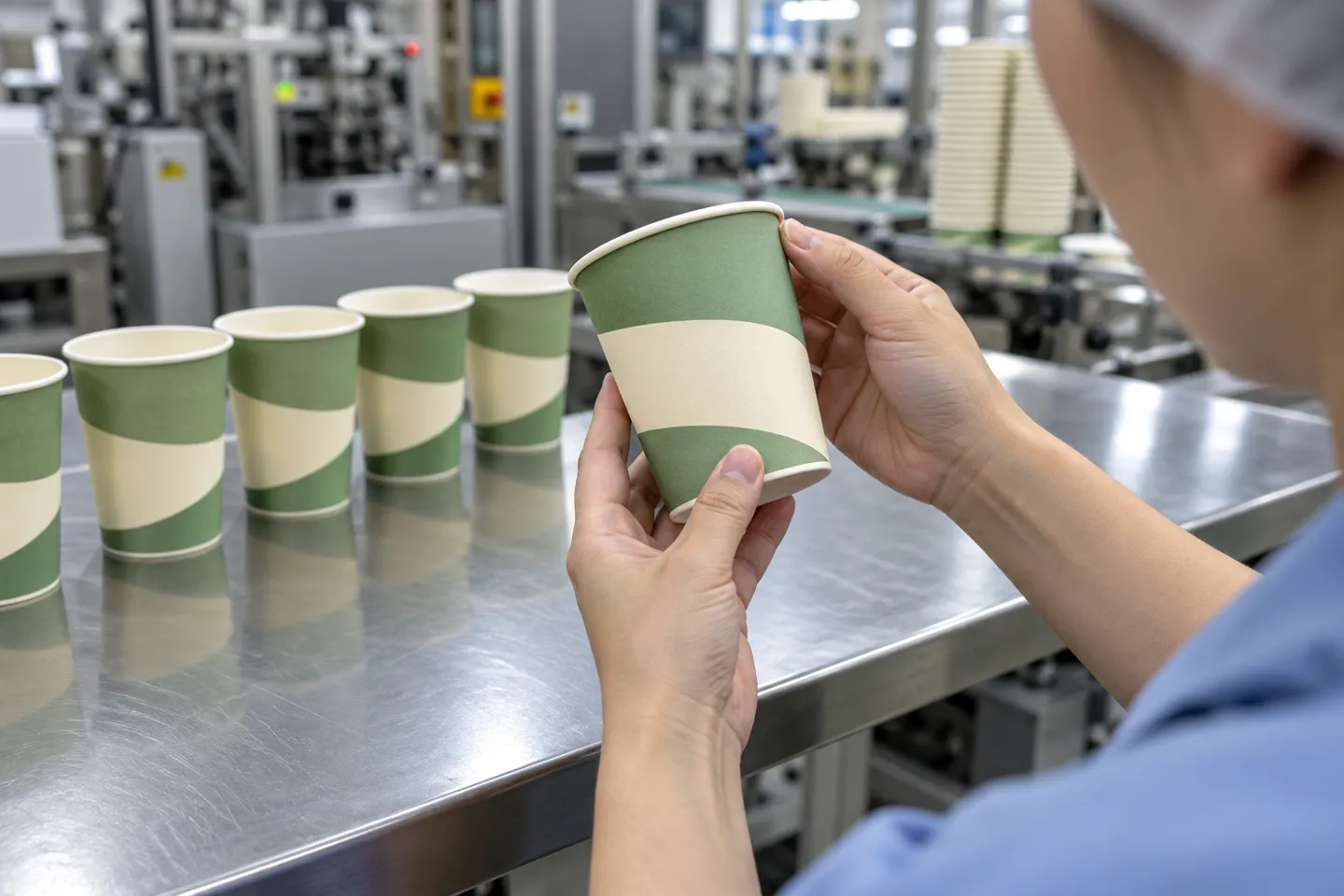
How Printing Gets Onto a Disposable Cup
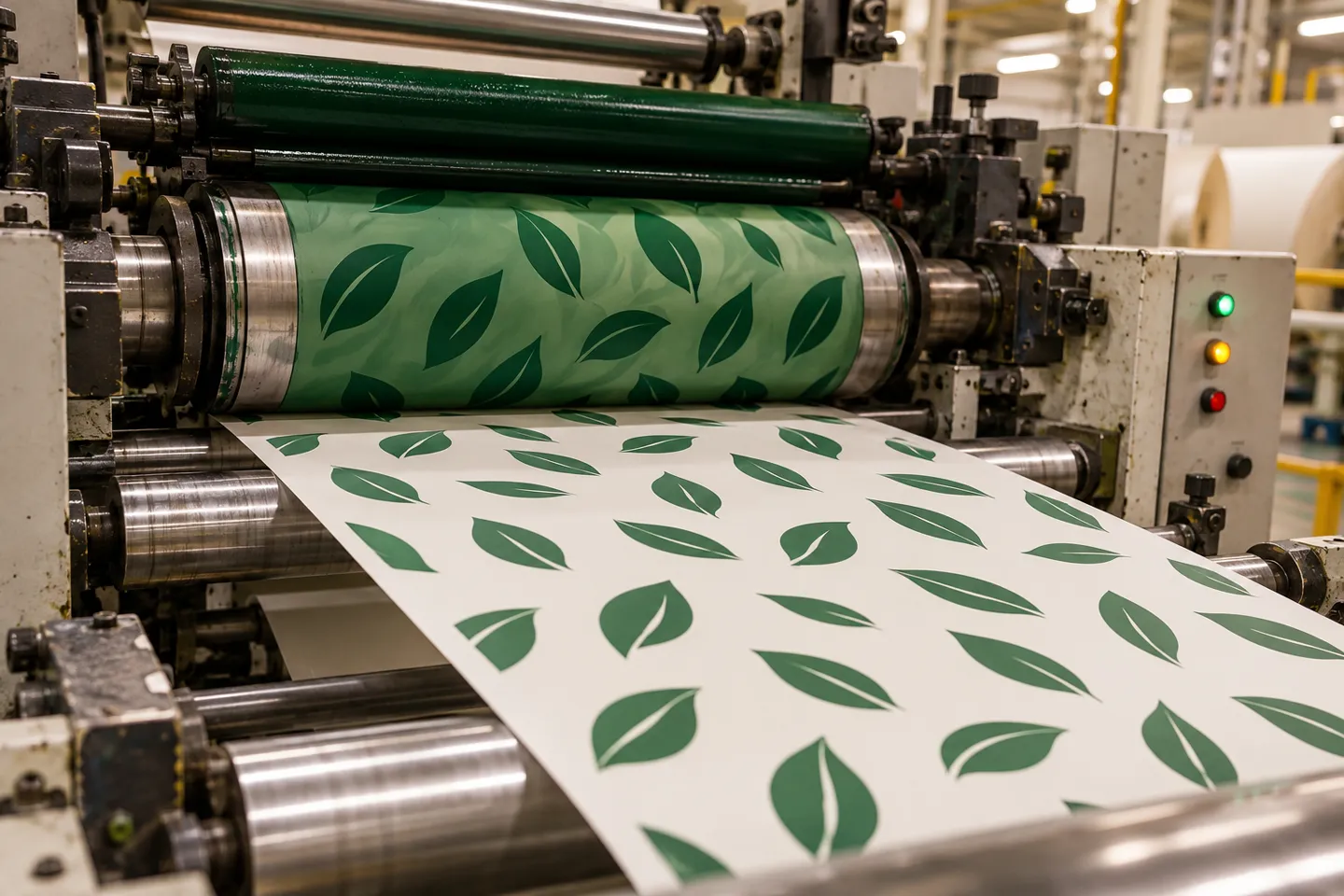
Cup printing happens before forming, not after. Paperboard arrives in rolls, already laminated with a thin polyethylene (PE) coating, usually about 18 g per square meter. Base board weights run between 160 and 320 gsm depending on the cup size. The printing unit applies ink to this coated sheet, and dryers cure it with hot air or UV light. Only then do die-cutting machines punch out the fan-shaped blanks that forming machines wrap into cups.
Three processes do this printing, and each has a distinct personality:
- Flexographic (flexo) printing uses flexible rubber or photopolymer plates, one plate per color. It runs fast, handles solid spot colors and full-wrap designs, and is the default on almost every coffee-chain cup you have held.
- Offset printing transfers ink from a plate to a rubber blanket and then onto the sheet. It renders photographic detail and smooth CMYK gradients that flexo cannot, which is why it shows up on premium and image-heavy runs.
- Digital printing needs no plates at all. It is slower and costs more per cup, but it makes short runs and proofs economical because there is no plate investment to amortize.
Plastic cups (PET and PP) sit slightly outside this chain: they are printed after forming, by screen printing or curved-surface digital printing, one cup at a time. That is a different cost structure again, and it is why printed plastic cups live mostly in the promotional and short-run world.
Four Routes and the 2,000× MOQ Spread
Search supplier sites and you will find four distinct business models selling what looks like the same product. They are not the same product. Each route is built around a different process, and each process sets its own minimum order quantity (MOQ).
Every number in the table below comes from a real, live offer. One US printer advertises a 1,000-piece minimum with production in 15 days (Cupprint, 2026). One trade publication reported a supplier pushing the minimum down to 50 cups for small events (Fresh Cup, 2026). A factory-side guide puts serious custom flexo and offset work at roughly 20,000 pieces per size, with 25 to 30 business days of production (CupsPak, 2026). And factory FAQs at the wholesale end list 100,000 pieces for a single item, or 50,000 across multiple items.
Four Supplier Routes at a Glance
| Route | Minimum order | Process | Lead time | Best for |
|---|---|---|---|---|
| Promotional printers | 0-1,000 pcs | Digital, or label on stock cups | 5-15 days | Events, weddings, trials |
| Local cup printers | ~1,000 pcs | Digital and short-run flexo | ~15 days | Small cafés, local brands |
| Custom cup factories | 10,000-30,000 pcs | Flexo and offset on roll-fed lines | 25-30 business days | Growing chains, private label |
| Container-load exporters | 50,000-100,000+ pcs | Flexo and offset, sea freight | 3-6 weeks door to door | Importers, distributors, chains |
The same cup can carry a minimum order of 50 pieces or 100,000 pieces: a 2,000-fold spread. The difference is the printing process, not the size of the supplier.
Read that last sentence again before comparing quotes. A 50-cup minimum is possible because digital printing skips plates entirely. A 100,000-piece minimum exists because flexo plates, die-cutting tooling and container logistics only make sense when they are spread across a very large run. Neither number is greed. Ask a container exporter for 2,000 cups, or a promotional printer for 200,000, and you are asking one process to behave like another. The price will tell you so.
2,000×
From a 50-cup minimum to a 100,000-cup minimum, on the same cup.
Match the route to your quantity before you compare prices.
Where Your Quantity Lands: The Real Cost Math
Somewhere between 1,000 and 30,000 cups, almost every buyer hits the same wall: the quotes stop making sense. A per-cup price that looked outrageous at 5,000 pieces becomes unremarkable at 50,000, and the reason is structural, not negotiable. This is where you work out which route your quantity actually belongs to.
The Five Parts of Your Per-Cup Price
A printed cup quote decomposes into five parts: the blank cup (paperboard plus coating), the printing plates (a fixed cost per color), the print run itself, packing, and freight. Four of the five scale roughly linearly with quantity. The plates do not.
What a plate set does to the per-cup price
2,000 cups
+$0.15
plate cost added to each cup
200,000 cups
under $0.01
the same plates, spread thin
That is the whole mechanism behind the MOQ spread. If a plate set for a two-color design costs, say, a few hundred dollars, that cost is divided across every cup in the run. The blank cup price barely moves; the plate amortization is what changes. Forum pricing makes the anchors concrete. Plain paper cups ran around $0.05 per cup by the case of 1,000 in a widely cited café-owner thread, though that figure is a few years old now (Reddit, r/smallbusiness, 2019). In 2025, buyers in the same community were quoting about $0.22 per cup for 1,000 custom-printed 16 oz plastic cups from a US supplier (Reddit, r/smallbusiness, 2025). Volume discounts come in steps, not curves: factory price breaks commonly sit at 50,000, 100,000 and 500,000 pieces.
The local-versus-overseas question is the same math with freight and tariffs bolted on. A nearby printer charges more per cup but ships in days, with no customs exposure. An overseas factory charges less per cup at volume, but you wait for production plus a sea crossing, and the landed cost moves with trade policy. Buyers importing from abroad are actively warning each other about tariff surprises in the current climate (Reddit, r/smallbusiness, 2025). The honest comparison is landed cost per cup at your real annual volume, not the unit price on the quote.
Local Printer vs Overseas Factory at 10,000 Cups
| Factor | Local / US printer | Overseas factory |
|---|---|---|
| Unit price | Higher | Lower |
| Plate and setup fees | Often lower or bundled | Charged per order, sometimes per color |
| Lead time | ~15 days | 25-30 business days plus sea freight |
| Tariff exposure | None | Tracks trade policy |
| Realistic annual volume | Up to ~50,000 pcs | 100,000 pcs and up |
When the Label Workaround Works and When It Leaks
Stuck between a 10,000-piece MOQ and a launch date, many small brands buy printed labels instead. One founder described exactly that move in a candid thread: around $450 for 2,300 stickers (Reddit, r/smallbusiness, 2019). It is a legitimate bridge, and knowing its edges keeps it from becoming a branding liability.
The deeper point: the workaround fails precisely when your brand starts compounding. A logo that peels at the seam or sits crooked after condensation costs more in perceived quality than the per-cup savings ever returned. If you are past 10,000 cups a year, price the printed route properly instead of stretching the label route past its limit.
Past 10,000 cups a year, printed cups win on cost as well as looks: get a process-matched quote at your real volume.
Get a Quantity-Matched QuoteFrom Artwork to Production: The Approval Chain
Once you pick a route, the risk moves from pricing to execution. Cup printing failures are rarely printing failures; they are approval failures, things signed too early or checked too late. Four checkpoints decide whether your 30,000 cups arrive as designed.
1. Artwork preparation. Factories need vector files (.ai, .pdf, .cdr) at a minimum of 300 dpi, with fonts converted to outlines. This sounds like paperwork, but a factory guide written from the production floor estimates roughly a quarter of artwork files arrive with fixable problems (CupsPak, 2026). The usual two: fonts not outlined, images below 300 dpi. Every one of those files bounces back and forth for days.
2. Digital proof. Reputable suppliers return a digital proof within one business day of ordering, showing your logo laid out on the actual cup template. This is your last cheap chance to change anything: once you sign the proof, the order goes to plate-making and further changes are off the table.
3. Physical pre-production sample. A screen shows colors that a wet-ink press on coated board will not reproduce exactly. For anything brand-critical, insist on a physical sample from the production line before the full run. Pantone spot colors should be declared explicitly in your order instructions so the factory plates them as dedicated inks rather than approximating them in CMYK.
4. Contract terms. Two clauses deserve a slow read. First, the setup or plate fee: fair suppliers charge it once per size and design, never again on identical reorders. Second, the over/under run: custom printing commonly carries a plus or minus 10% variance between ordered and delivered quantity. Both terms should be in the quote, not discovered at delivery.
Before you sign anything
1
Artwork
Vector files at 300 dpi, fonts outlined
2
Digital proof
Signed proof, or changes are over
3
Physical sample
Sample approved for brand colors
4
Contract terms
Plate fee one-time, ±10% run clause in writing
One habit separates buyers who never fight about color from buyers who always do. They treat the digital proof as a layout check and the physical sample as the color contract. The proof confirms what is printed where; only a press-printed sample tells you what the color actually looks like in daylight, next to your logo’s Pantone chip.
What You Print On: Structures, Sizes and Printable Zones
The same artwork behaves differently on different cup bodies, and the differences are structural, not cosmetic.
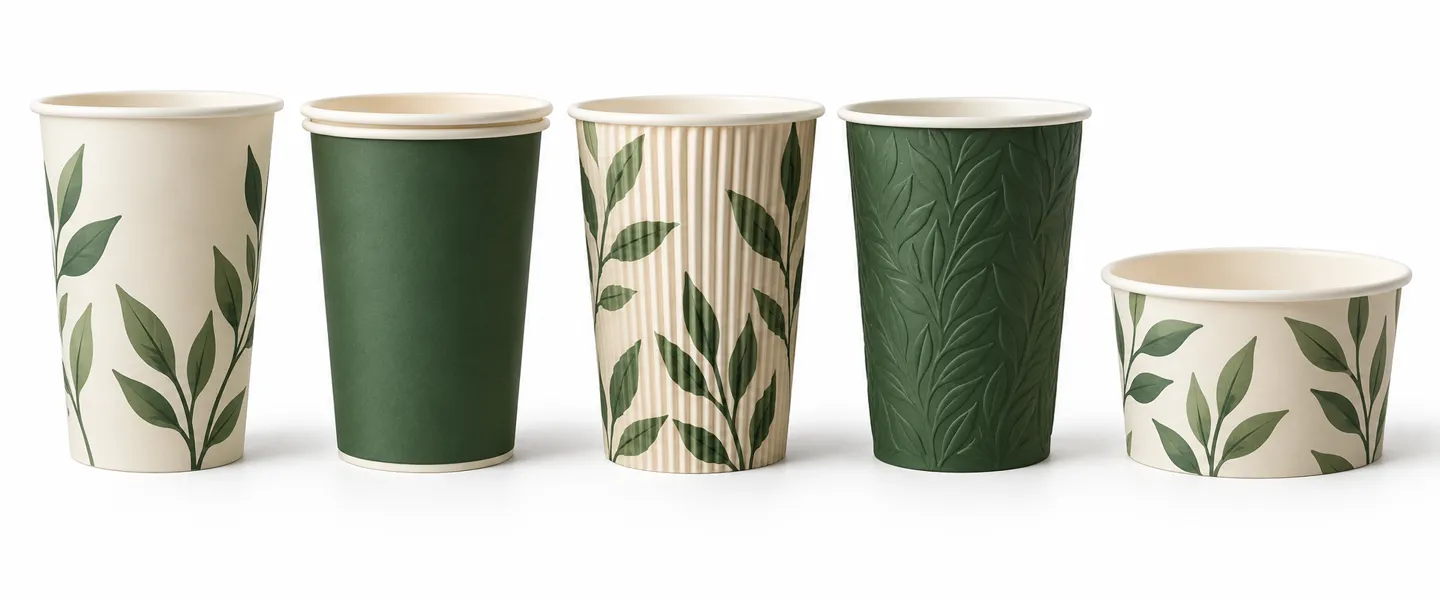
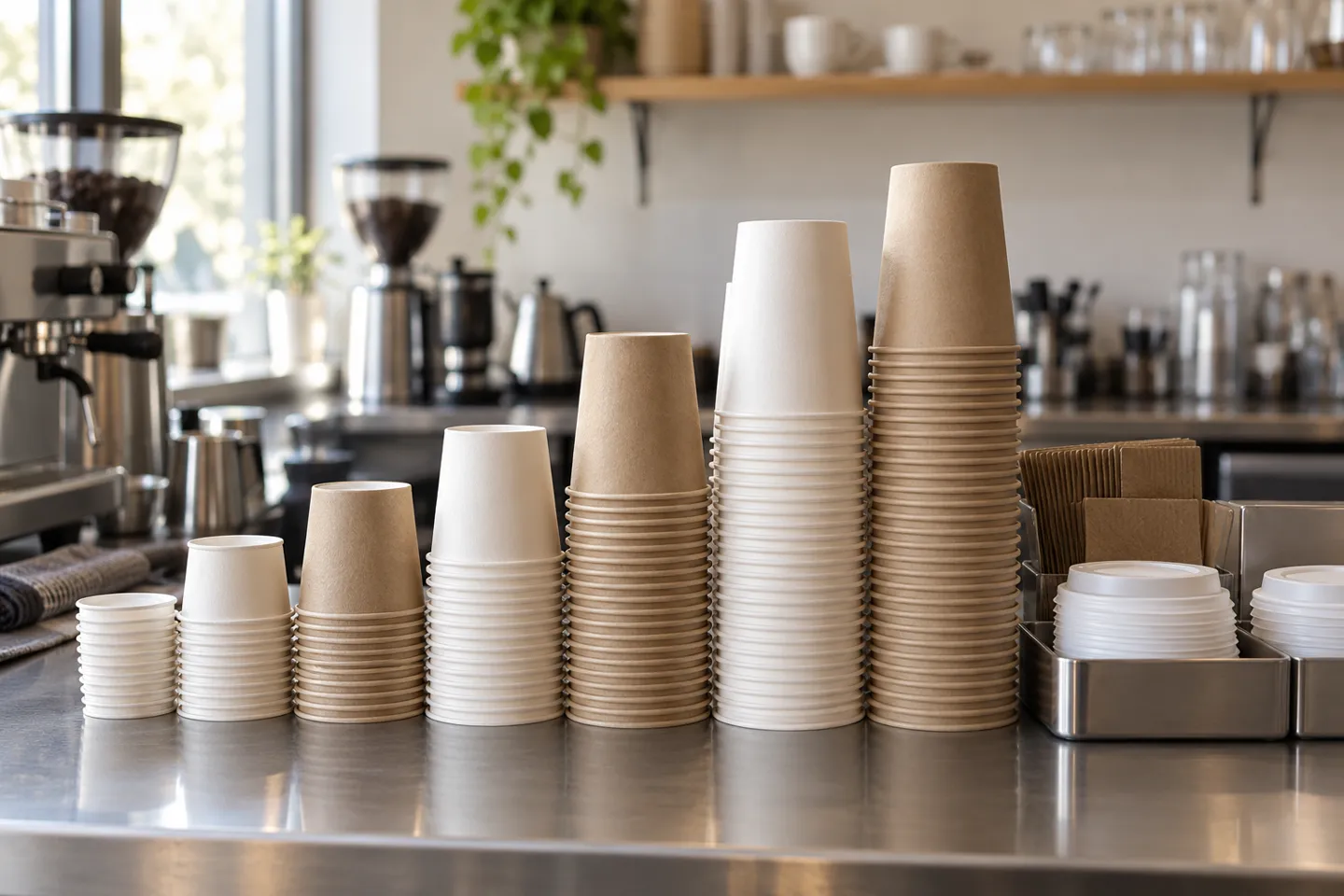
Single wall cups are the entry point: one layer of paperboard, 1 oz espresso sizes up to 26 oz, the widest size range and the lowest unit cost. Double wall cups bond a second paper layer with an air gap, so hot drinks stay hot and bare hands stay comfortable without a separate sleeve. Ripple wall cups add a corrugated outer layer, three plies total, for grip and insulation in one body. Embossed wall cups trade a textured outer wall for extra rigidity and compact stacking. Certain lines print up to eight colors with water-based inks on the embossed surface. Ice cream and dessert cups run shorter and wider, from 2 oz tasting sizes to 32 oz tubs, usually paired with dome or flat lids.
Cup Structures and Their Printing Notes
| Structure | Size range | Insulation | Printing note |
|---|---|---|---|
| Single wall | 1-26 oz | None, add a sleeve | Full CMYK and Pantone, lowest unit cost |
| Double wall | 8-20 oz | Air gap, sleeve-free | Standard printing, premium feel |
| Ripple wall | 8-20 oz | Corrugated grip | Texture sits under the print layer |
| Emboss wall | 4-20 oz | Rigidity and stackability | Up to 8 colors, water-based inks |
| Ice cream / dessert cups | 2-32 oz | Cold hold | Dome or flat lids, full-color wrap |
Printable zones have hard limits. The wraparound zone is standard, but the inner wall and the bottom of the cup cannot be printed. The cup is formed after printing, and no press contacts those surfaces afterward. Lid choice is a separate material decision with its own print logic. PS lids in black or white take simple marks; transparent PET dome lids generally stay clear; paper lids, increasingly common on soup and ice cream cups, accept printing well. The sleeve is a second print surface by design. A single wall cup with a printed sleeve carries your brand in two pieces that ship flat and assemble at the counter.
Food-contact rules run under all of this. Cup-grade inks are soy-based or water-based with low migration, so they stay in the coating layer instead of reaching the drink. Compliant materials carry FDA and LFGB food-contact documentation. If your market adds compostability requirements, PLA-coated and bagasse-based options exist. Confirm the certificate trail (FSC, BPI, DIN) for the exact product, not the product family, before you commit.
Container-Volume Decisions: Process, Full Coverage and Coatings
At container volume the questions change. Unit price stops being the headline; process fit, coating compatibility and failure modes move to the front, because a wrong choice at 200,000 cups is a wrong choice multiplied.
Where Flexo Ends and Offset Takes Over
The flexo-versus-offset decision is not a quality ranking. It is a cost-structure decision with three inputs: your artwork coverage, your color count, and your quantity.
Flexo plates are charged per color, and flexo runs fast enough that the plates amortize quickly at volume. That makes flexo the cheapest per-cup route for solid-color logos and full-wrap designs at roughly 20,000 pieces and up. The practical color ceiling sits around seven or eight colors, depending on the press. Offset carries lower plate-making costs and handles photographic CMYK plus Pantone spot inks, so it wins on image-heavy designs where gradients and skin tones matter. But offset’s speed advantage never arrives: for full-coverage artwork, factory experience favors flexo because it holds production stability better (Bioleader, 2026).
The matrix below is the actual decision tool, not the process names:
Artwork Type × Quantity: Process Decision Matrix
| Artwork type | Quantity band | Recommended process | Where it breaks |
|---|---|---|---|
| 1-2 color logo | 20,000+ pcs | Flexo | Below ~10,000 pcs the plate cost per cup stops amortizing |
| CMYK photo gradient | Mid volumes | Offset | Large full-coverage areas raise rub-transfer risk, so flexo or adjusted artwork wins |
| Multi-color + Pantone spots | 30,000+ pcs | Flexo, 7-8 colors | Past the color ceiling, merge inks or move the design to offset |
| Full-coverage single color | 10,000+ pcs | Flexo | Unstable on water-based coated stock with offset |
Coatings sit underneath this whole decision. Water-based (aqueous) coated paper normally prints flexo; PE and PLA laminated stock can run either route depending on the line (Bioleader, 2026). The trap is sequencing. Pay for plates before confirming the coating system your cups will use, and the chain reaction starts. A coating change can force a process change, and a process change invalidates the plates you already paid for.
Full-Coverage Artwork and the Ink-Rubbing Trap
Printed cups do not ship politely. They nest inside each other, dense and friction-locked, for weeks of transit. Full-coverage, multi-color artwork turns every nested contact into an ink-on-ink rub point, which is exactly why experienced factories push back on glossy full-bleed designs that look flawless as flat artwork.
Lead time at this scale is three numbers stacked, and buyers who conflate them miss launches. Production itself runs 25 to 30 business days at a serious factory (CupsPak, 2026). Local US printers quote around 15 days for short runs (Cupprint, 2026). Sea freight adds weeks on top, which is why wholesale exporters quote 3 to 6 weeks from order to delivery. The failure modes are predictable, and so are the countermeasures. Color disputes die with an approved physical sample. Plate refunds die with a coating confirmation before artwork handoff. Launch delays die with a lead-time budget that includes the ocean.
The Importer’s Math: From MOQ Tug-of-War to Process Matching
Read back through this chain and the importer’s operating logic falls out of it. When a café customer complains that “the MOQ is too high,” the complaint is not about a number; it is about an unmatched process. Respond with the trio: quantity, color count, coating system. A 2,000-cup request is not a failed flexo order, it is a digital print or stock-cup-plus-sleeve order that nobody has quoted yet. Separating those two conversations closes more deals than any discount.
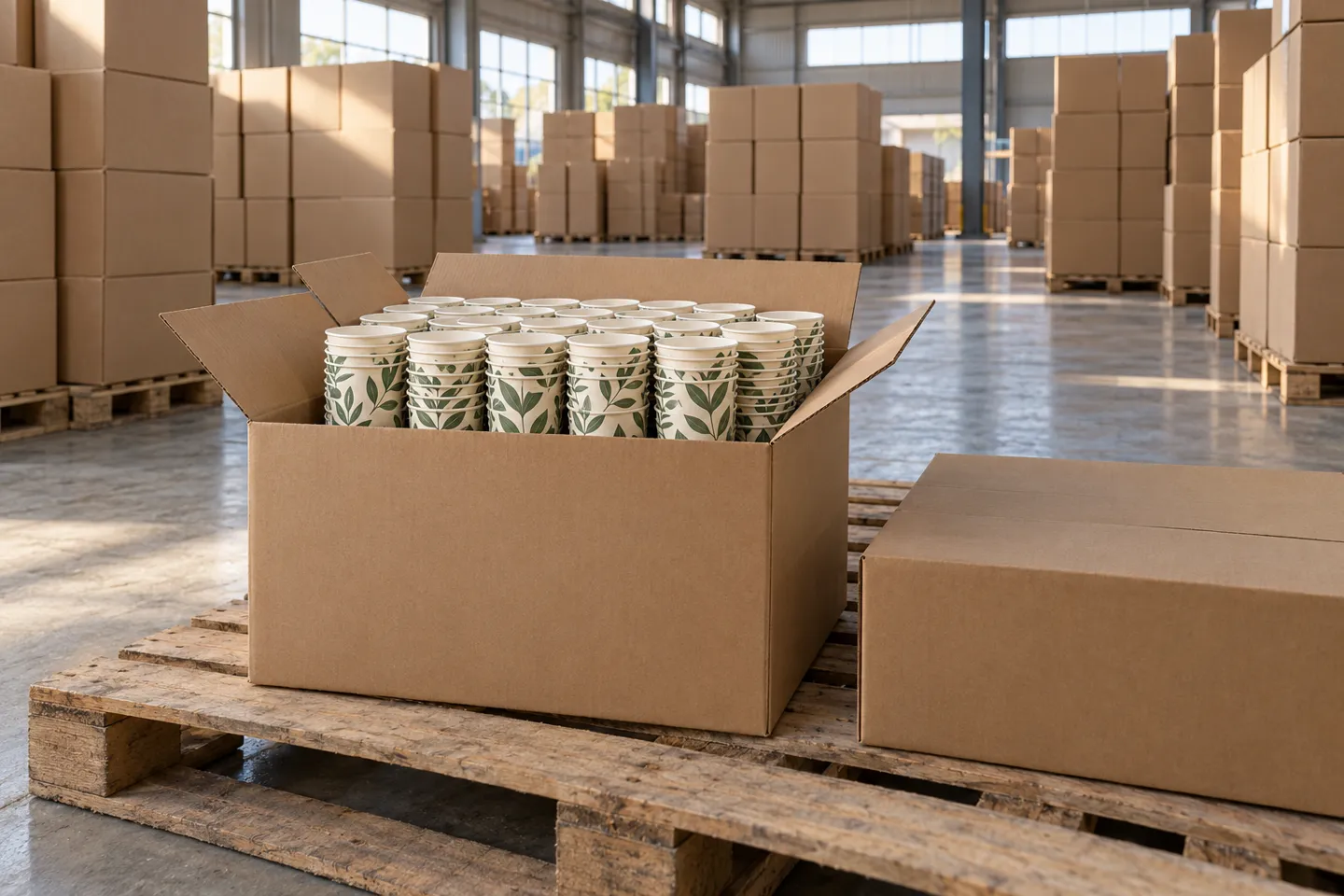
Group your stock the same way the production line does. Blank cups carry low minimums and fast turnaround; branded cups belong on flexo and offset runs at 30,000 pieces and up. Keeping the two inventories separate means a mid-season top-up order never waits behind a container production slot. Put the money terms in the quote from day one. Plate fees are charged once per size and design, custom printing carries a ±10% over/under run, and Pantone colors should be declared in writing. Terms printed on the quote are a filter; terms discovered at delivery are a dispute.
The same logic scales across the catalog. Bowls, food boxes and paper bags run on comparable print lines. Importers therefore mix cups with containers and bags in one 20’GP or 40’HQ load, amortizing freight across the category instead of paying it four times.
If you are sorting supplier quotes for private-label cup programs, this is where it pays to work with a factory that runs both processes. We print flexo and offset under one roof, so the process is matched to your quantity, colors and coating before the quote rather than after the complaint (YoonPak, 2026). In practice that means CMYK and Pantone on the same run, an eight-color water-based embossed line for premium walls, and a one-time plate fee instead of a per-order charge. It also means operational support you can plan around. Digital proofs arrive within one business day, physical samples ship out in about 48 hours, and standard printed orders deliver in 3 to 6 weeks. Production capacity of up to 16 billion cups a year stands behind that schedule.
Benchmark a Factory-Direct Quote on Your Next Cup Order
YoonPak sizes flexo or offset to your quantity, colors and coating before quoting, with digital proofs back in one business day.
Get a Custom Cup QuoteReferences
- Fresh Cup. “With A 50-Cup Minimum, LogoCup Makes Custom Cups Doable for Any Occasion.” 2026. freshcup.com/with-a-50-cup-minimum-logocup-makes-custom-cups-doable-for-any-occasion/
- Cupprint. “Custom Printed Paper Cups | Made in USA.” 2026. cupprint.com/us/
- Reddit, r/smallbusiness. “Logo cups with lower MOQ?” 2025. reddit.com/r/smallbusiness/comments/1jqk8c0/logo_cups_with_lower_moq/
- Reddit, r/smallbusiness. “Coffee Shop Owners.” 2019. reddit.com/r/smallbusiness/comments/b2cdh4/coffee_shop_owners/
- Reddit, r/smallbusiness. “Cups with logo are so expensive!” 2019. reddit.com/r/smallbusiness/comments/bct3hy/cups_with_logo_are_so_expensive/

 English
 German
 Spanish
 Italian
 Dutch
 French
 Portuguese
 Russian
 Arabic
 Korean