

Are Coffee Cups Recyclable? The Answer Depends on the Lining
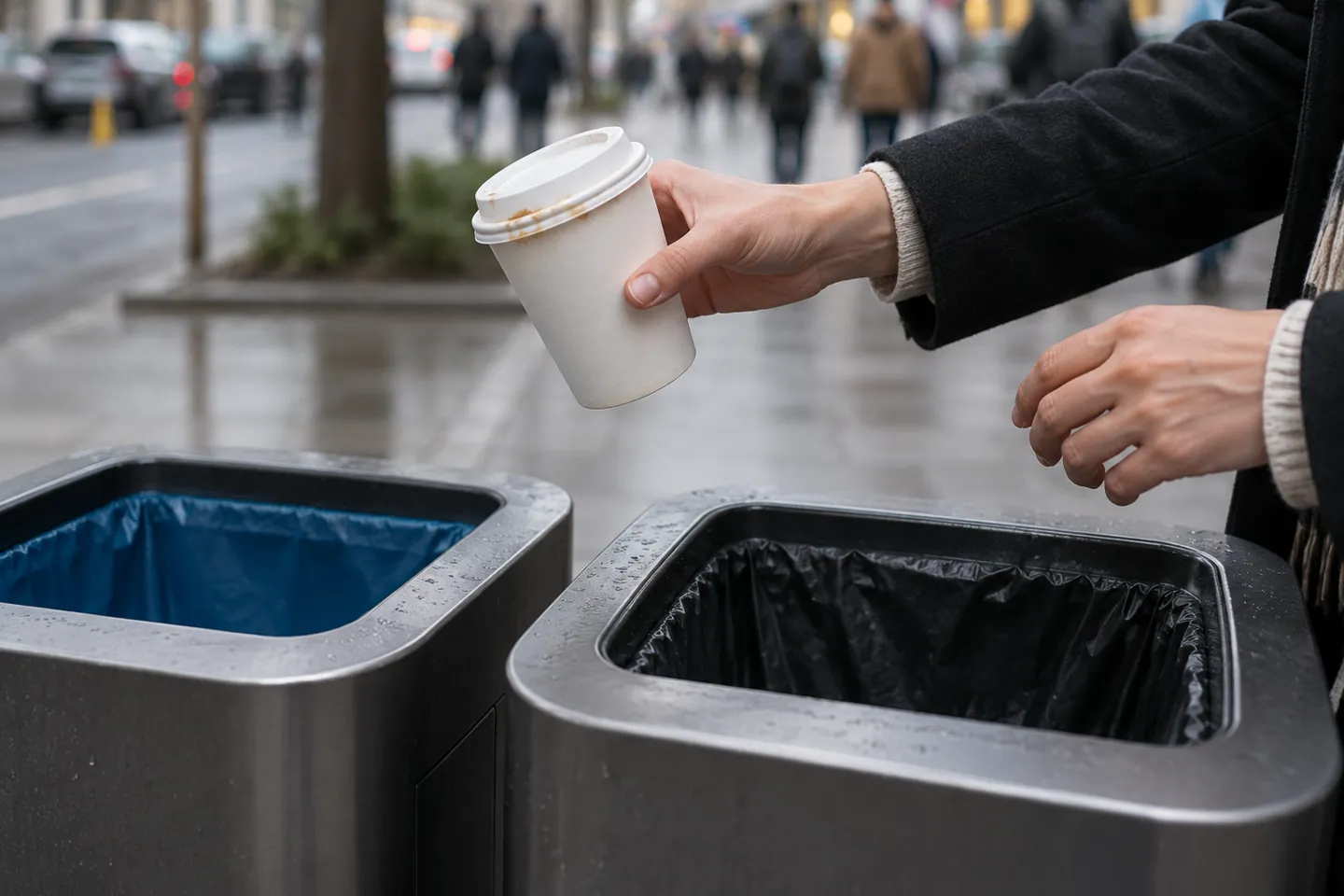
A customer finishes a flat white, snaps the lid back on, and stops between two bins. The cup feels like paper, prints like paper, tears like paper. In most cities it still cannot go into the paper bin, and the reason hides in a layer thinner than a business card.
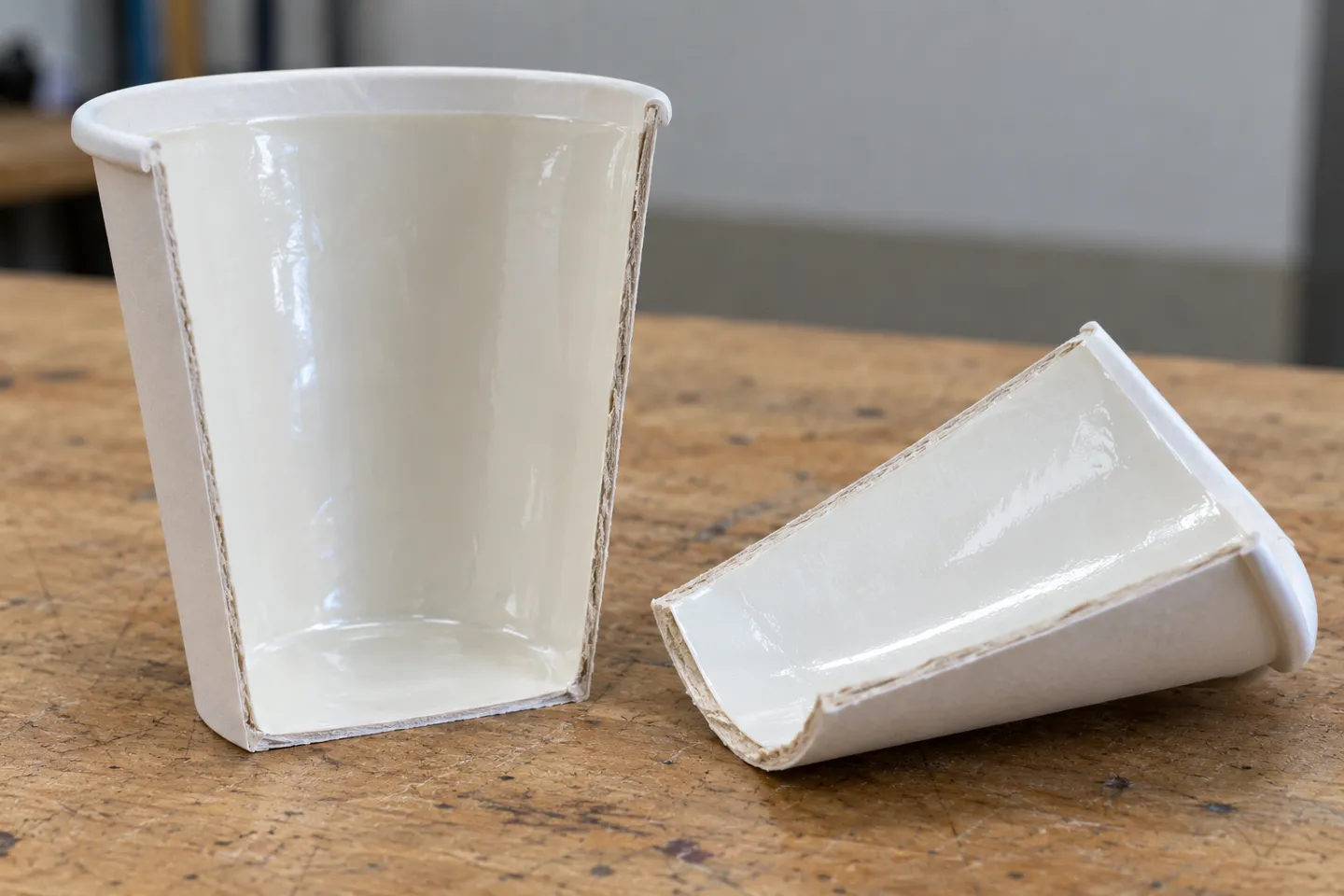
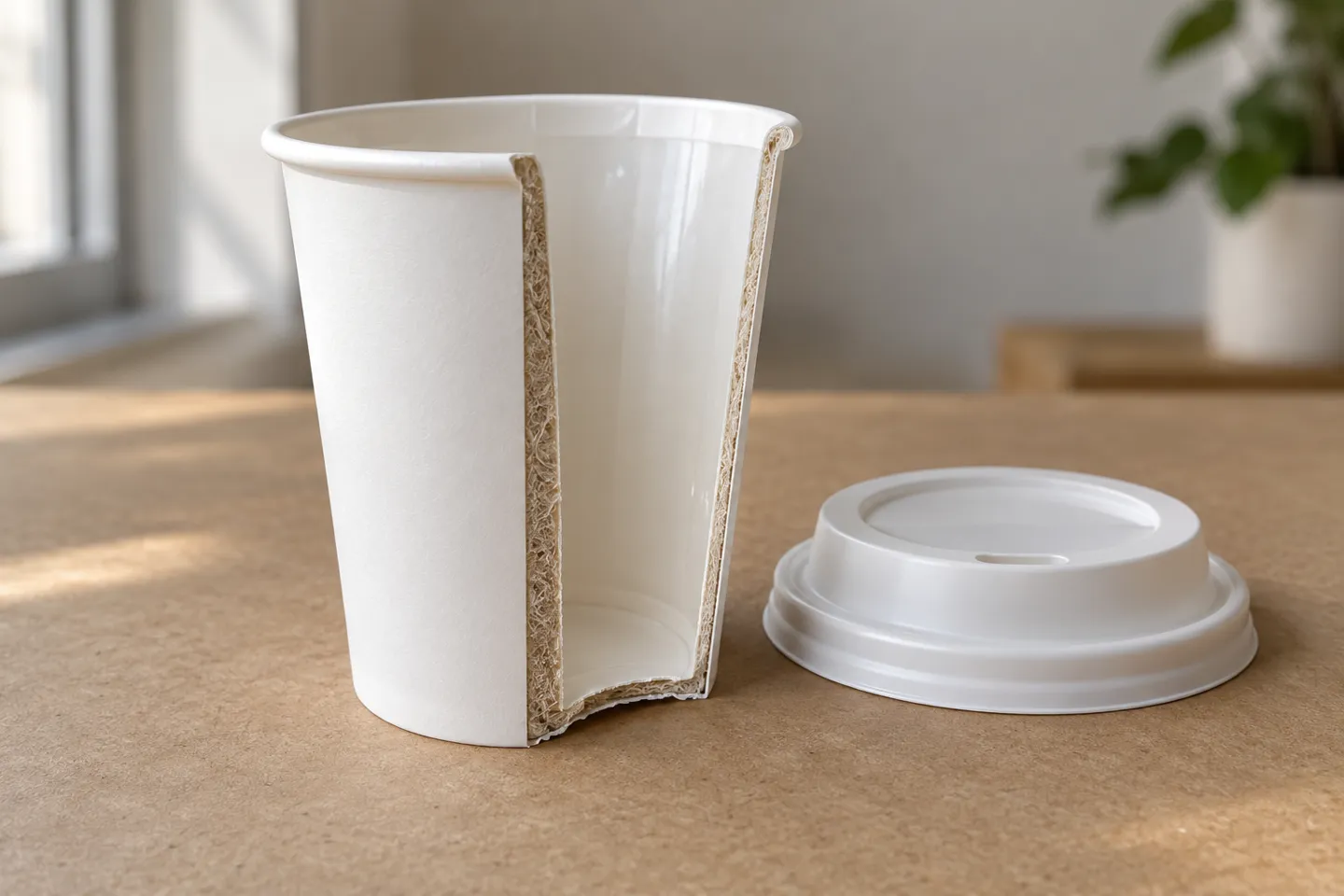
A hot-drink cup is paperboard, typically 170 to 320 grams per square meter, wrapped around a polyethylene lining. Commercial spec sheets write the combination as 300 gsm + 18PE: 18 grams of PE film per square meter. The fiber gives the wall its stiffness. The film stops the leak. Neither does its job without the other.
That partnership is exactly what defeats paper recycling. A paper mill reclaims fiber by soaking paper in water and beating it apart into pulp. Polyethylene ignores water. If the film stays attached, it rides along as plastic contamination in a bale of paper pulp. Historically, mills would rather reject the load than let the film through, which is why generations of coffee drinkers were told a paper cup belongs in the trash.
One clarification, because “coffee cup” names two different objects. A ceramic mug, a glass tumbler, or a stainless travel cup is a durable product. Those live for years and, at end of life, follow the metal, glass, or rigid plastic streams. This article is about the disposable takeaway cup, the kind that holds a drink for twenty minutes and then becomes somebody’s disposal problem.
Everything about where that cup ends up follows from one decision made at the factory: what the lining is made of. Four lining types are in commercial use today, and each one takes a different path after the last sip.
The Four Lining Types and Where Each One Actually Ends Up
The lining is small, often under 5 percent of the cup’s weight, but it decides the cup’s entire afterlife. Here is the full map, including the two linings most buyers have never been told about.
PE Lining: The Standard That Mills Learned to Handle ⭐
Polyethylene lining is the default for hot cups across the industry, and it earned that position honestly. It survives boiling liquids, it seals the side seam, and it adds almost nothing to the weight or the price. The problem was never performance. The problem was that mills had no economical way to separate an 18 gsm film from the fiber around it.
That is changing. Facilities that re-pulp cups with the right equipment can separate the coating during the recycling process, and the number of mills accepting cups keeps growing. The machinery is real, but the coverage is uneven, which turns the question “is a PE cup recyclable” into a per-city lookup rather than a yes-or-no answer.
One habit worth breaking: the lid is not the cup. Most hot-cup lids are polystyrene (PS), one of the least recyclable common plastics. Judging the whole drink by the cup body while sending a PS lid along with it gets the answer wrong either way.
Wax Lining: The Legacy Route Nobody Mentioned
Before polyethylene took over, cold-drink cups were sealed with paraffin wax. Wax is food safe and it works fine for cold sodas and water, which is why it dominated mid-century vending. It has two fatal weaknesses for modern use. It softens near hot beverages. During repulping it does not disperse cleanly either, so wax-coated stock is only usable at facilities that specifically handle it. Wax cups still circulate in some cold-chain markets, and they still get advertised as plain paper cups. Neither the advertisement nor the bin is honest about what happens next.
PLA Lining: Plant-Based, but Not Paper
Polylactic acid is a polymer made from plant starch, most often corn. Because it is not petroleum-based, it gets marketed as the green lining, and in one specific end-of-life scenario that marketing is true. PLA breaks down in industrial composting, where sustained temperatures sit around 58 C, which is far hotter than a backyard bin ever gets (Michigan State University Extension, 2026). Certification standards encode exactly this: EN 13432 in Europe and ASTM D6400 in North America both certify a product for industrial composting, not for a home heap.
Outside that facility, the story flips. A PLA-lined cup in a paper recycling stream is a plastic contaminant, the same as PE. A PLA cup in a home compost bin sits largely intact for a very long time. And a PLA cup in a city with no industrial composter goes to landfill, just in a plant-based costume. PLA only delivers its promise where an industrial composter actually accepts it, and that coverage is thinner than most buyers assume.
Water-Based Coating: Designed to Be Recycled as Paper
The newest option attacks the problem at the source. Water-based barrier coatings replace the PE film with a dispersion that disperses during repulping. The mill then treats the cup as ordinary paper, with no separation step at all (Michelman, 2026). Coated cups built this way have passed mill repulping trials and are entering commercial lines now.
The honest caveat: repulpable does not automatically mean recycled. A technically recyclable cup still needs a local collection system that accepts it, and many municipal guidelines predate the coating and have not caught up. Buyers who choose this route should verify acceptance in their target market rather than assume the technology carries the claim by itself.
The Lid, the Sleeve, and the Straw: Separate Fates
A drink order is three objects with three destinies. The sleeve is plain paper and belongs in the recycling bin almost everywhere. The straw, if paper, follows the sleeve; if plastic, it follows local plastic rules or the trash. The lid is the complicated one. PS lids are the worst case and effectively unrecyclable in most systems. Polypropylene (PP) lids and cups are moving in the opposite direction. In early 2026 Starbucks announced that its PP cold cups earned a widely recyclable designation, expanding curbside access to more than 60 percent of U.S. households (Starbucks Stories, 2026). PET clear lids and cups ride the PET bottle stream where PET is collected. Paper lids, newer still, are designed to die with the cup. When a customer asks whether the cup is recyclable, the accurate answer is a sentence per component, not one word for the drink.
Four Linings, Four End-of-Life Paths
| Lining | Source | End-of-life path | The condition that decides it |
|---|---|---|---|
| PE film | Petroleum-based plastic | Paper recycling where mills separate coating | Mill coverage is city-by-city; check the local list |
| Wax | Paraffin, legacy | Specialized handling only | Almost no standard facility accepts it |
| PLA | Corn starch polymer | Industrial composting | Facility must exist and accept it; ~58 C required |
| Water-based coating | Polymer dispersion | Paper recycling as normal fiber | Local guidelines must accept coated cups |
Recycling Is Local: Why the Same Cup Gets Four Different Answers
Ask whether a paper cup is recyclable in Denver, in London, and in a city with no industrial composter, and you will collect three correct, contradictory answers. The cup did not change between the questions. The infrastructure did. Recyclability is not a property printed on the cup; it is a property of the facility network around the bin.
North America is the fastest-moving case. About 40 paper mills across the continent now accept paper cups, and ten cities, including Atlanta, Denver, New York, San Francisco, and Seattle, list them in curbside programs (AF&PA, 2025). One caution on that source. AF&PA is a trade association with a stake in the answer, so treat the trend as directionally real and verify city by city before repeating it on packaging.
North America: the mill map is moving
40
paper mills accepting cups (2025)
10
cities with curbside access
2025-2026: the list is still growing.
The United Kingdom runs a different design. Household collection generally does not accept cups, but large coffee chains take them back at the counter for dedicated recycling (Recycle Now, 2026). Neither system is better in the abstract. They are different collection networks, and each only works when people know which one they are standing in.

Composting coverage is thinner still. A PLA cup’s promise only exists where an industrial composter operates and accepts food-service packaging, and many regions have neither. In those places every lining, plant-based or not, ends up in the same landfill.
The whiplash has a source. In 2018, a UK parliamentary inquiry counted fewer than 1 in 400 of Britain’s 2.5 billion annual disposable cups as recycled (UK House of Commons Environmental Audit Committee, 2018). Most of what the internet still says about cups was written inside that era.
Since 2025, roughly 40 paper mills across North America already recycle paper cups, and ten cities have put them on curbside lists. The line “paper cups cannot be recycled” in an older article is expiring. That cuts both ways for anyone in the beverage business: the shelf-stable answer you memorized in 2018 is now wrong in some cities and still right in others. The only durable habit is checking your local hauler’s current accepted list, and re-checking it once a year.
When one program spans cities with different recycling rules, YoonPak quotes lining type, certification numbers, and end-market acceptance per lining line.
Request a market-specific quoteChoosing Cups by Market: North America, Europe, and the Middle East
A single lining specification cannot serve three markets with three different infrastructures. Buyers who treat “eco-friendly” as one product category end up with a warehouse full of the wrong certification for the wrong city. The workable approach is to split the program by market and let local end-of-life reality pick the lining.
North America: PE Cups Are Sellable, Claims Are Local
PE-lined cups remain a sound buy for U.S. and Canadian programs. The mill list is growing and the cups are the cheapest to a workable specification. What must stay local is the claim. Recyclable is true in Seattle and not yet true across the state line, so packaging text should follow the hauler’s current list rather than a national average. Two upgrades travel well everywhere: swap PS lids for PP or paper versions, and specify a water-based coating where the supply chain has matured for your volume.
Europe: Compliance Pressure Favors Certified Lines
Europe changes the calculus twice. First, the Single-Use Plastics Directive regulates products by polymer content, not by origin. Its definition covers plant-based polymers, so a PLA-lined cup is still legally a single-use plastic product in the EU (European Commission, 2026). Second, green-claims enforcement is tightening, which puts unverified environmental marketing on the liability list. The European line therefore rewards documented choices. Ask for EN 13432-certified products where the channel actually reaches an industrial composter. Ask for paper lids and fiber-based accessories where they exist. Put lining specifications in writing rather than taking them from a sales page. Buyers who skip the paperwork step are the ones who later discover their “100% plastic-free” cups were coated all along.
The Middle East and Other Markets: Plan Around Thinner Infrastructure
Cup recycling lines and industrial composters are both scarce across much of the Middle East, and import regulations vary by country. Copying a European compliance playbook there buys certifications that no local facility can honor. The honest sequence is reduction first: reuse programs where operationally possible, lighter cups, lids only on request. Where single-use is unavoidable, the lining choice matters less than the volume. Optimize for the disposal path the city actually has, which today is usually landfill. Say so internally rather than importing a claim the infrastructure cannot cash.
What to Ask a Supplier Before You Commit
Whatever the market, four fields belong on the purchase order as written requirements, not verbal assurances. Lining type and weight, in grams per square meter, so the claim matches the physical product. Certification numbers, including the certifying body, so EN 13432 or BPI claims can be checked against a registry. End-market verification, meaning evidence that facilities in the destination city actually accept the product, not a generic recyclability logo. And order terms per lining line. Minimum order quantities and lead times usually differ between PE, PLA, and coated lines, and a program that blends markets needs both tracked separately.
Market Playbook: Lining Routes and Claim Boundaries
| Market | Recommended lining route | The route holds when | Claim boundary |
|---|---|---|---|
| North America | PE for volume; PP or paper lids; water-based where mature | Mill list keeps growing; hauler accepts locally | Recyclable only city-by-city, never nationwide |
| Europe | EN 13432-certified lines; paper lids and accessories | Industrial composter reachable by the channel | PLA still counts as single-use plastic; claims need documented certification |
| Middle East | Reduction and reuse first; lining secondary | Volume unavoidable only | No imported claims; state the real disposal path internally |
| No-infrastructure market | Lightest cup, lids on request | Always | No environmental claims; internal honesty instead |
What You Can and Can’t Claim About Your Cups
The words recyclable, compostable, and biodegradable are regulated claims in most developed markets, and each one carries a condition attached. Recyclable requires a system that actually collects and reprocesses the item. Compostable requires certification plus a facility that accepts it. Biodegradable is so loose that several jurisdictions discourage it outright. The condition travels with the word; a claim printed without its condition is the sentence a regulator reads first.
Real purchases have already gone wrong on this exact point. A European sourcing professional described asking manufacturer after manufacturer for a truly plastic-free cup after new single-use rules took effect. Nobody could state what their coating actually was (r/ZeroWaste, 2024). Wax-lined cups spent decades advertised as paper cups and ended up recyclable almost nowhere. Compostable cups ordered for venues without industrial composters went to landfill with an eco label still visible on the lid. Three different claims, one identical failure mode: the statement outran the conditions.
Three checks keep a claim inside its boundary, and all three happen before the artwork goes to print. Verify the certification number against the issuing body’s registry. Confirm that facilities in the destination city accept the product today, by name of the facility or the hauler’s current list. Check the destination market’s current advertising rules, because green-claims enforcement in Europe and parts of North America now reaches packaging language. A claim that survives all three checks is safe. A claim that fails any of them is a refund waiting to happen.
Before printing any eco claim
- 1Certification number verified in the issuer’s registry.
- 2Destination facility confirms acceptance today.
- 3Destination market’s green-claims rules checked.
The pattern behind every failed claim is the same. Someone chose the strongest available sentence instead of the truest one. The truest sentence is shorter, weaker-sounding, and survives contact with an inspector or a skeptical customer.
Running a Cup Program Across Markets
Everything above collapses into three operating rules for anyone importing or stocking cups at scale.
Split the program by market, not by supplier catalog. The North American line runs PE with PP or paper lids. The European line runs certified compostable products with fiber accessories. Markets with thinner infrastructure get reduction measures, lighter weights, and lids on request. One lining across all three markets is not a simplification; it is a guarantee that at least one line’s end-of-life story is false somewhere.
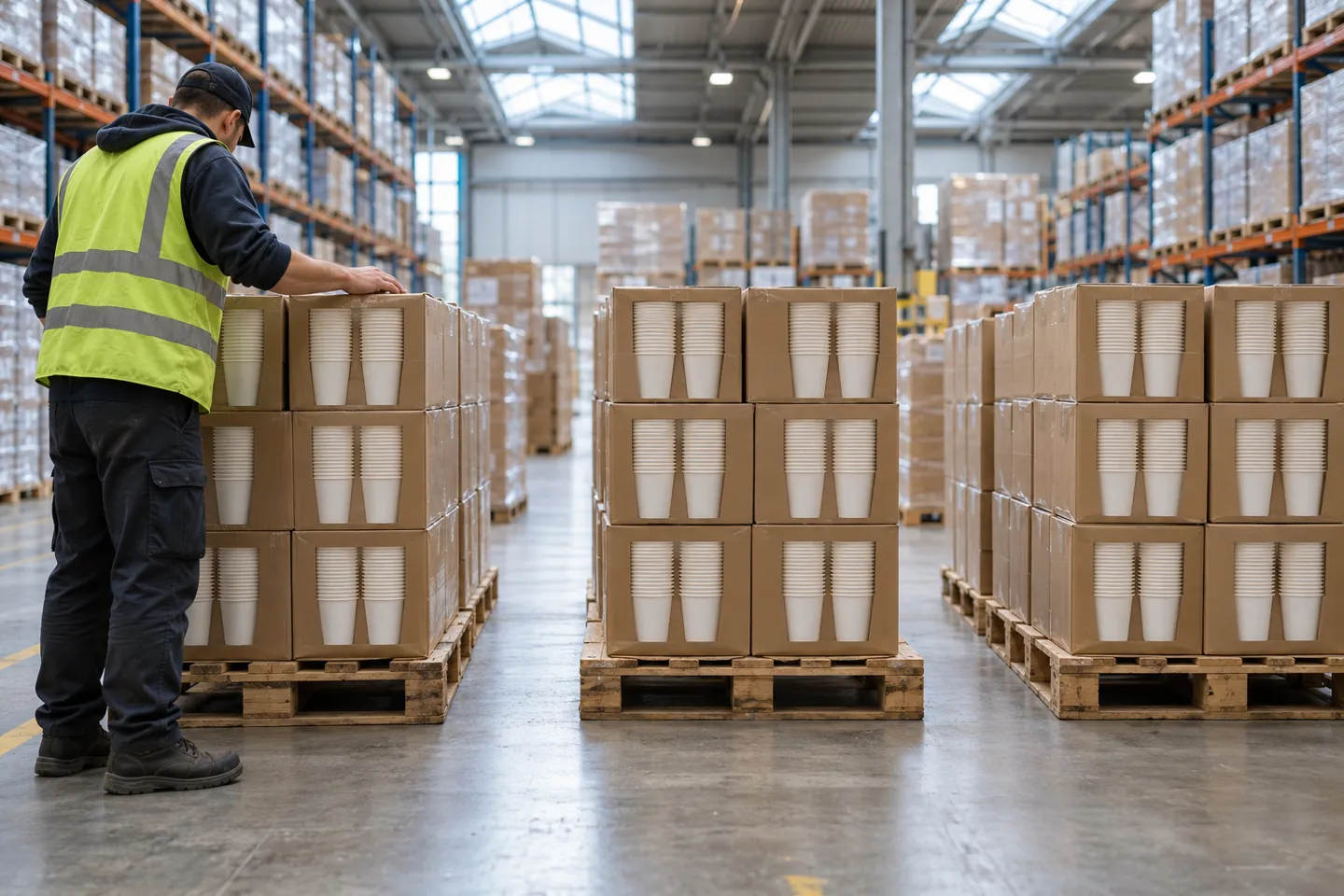
Treat verification as a living field. The mill list moved this year and the enforcement climate moves every quarter, which means the claim you verified at container-booking time can drift before the goods land. A review cycle, annually or per order, keeps the program aligned with the infrastructure it depends on.
Tilt inventory toward certified lining lines over time. PE volume lines remain the workhorse where infrastructure supports them. Certified compostable lines earn their premium in channels that reach industrial composters. Accessories migrate toward paper wherever acceptance exists. The direction of the shift is set by infrastructure, and infrastructure is currently moving toward mills that handle coated fiber.
Supplier self-check before the next order
- Lining type and weight stated in gsm.
- Certification numbers verifiable in issuer registries.
- End-market acceptance confirmed for the destination city.
- MOQ and lead time quoted per lining line.
Our own lines follow exactly this structure. PE and water-based coated cups cover volume markets. EN 13432-certified PLA lines with matching PLA lids cover channels that reach industrial composters. Paper lids and sleeves cover the rest of the range. We publish the BPI, DIN CERTCO and FSC certifications behind the fiber we buy (YoonPak). We hold lining weights and certification numbers in every quotation, and we quote MOQ and lead time per lining line so a mixed-market program can be split honestly. Where a market has no facility that can honor a claim, we say so in the quotation instead of printing a logo.
And the rule that closes the loop belongs to the shop counter, not the warehouse. When a customer asks whether the cup is recyclable, the most convincing answer is the most specific one available: the city, the facility, the current list. Specific answers age slowly. Optimistic ones expire.
Source cups that match your market’s end-of-life reality
PE, water-based coated, and EN 13432-certified PLA lines, documented with BPI, DIN CERTCO and FSC certifications, quoted with MOQ per lining line.
Start your custom cup quoteReferences
- AF&PA. “Can Coffee Cups Be Recycled?” 2025.
https://www.afandpa.org/news/2025/can-coffee-cups-be-recycled - Recycle Now. “Paper Coffee Cups.” 2026.
https://www.recyclenow.com/recycle-an-item/paper-cups - UK House of Commons Environmental Audit Committee. “Disposable Packaging: Coffee Cups.” 2018.
https://publications.parliament.uk/pa/cm201719/cmselect/cmenvaud/657/657.pdf - Michigan State University Extension. “Compostable Packaging: A U.S. Packaging Producer’s Guide to the New Rules and the Science Beneath Them.” 2026.
https://www.canr.msu.edu/resources/compostable-packaging-a-u-s-packaging-producer-s-guide-to-the-new-rules-and-the-science-beneath-them - European Commission. “Single-Use Plastics.” 2026.
https://environment.ec.europa.eu/topics/plastics/single-use-plastics_en - Michelman. “Solutions for Recyclable Hot Beverage Cups.” 2026.
https://www.michelman.com/about-us/thinking-ahead/recyclable-hot-cup-solutions/ - Starbucks Stories. “Polypropylene Cups Earn Widely Recyclable Designation, Expanding Access to Curbside Recycling Nationwide.” 2026.
https://about.starbucks.com/press/2026/polypropylene-cups-earn-widely-recyclable-designation-expanding-access-to-curbside-recycling-nationwide/ - Reddit r/ZeroWaste. “Are Disposable, Real Plastic-Free Cups Possible to Make?” 2024.
https://www.reddit.com/r/ZeroWaste/comments/1b3ra1d/are_disposable_real_plastic_free_including/



 English
 German
 Spanish
 Italian
 Dutch
 French
 Portuguese
 Russian
 Arabic
 Korean