

Coffee Cup Materials Explained: What Every Layer Does and What to Ask Your Supplier
Inside a Disposable Coffee Cup: The Four Material Layers
Pry the lid off a takeaway flat white and tip it toward the light. You are not looking at a paper cup. You are looking at a laminate: printed ink outside, paperboard in the middle, a plastic film sealed inside, and a lid matched to a specific rim diameter. Every purchase order that ends well names all four of those layers. Every complaint about a leaking or soggy cup traces back to one of them.
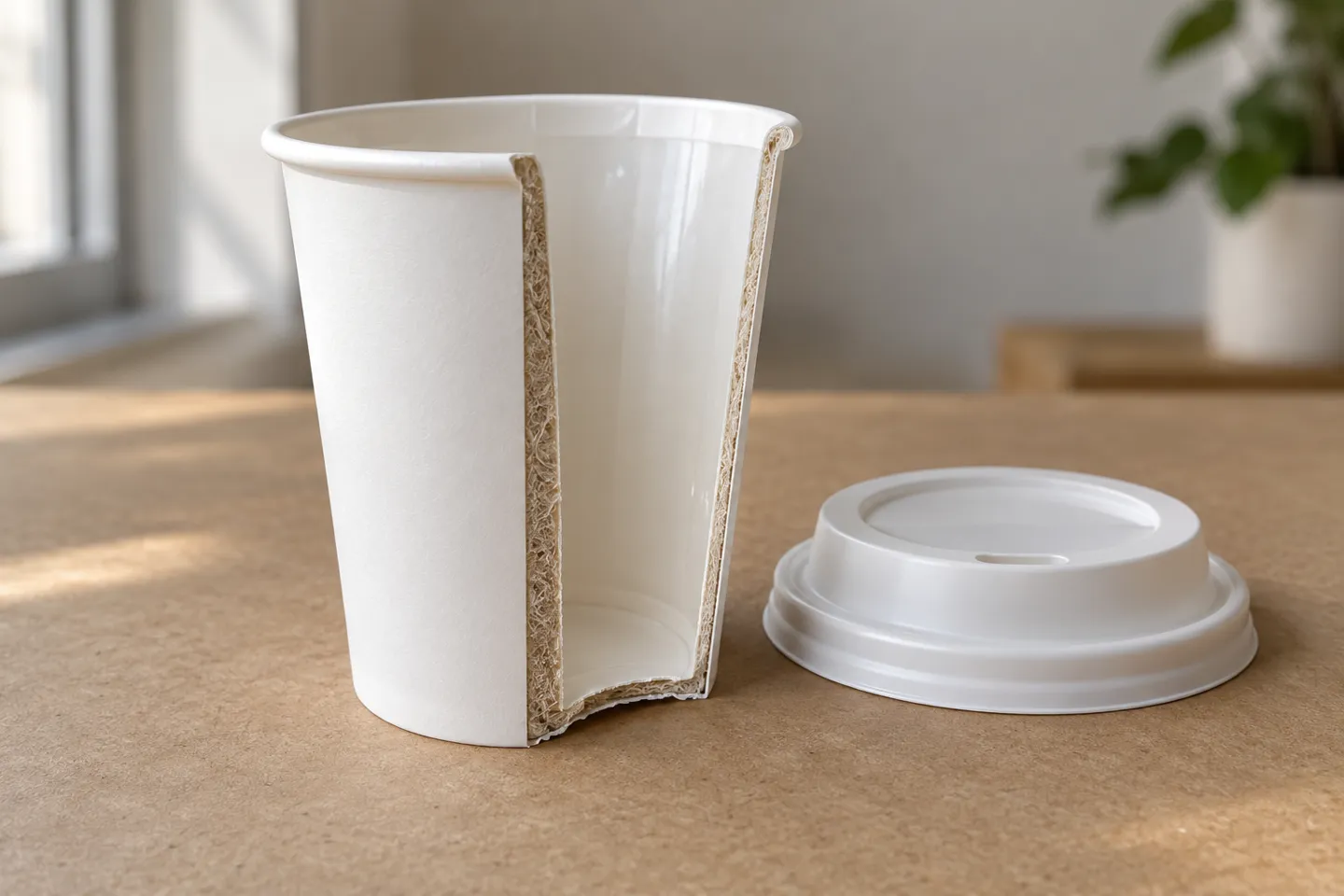
One clarification before the layers, because search results mix two different worlds. The mug you keep at your desk is ceramic, glass, or stainless steel, and its material questions are about taste and durability. A disposable coffee cup is a food-contact packaging system, and its material questions are about leak prevention, heat, compliance, and cost per unit. This article stays with the second world, because that is where buying decisions live.
The four layers, outside in:
- Ink and print layer. Food-grade soy-based or water-based inks, chosen for low migration so the print never flavors the drink.
- Paperboard body. Food-grade board, typically 160 to 320 gsm across common cup sizes, with heavier board on larger cups for wall strength (published manufacturer specification).
- Inner lining. A thin polymer coating, most often around 18 gsm of polyethylene (PE), that makes the cup waterproof. Paper does not hold liquid; the lining does.
- Lid and accessories. Usually PS plastic matched to the rim diameter, with separate hot and cold designs.
Food-contact safety is a property of the whole stack, not the paper alone. Regulators treat it that way. In the United States, paper and paperboard components that touch food fall under 21 CFR Part 176 (eCFR). In the EU, materials must meet the framework regulation’s safety requirements, with FDA and LFGB standards as the usual commercial benchmark. When you evaluate a supplier, you are evaluating all four layers together. That is why this article moves from paper to lining to lids, then to the paperwork that proves the claims.
Base Paper and Wall Structure: What Each Choice Changes
Walk into any café supplier’s catalog and the cups sort along two axes: what the board is made of, and how many walls it has. Neither axis is a quality ranking. Both are trade-offs you can price.
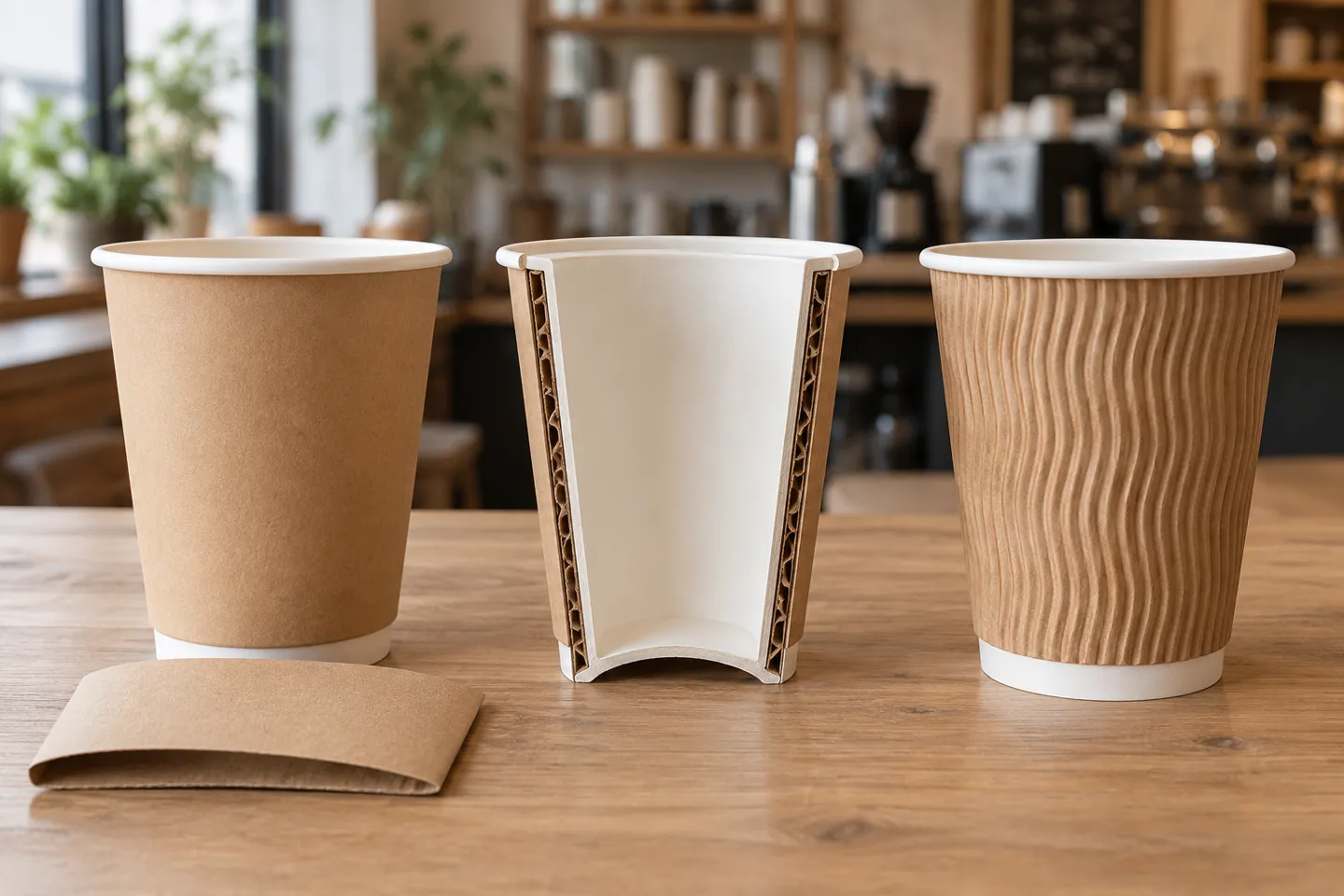
On the base material axis, bleached virgin board prints the sharpest logos and is the default for branded cups. Unbleached kraft board skips the bleaching step, which gives the natural brown look many bakeries and roasters want, though color printing competes with the brown substrate. Bagasse, the fiber left after sugar extraction, appears mostly in molded bowls and containers, and it carries the strongest plant-based story of the three.
On the structure axis, the differences are all about where the air goes. A single wall is one layer of board: light, cheapest, and hot to hold, which is why it usually pairs with a sleeve. A double wall bonds a second board layer with a trapped air gap, so the cup insulates itself. A ripple wall corrugates that outer layer, adding grip. An embossed triple wall pushes insulation further for the longest holds.
| Option | What it changes | The trade-off |
|---|---|---|
| Bleached virgin board | Sharpest print, cleanest brand canvas | None functional; premium look is the point |
| Unbleached kraft board | Natural, artisan look | Muted color printing on brown ground |
| Bagasse | Plant-based story, compostable | Mostly bowls and containers, not hot cups |
| Single wall | Lowest unit cost, lightest | Hot in hand; budget a sleeve |
| Double wall | Insulates via air gap, no sleeve needed | More material, higher unit price |
| Ripple wall | Insulation plus grip texture | Highest perceived bulk |
| Emboss (triple) wall | Maximum heat barrier | Premium tier, less common |
The real-world tiebreaker is the sleeve budget. Café owners on r/coffeeshopowners report switching to ribbed or double-wall cups precisely because it “saves having to get sleeves” (r/coffeeshopowners, 2025). If you sell mostly takeaway, insulation built into the wall is often cheaper than insulation purchased as an accessory. If your cups ride in carriers or get bagged quickly, a single wall plus sleeve can still win on cost.
The Lining Decision: PE, PLA, or Water-Based Coating
Now the layer that actually holds your coffee. Three coating systems dominate the market, and the choice is genuinely three-way because each one fails differently.
PE lining: the proven default
PE is a film of polyethylene laminated onto the board, around 18 gsm on standard cups. Larger 20 to 26 oz sizes carry double-sided coating, where both faces need protection (published manufacturer specification). It seals reliably, handles boiling drinks without softening, and every cup-forming line in the world is set up to run it. Its weakness is end of life: the fused plastic film is why a paper cup rarely rides a standard paper recycling stream.
PLA lining: compostable, with conditions
PLA is polylactic acid, a biopolymer derived from plant starch, usually corn. Its commercial promise is compostability, and its certification path runs through BPI or DIN marks. Read the conditions before you buy the story. PLA composts in industrial facilities, not in a backyard bin or a landfill, and those facilities depend on your local market. The newer evidence is less comfortable. A 2026 University of Queensland study found PLA-lined cups released roughly 12 times more particle mass than PE-lined cups in hot water (University of Queensland, via Phys.org, 2026). That is about 4.3 million nanoparticles per milliliter, versus 2.7 million for PE. The lead researcher’s own framing matters: this does not mean PLA is inherently unsafe, and the health effects of these particles remain unclear. What it does mean is that “biodegradable” describes one end-of-life scenario, not the cup’s behavior in your customer’s hand at 90 degrees Celsius.
The compostability trade-off, measured in hot water
University of Queensland particle-release study, 2026.
Water-based coating: the newer option
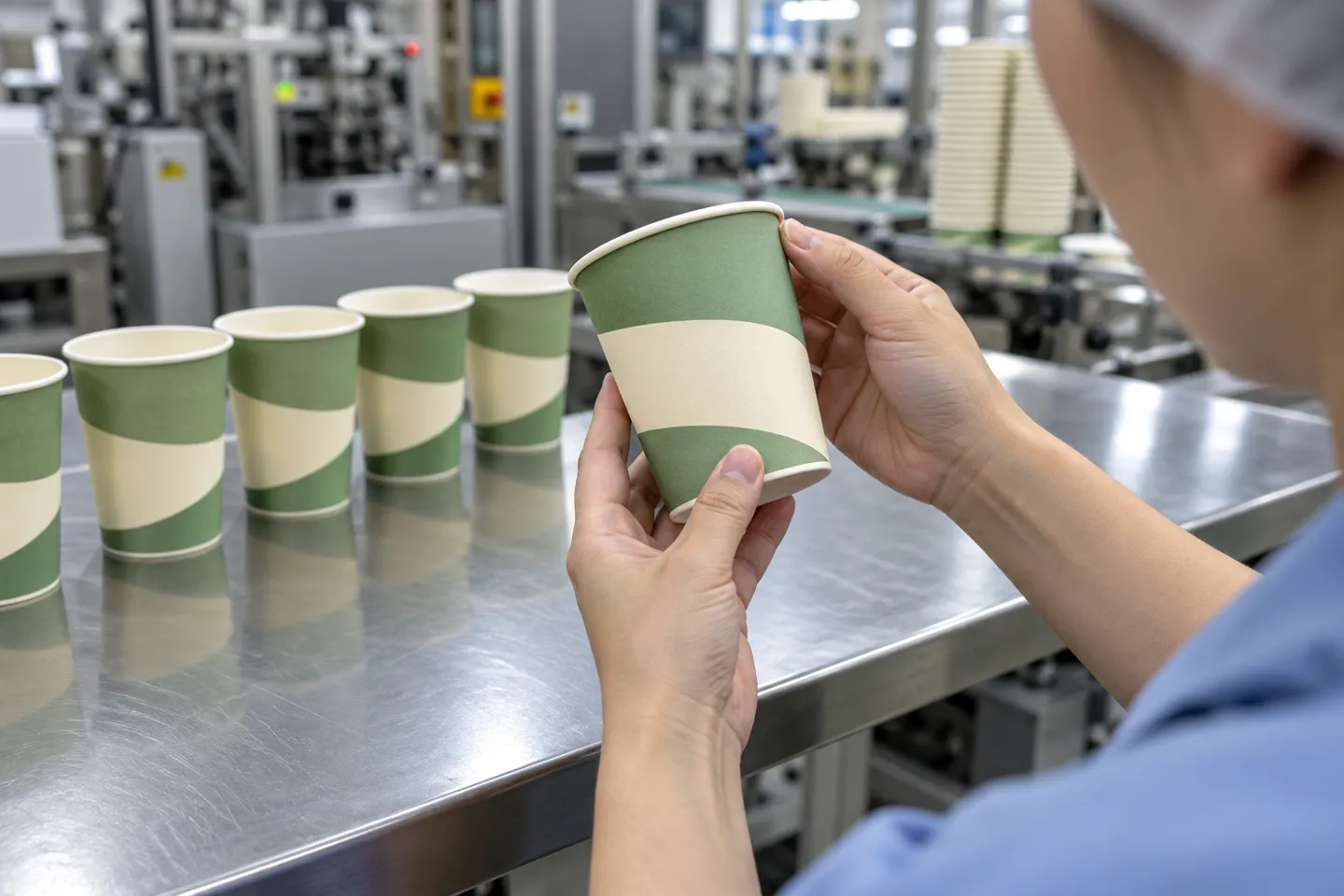
Water-based (aqueous) coatings replace the plastic film with a dispersion barrier applied like a print coat. Their appeal is real: cups advertise as repulpable and recyclable in standard paper streams, which answers the exact objection PE cannot. The constraints are industrial rather than scientific. Fewer coating lines run it, unit cost sits higher, and run availability varies by region and volume. Ask any supplier quoting it for production references at your quantity before you commit a launch to it.
| Coating | Leak protection | Heat tolerance | End of life story | Cost position |
|---|---|---|---|---|
| PE (18 gsm typical) | Proven, industry default | Excellent for boiling service | Hard to recycle in paper streams | Lowest |
| PLA (plant-based) | Good, formulation-dependent | Lower than PE; confirm with hot-drink tests | Compostable in industrial facilities only | Mid |
| Water-based | Good on current generations | Good | Repulpable in standard paper streams | Highest |
Regulation is pushing this decision for you if you sell into Europe. The EU’s single-use plastics directive restricts certain single-use plastic items (EUR-Lex, Directive (EU) 2019/904, 2019). It has made lining systems a sourcing variable rather than a footnote. Importers serving EU markets increasingly stock PE as the workhorse and a certified alternative for customers with compostability mandates, rather than betting the whole catalog on one system.
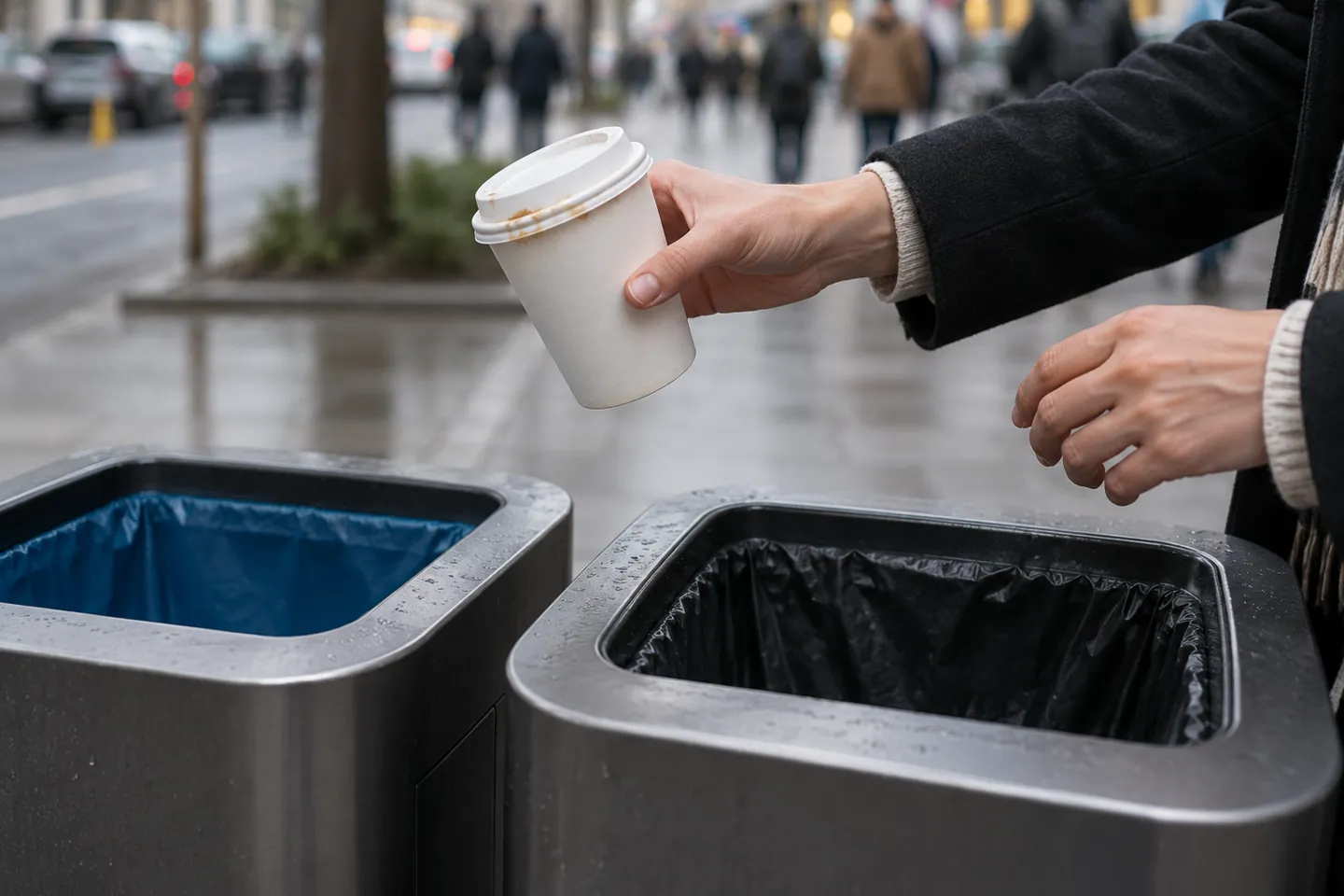
“Compostable” describes end of life, not hot-drink behavior. Before you print a leaf logo on your cup: confirm which certification applies (BPI or DIN), confirm industrial composting exists in your customers’ municipalities, and ask the supplier for particle-release and food-contact test reports on the exact lining formulation.
Turning Materials into Specs: Size, Lid Fit, Temperature
Material knowledge earns its keep when it turns into a specification sheet you can send to three suppliers and compare. Four numbers do most of the work.
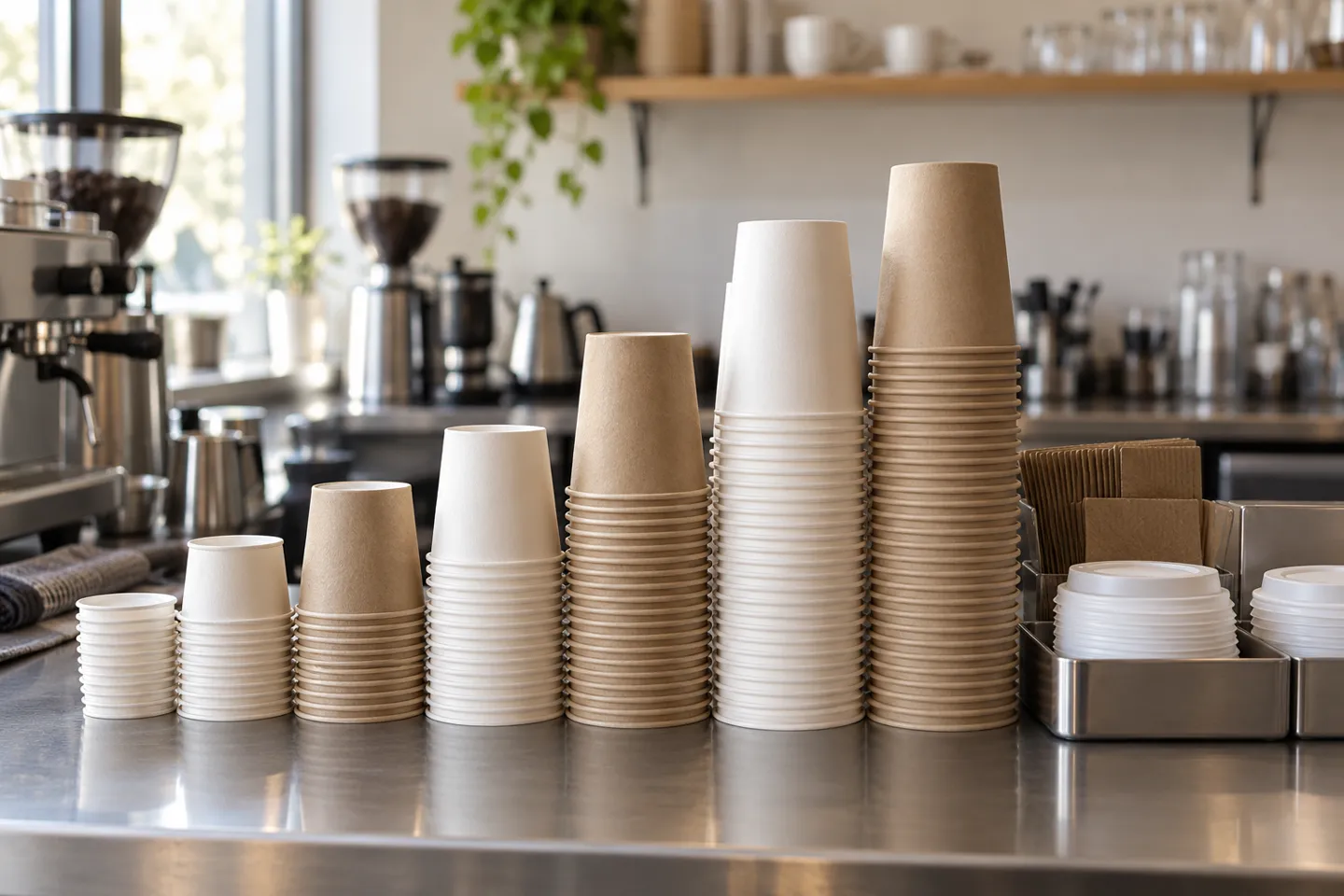
Capacity. The hot-drink sequence runs 4 oz espresso through 8, 12, and 16 oz as the volume core, with stock sizes out to 26 oz. Choose your size family before your printer, because printing plates are size-specific.
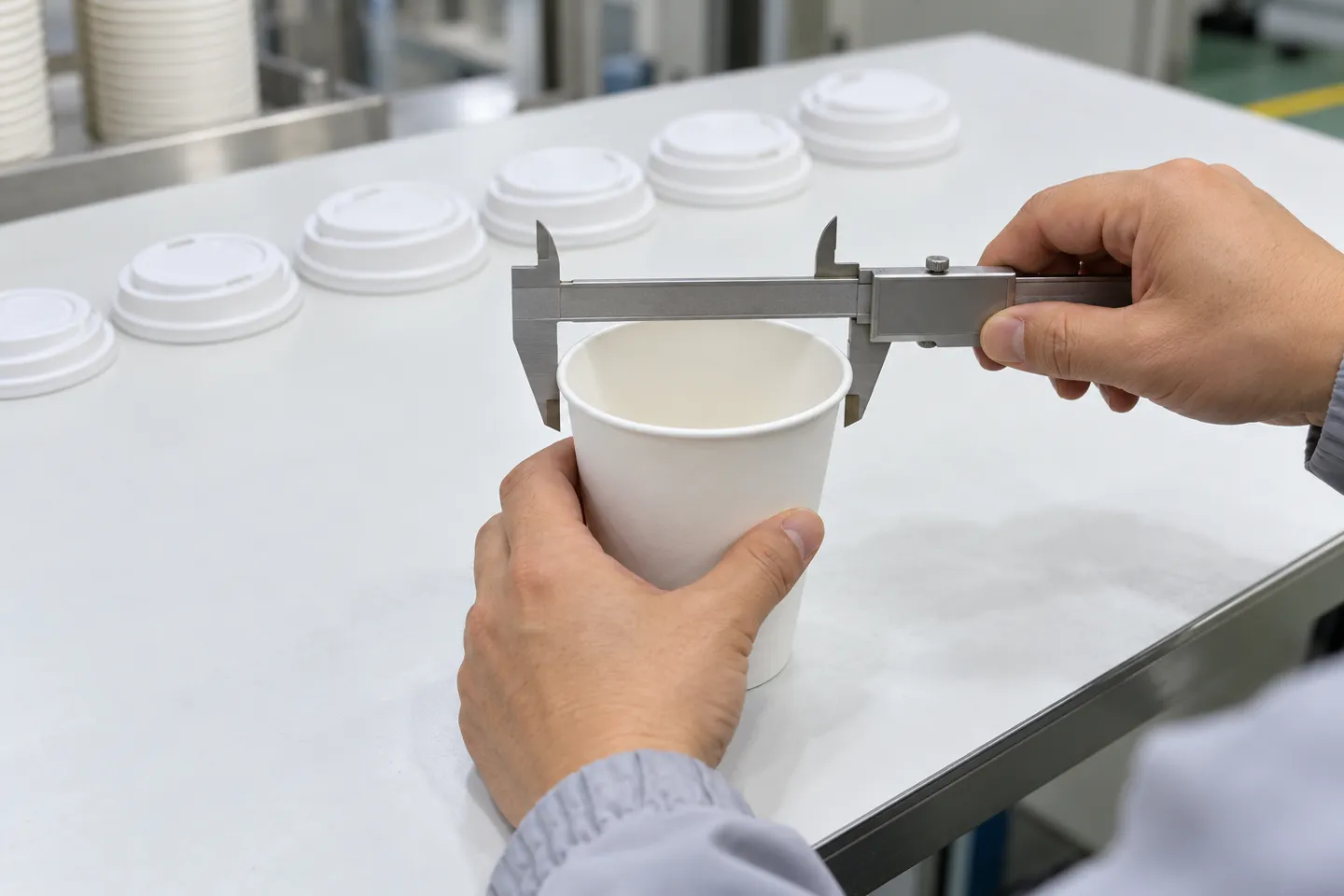
Lid diameter. Lids match rim diameters, not capacities. The common fits are 62, 80, 90, and 95 mm, with separate hot lids (domed, sip hole) and cold lids (flat, straw slot) (published lid chart). Write the diameter into every purchase order. Owners report the classic lock-in failure: lids “type specific” to one supplier’s cups, so switching cup vendors strands your lid stock (r/coffeeshopowners, 2025). Standardizing on one or two rim diameters across your size range is the single cheapest insurance in this category.
Board and coating weight. Specified together, in the format suppliers quote: for example 300 gsm board with 18 PE coating. This one line is what stops a “same cup” quote from hiding a lighter, floppier wall.
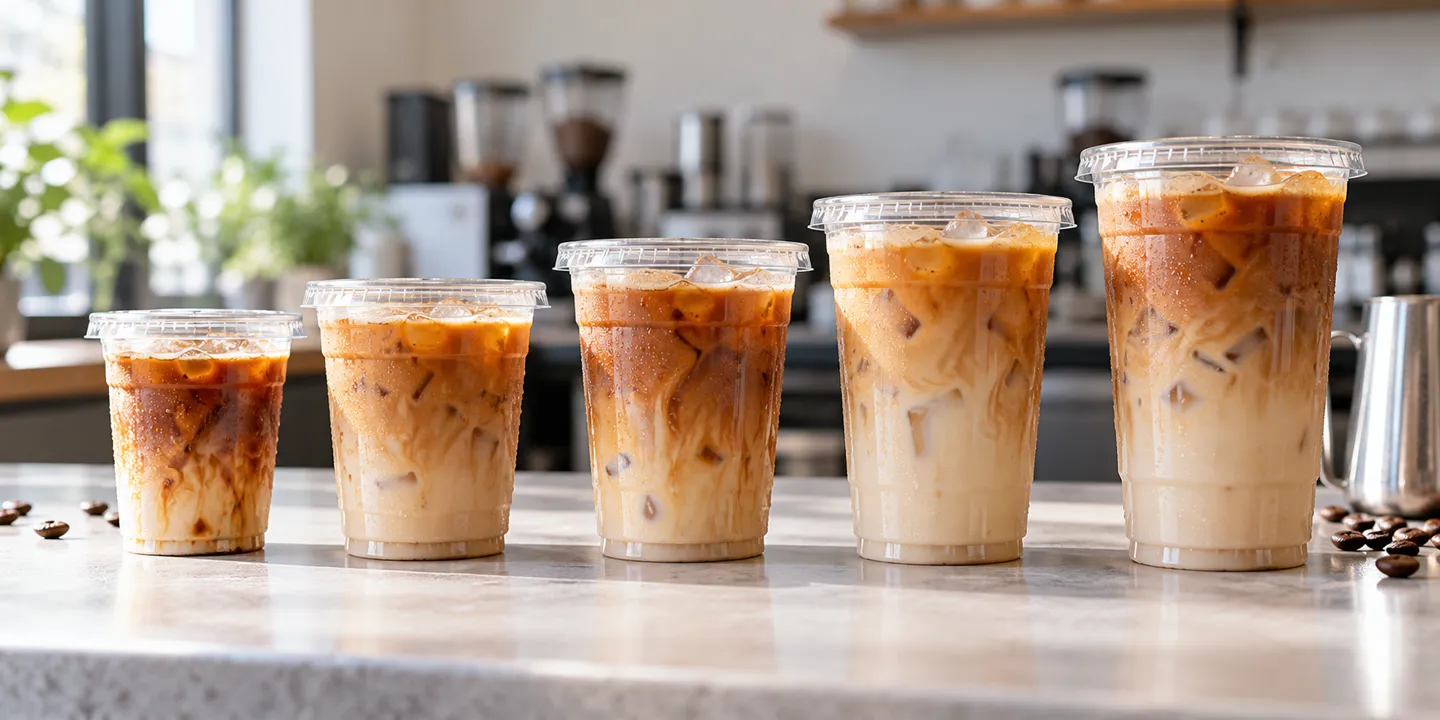
Temperature range. Double-coated hot cups handle boiling service; PET cold cups publish ranges down to minus 20 degrees and up to 120 degrees Celsius. Match the rating to your menu, including iced drinks that start hot-brewed.
Materials-to-Operation Boundary Matrix
| Your operation | Wall structure | Lining watch-out | Lid spec to lock |
|---|---|---|---|
| Takeaway espresso bar | Double or ripple wall (skip sleeves) | PE for boil stability, PLA only with composting mandate | 80/90 mm hot lids |
| Delivery-heavy kitchen | Double wall, leak-tested lids | Double coating on larger sizes | 90 mm hot, seal-check in samples |
| Convenience store station | Single wall + dispenser compatibility | Consistent rim so dispenser jaws fit | Match dispenser OEM diameter |
| Iced drinks and cold brew | PET clear cups | Minus 20 to 120 C rating for dual use | 90/95 mm flat cold lids |
| Bakery pairing | Kraft single or double wall | Kraft mutes color, plan art accordingly | 80/90 mm by size family |
| Gelato and frozen | Double-coated paper or PET | Freezer cycling, confirm coating flexibility | 95 mm cold lids |
One more spec decision: ink. Food-grade soy or water-based inks with low migration are the standard ask, and they cost nothing extra at competent factories. If your design uses heavy ink coverage inside the rim area, ask the printer how the zone around the drinking edge is handled.
Verify Before You Buy: Documents, Samples, and Incoming Checks
A specification sheet is a promise. This stage is how you check whether the factory keeps promises, and it is where the category’s most expensive failures are prevented.
Your four-number spec is exactly what a factory quote should answer, so send it and compare what comes back line by line.
Get a Spec-Matched QuoteAsk for the documents first
The paper trail you are entitled to see starts with food-contact test reports against FDA and LFGB limits for the exact board and lining combination. Next come the factory’s ISO 9001 and ISO 14001 certificates. Supplying retail chains adds BRC food-safety certification. Marketing the fiber as certified adds FSC chain-of-custody documents. If a supplier claims compostability, the BPI or DIN certificate number should be verifiable on the certifier’s public register, not just on their PDF. A factory that hesitates to send reports for the exact SKU you are buying is answering your question.
Test samples like it’s your reputation
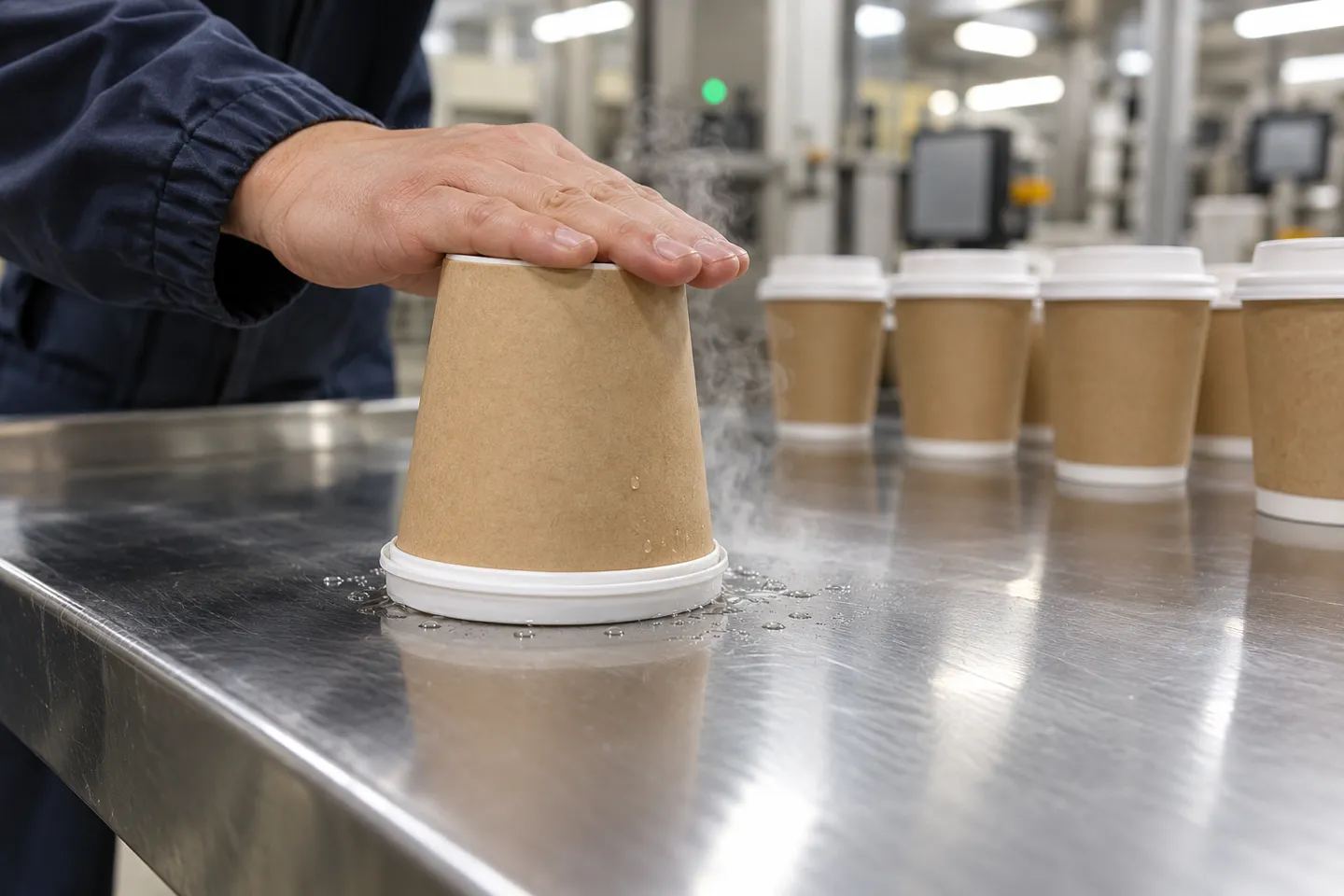
The standard workflow at established factories runs: digital proof within one working day, physical samples within about 48 hours, then mass production only after you approve (published supplier workflow). Use the sample for real tests, not looks. Fill it with boiling water and hold it. Seat the lid and invert the cup over a counter for a minute. Check print registration against the digital proof. Crush the empty cup; the side seam should not split. These five minutes catch the failures that reviews are full of.
During mass production, ask what the line inspects and how often. The stronger factories run hourly checks across printing, forming, and sealing. When a defect appears, they scrap everything since the last passed check. They also print a date, time, and serial on the cup bottom, so any claim traces to a batch. Ask for the AQL plan on your shipment. None of this is exotic; it is the difference between a supplier and a reseller with a catalog.
Plan for the failures that actually happen
Forum complaints in this category repeat, and each maps to a check you can run (r/coffeeshopowners, 2025):
Six failure patterns, each with the check that prevents it
- Lids that leak or pop off invert-test on samples, lock rim diameter in the PO.
- Lid stock stranded after switching suppliers standardize rim diameters across sizes before signing.
- Customs delays write the lead time (typically 3-6 weeks for standard orders) into the contract with a defined date basis.
- Tariff surprises cost the landed price, not the unit price, before comparing quotes.
- Shady intermediaries verify the factory address and certificate numbers independently.
- Inconsistent budget brands agree an AQL inspection plan and remedies in writing.
Two warranty terms tell you who you are dealing with: the coverage length (a year is common) and the claim mechanics. The buyer-friendly pattern in this market is remediation with evidence: send photos and video of the defect, no return shipment required, replacement or rework inside about 30 days. That clause is worth more than a cent off the unit price, because it prices the supplier’s confidence in their own QC.
Reading the Cup Business Like a Buyer
For importers and wholesalers, the material layers stop being product features and become inventory structure. Three conclusions follow from everything above.
First, weight the catalog toward insulated stock. The end-customer evidence is consistent: owners buy double-wall and ribbed cups to eliminate the sleeve line item, and sleeve elimination is a standing order. A single-wall-plus-sleeve deal, by contrast, has to be re-won every season. Stocking insulated structures sells the operating cost saving, not just the cup.
Second, plan SKU width by lid diameter, not by capacity. The rim diameters repeat across size families. A range that concentrates on the 80 and 90 mm families covers most hot-drink volumes with fewer lid SKUs and fewer dispenser mismatches. The switching cost then works for you instead of against you.
Third, treat coating mix as a market-by-market decision. PE remains the volume base everywhere. Certified-compostable and repulpable options earn their slot where regulation or municipal composting creates demand (EUR-Lex, Directive (EU) 2019/904, 2019). Today that means parts of Europe first. The market’s price ladder rewards exactly this planning. Volume breaks at 50,000, 100,000, and 500,000 pieces are the standard steps (published pricing tiers). Stock cups start around 10,000 pieces and custom printing around 30,000. Standard lead times run three to six weeks, and a month of free warehousing is commonly available to stage deliveries. Owners discussing supplier moves cite landed-price swings of a few cents per cup between branded double-wall and unbranded stock (r/coffeeshopowners, 2025). That is precisely the margin a sleeve budget or a stranded lid stock can erase.
The through-line of this article is that unit price is the smallest number in the cup business. The sleeve you no longer buy. The lid stock that survives a supplier change. The certification that clears customs the first time. The claim you never have to pay out. Those are the numbers that decide whether the business works. Buyers who specify by layer, verify by document, and stock by diameter run on sturdier margins than buyers who shop by sticker. The gap compounds with every reordering cycle.
If you want to pressure-test these specs against a live catalog, YoonPak publishes its full paper coffee cup materials, structures, and specifications online.
Price Your Cup Program on Real Specifications
Wholesale and custom-printed paper cups, quoted against your board, lining, and lid specs.
Start Your Cup QuoteReferences
- Ke Shi et al. “Release of Nanoplastic and Microplastic from Polyethylene and Polylactic Acid Lined Single Use Paper Cups.” ACS Food Science & Technology, 2026. https://phys.org/news/2026-08-takeaway-cups-microplastics-coffee.html (study coverage; University of Queensland)
- EUR-Lex. “Directive (EU) 2019/904 on the reduction of the impact of certain plastic products on the environment.” 2019. https://eur-lex.europa.eu/eli/dir/2019/904/oj
- eCFR. “Title 21, Part 176: Indirect Food Additives: Paper and Paperboard Components.” https://www.ecfr.gov/current/title-21/chapter-I/subchapter-B/part-176
- r/coffeeshopowners. “Best disposable cups?” 2025. https://www.reddit.com/r/coffeeshopowners/comments/1kyc7op/best_disposable_cups/
- r/coffeeshopowners. “Customize coffee cups.” 2025. https://www.reddit.com/r/coffeeshopowners/comments/1ok3lgr/customize_coffee_cups/


 English
 German
 Spanish
 Italian
 Dutch
 French
 Portuguese
 Russian
 Arabic
 Korean