

Dunkin Donuts Packaging, Explained: What’s in the System, Where It Fails, and How to Get It for Your Own Shop
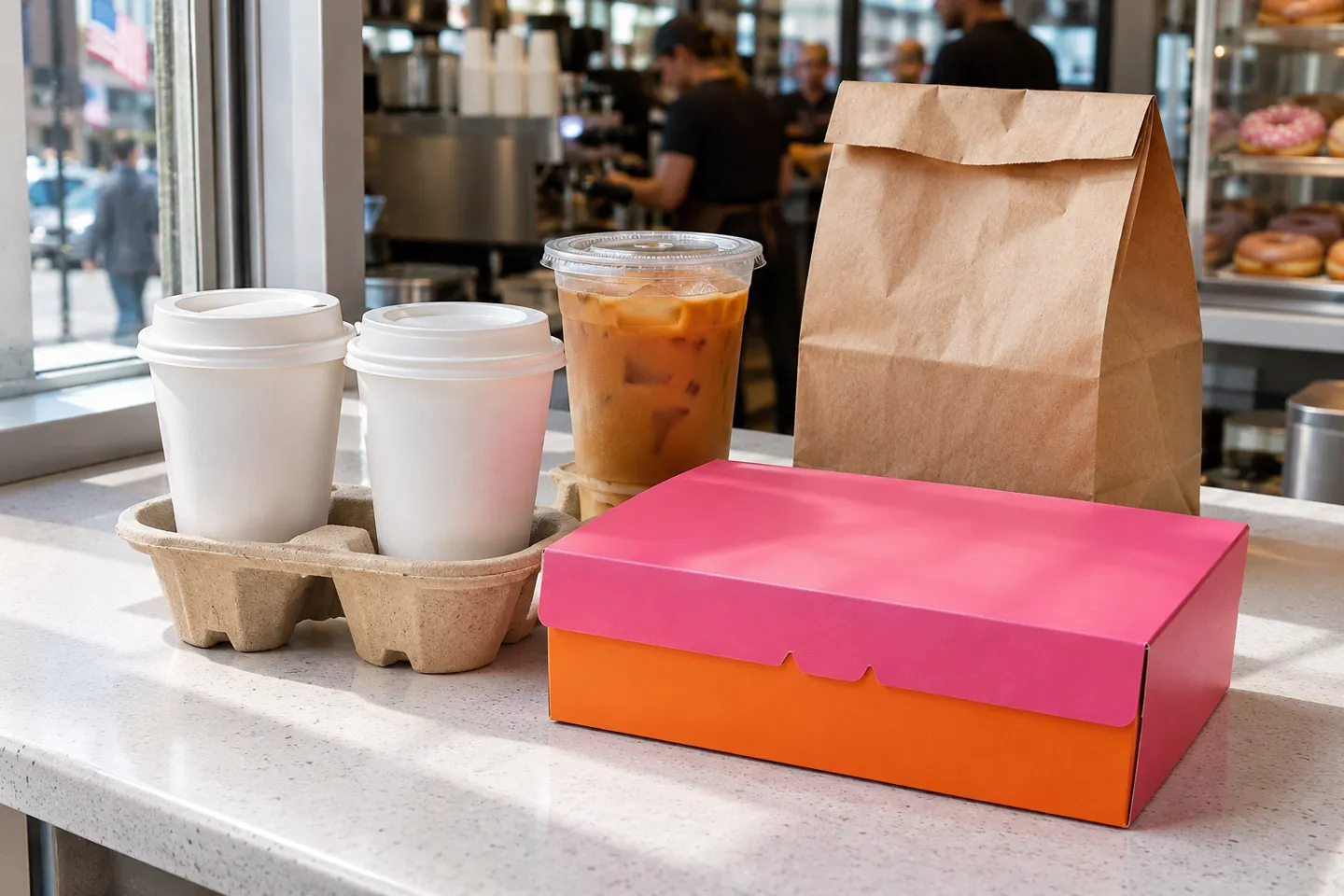
A dozen donuts sits in a pink-and-orange cardboard box on the counter, lids of two iced coffees poking out of a carrier beside it, napkins stuffed in the bag with the MUNCHKINS box. Nobody in the line thinks about any of this as “packaging”. Yet every piece in that stack was chosen to solve a specific problem: keep the donuts from getting crushed, keep the hot coffee hot without a sleeve, keep the iced latte from tipping over in the cupholder of somebody’s Civic.
Dunkin’ has been running one of the most visible packaging programs in American foodservice for decades, and in 2019 it rebuilt the whole lineup at once: new cups, donut boxes, MUNCHKINS treat boxes, Box O’ Joe carriers, and napkins rolled into every restaurant in the country as part of the brand refresh that also dropped “Donuts” from the name (Packaging Gateway, 2019). The pink and orange stayed; almost nothing else did.
This article walks through that system the way a packaging buyer would look at it: what each piece is for, where it wins, where it visibly fails, and what it takes to get the same kind of system built for your own shop.
What’s Actually in Dunkin’s Packaging System
The lineup looks like a random pile of cups and boxes until you sort it by what each piece carries. Once sorted, six categories cover essentially everything the brand hands across the counter.
The Dunkin’ Packaging Lineup by Function
| Piece | What it carries | The problem it solves |
|---|---|---|
| Hot cups (double-wall paper) | Coffee, espresso, tea | Insulation without a sleeve, after the foam era |
| Cold cups (clear plastic) | Iced coffee, coolattas | Condensation control, lid fit, visibility of the drink |
| Donut boxes | Donuts by the half-dozen and dozen | Crush protection and presentation for fragile glazed product |
| MUNCHKINS boxes | Donut holes | Count-based snacking formats that travel in one hand |
| Box O’ Joe | Brewed coffee for groups | One carrier replaces a stack of individual cups |
| Bags and napkins | Sandwiches, bagels, extras | Loose items that need containment but not structure |
Two things about this lineup matter more than the individual pieces. First, it is not a design exercise. Each item exists because a specific order type created a problem the other items could not solve, which is why the 2019 rollout replaced all of them at once instead of one category at a time (Comunicaffe, 2019). Second, the lineup keeps growing at the edges: group formats and limited-edition collaborative packaging keep appearing, and both follow the same logic of matching a container to an occasion.
That occasion logic is the real organizing principle here. Walk the lineup by scene, starting with the one everybody argues about: the carryout box versus the bag.
Carryout: Donut Boxes, Paper Bags, and Where Each One Breaks
Donuts are the reason the box vs. bag question exists at all. A glazed donut is a fragile, sticky, grease-carrying product that bruises on contact and weeps onto whatever surface holds it. The internet has not reached consensus on the answer.
Why the box won for donuts
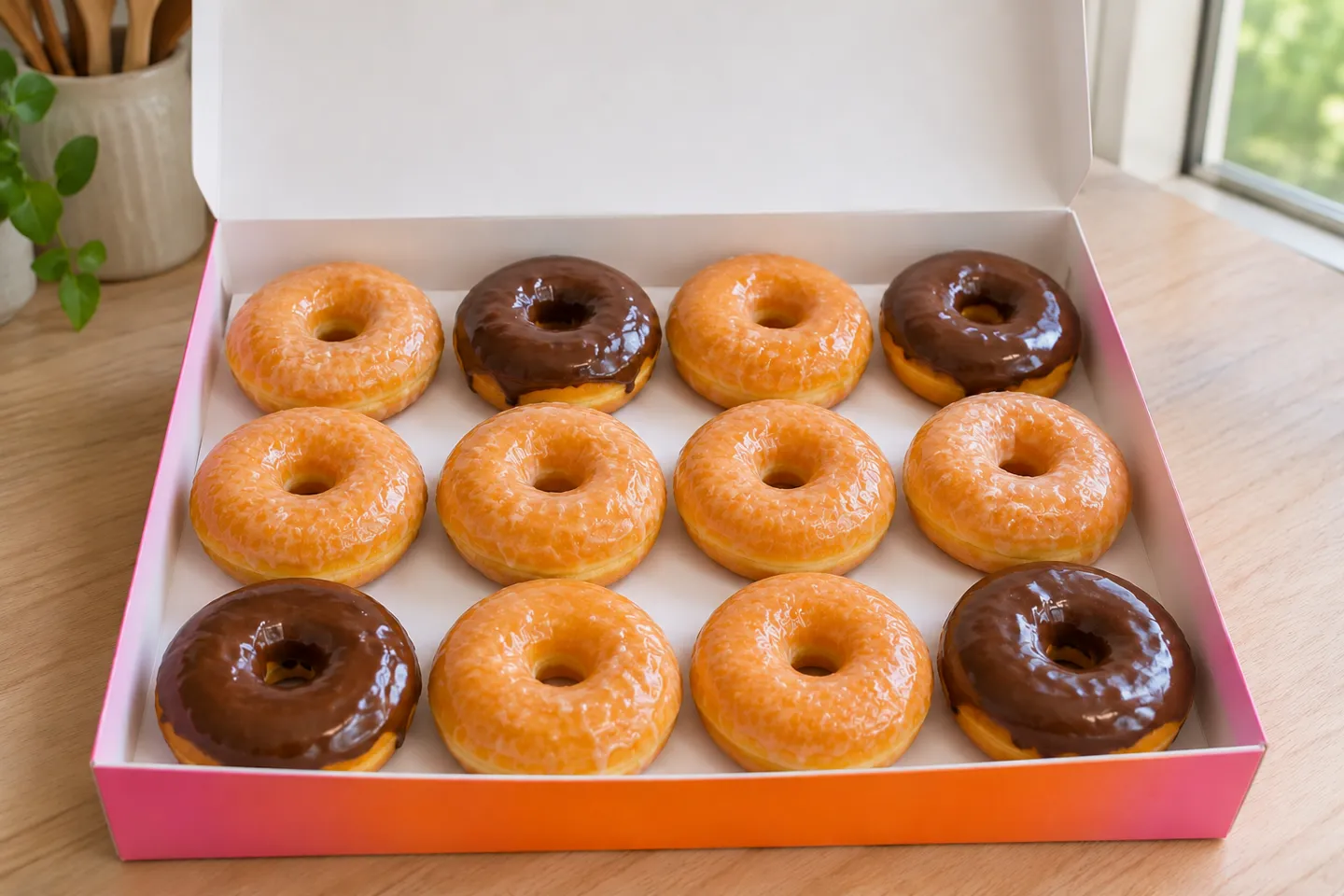
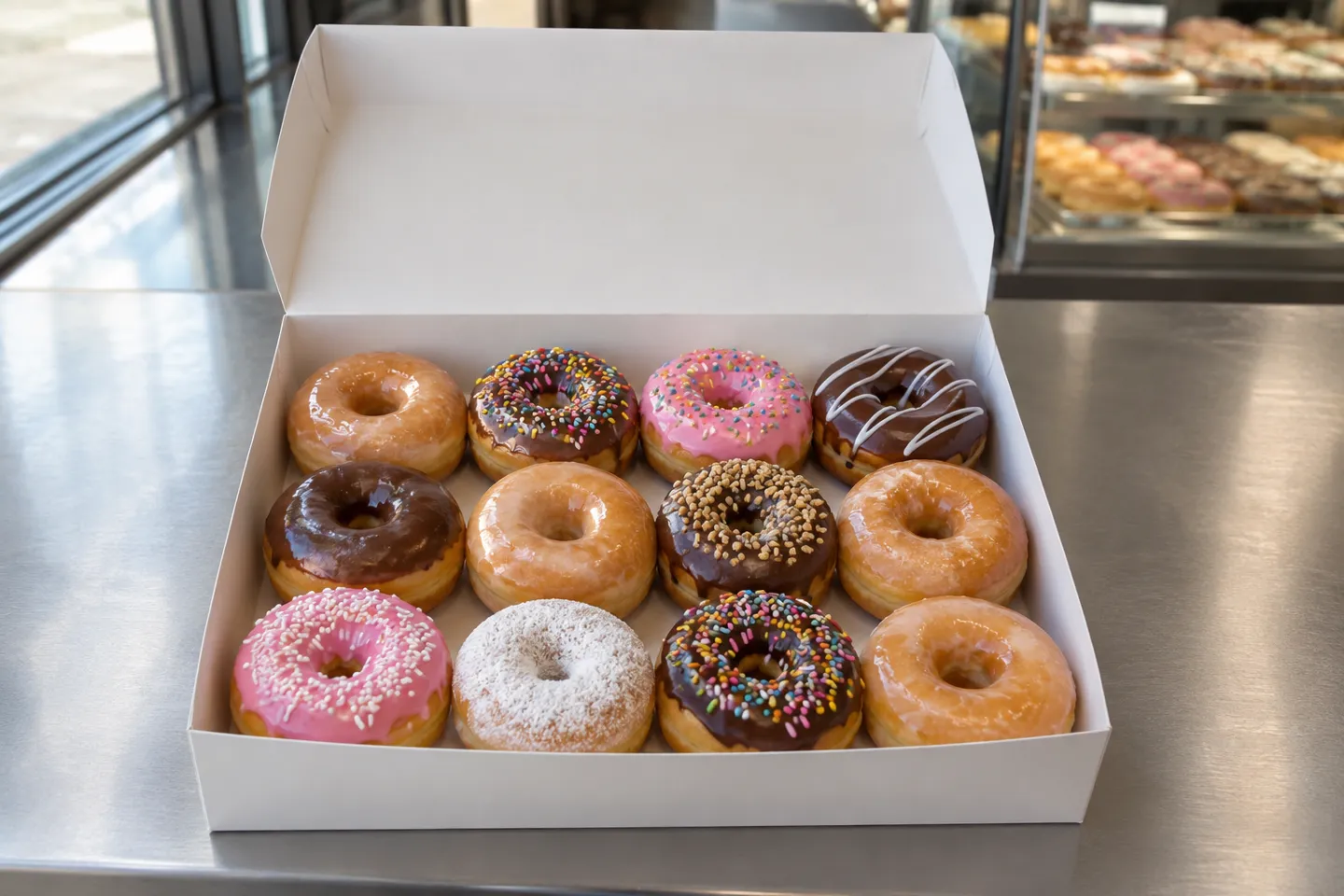
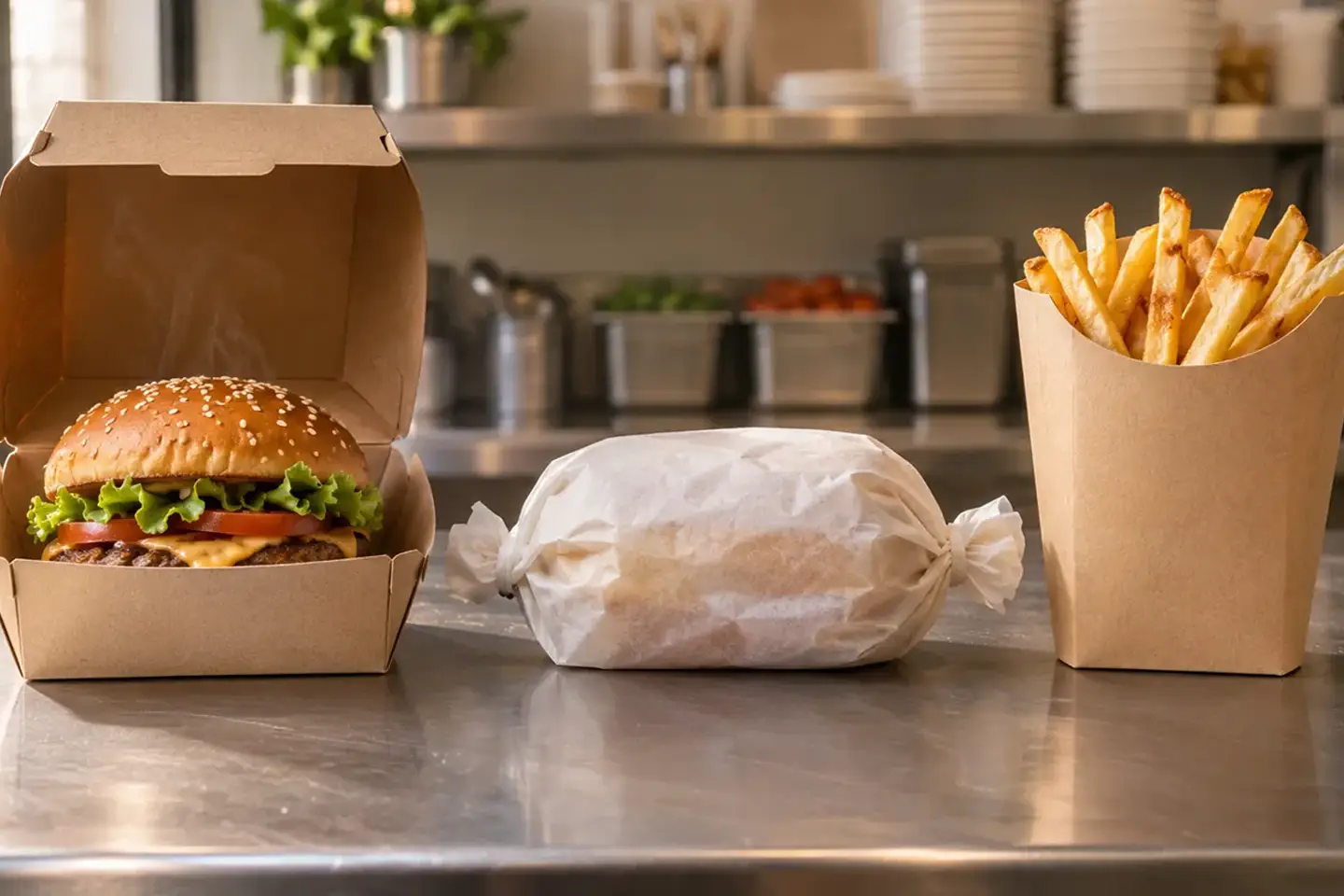
The box wins on structure. It holds the donuts apart in fixed positions, protects the icing from contact, stacks in a transit box without compression, and presents the product the moment the lid opens. In the Dunkin’ World Facebook group, the sentiment around boxes is overwhelmingly positive whenever the topic comes up, with members praising orders that arrive “in a box and not thrown in a bag messy”. When Dunkin’ shifted donuts back into boxes in some markets, the group discussed it like news, because for regulars the container is part of the product experience.
The box also carries the count logic. The formats people actually search for, the half-dozen and the dozen, exist because donuts are bought in social quantities, and the box dimensions are built around those counts rather than around food volume. A single-layer dozen box leaves no gap for icing to smear against a lid.
Where the bag still fights back
The bag is not obsolete, and the complaints against boxes are real. Delivery drivers and passengers report glazed donuts sliding inside boxes and icing ending up on car seats, and in one widely shared thread on r/DunkinDonuts a customer asked what corporate was thinking after a box leaked icing across a car interior (Reddit, r/DunkinDonuts, 2025). A flat box in a tilted car behaves nothing like a flat box on a counter. The bag, which grips contents and tolerates being held at any angle, handles the tilt problem better than a rigid box with a loose lid.
The honest summary is that the box and the bag are tools for different failure modes, and the failure modes are predictable enough to put in a table.
Carryout Containers: Where Each One Wins and Breaks
| Container | Best for | Where it wins | Where it breaks | Check before ordering |
|---|---|---|---|---|
| Donut box (count-based) | Glazed or iced donuts, half-dozen and dozen orders | Fixed positions, no contact, stackable, opens into a display | Tilts in transit; icing migrates to the lid and the car seat | Grease resistance of the box bottom and lid retention, tested with your actual glaze |
| Mini treat box | Donut holes, small pastries | One-hand carry, portion control | Product taller than the box crushes against the lid | Internal height against your product’s actual size |
| Gable box | Mixed orders, bakery assortments | Handle, closes fully, survives tilting | Condensation buildup for warm products | Venting options if products steam inside |
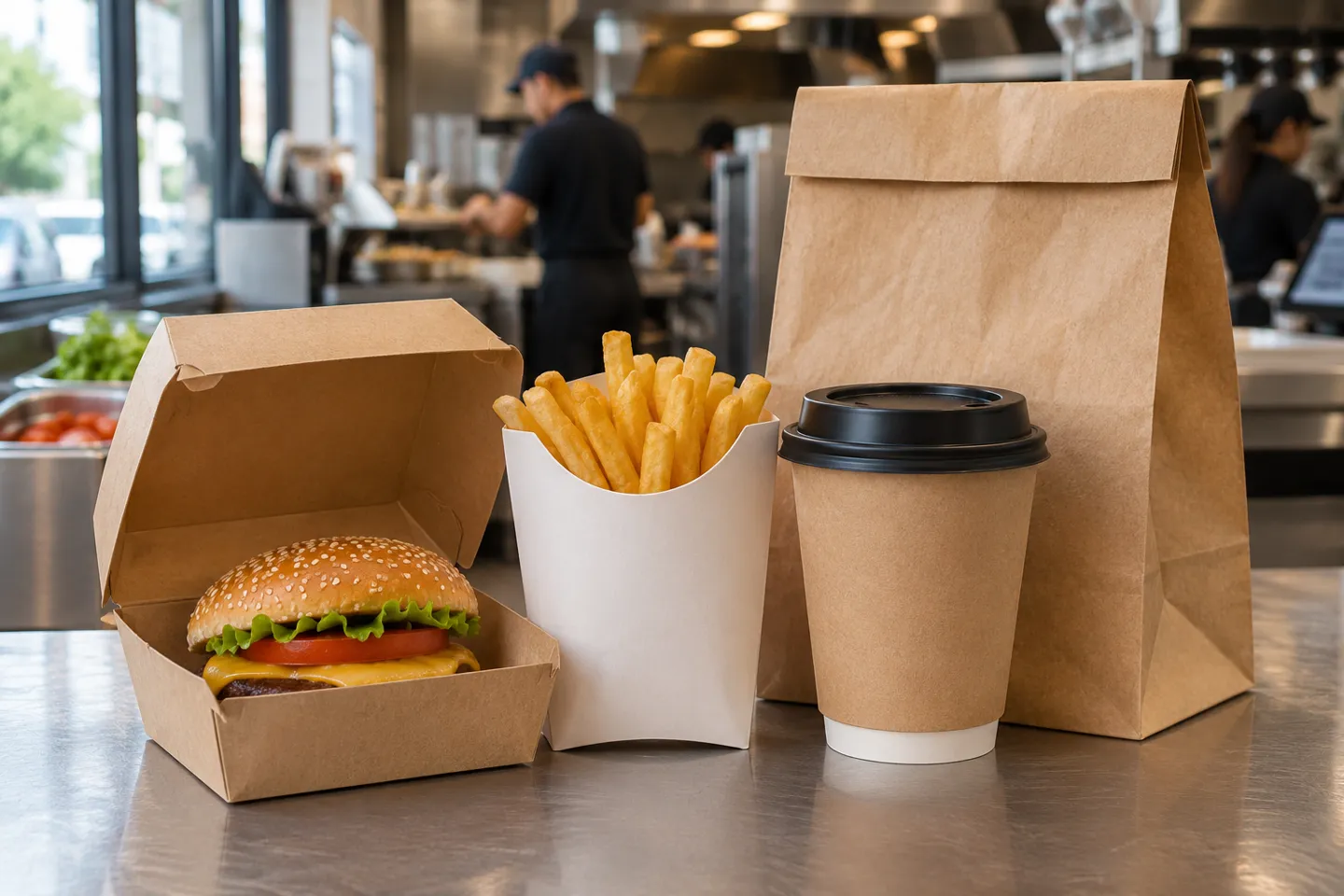
| Paper bag | Bagels, sandwiches, single snack runs | Angle-proof, breathable, cheap at volume | Zero structure; fragile product arrives bruised | Board weight; a thin bag telegraphs a cheap order |
The matrix above is the whole carryout decision in one place. The check column is the part buyers skip: the failure is never “cardboard quality” in the abstract, it is always a specific test nobody ran, like grease holdout on the bottom board or lid retention at 30 degrees of tilt.
The Delivery Journey: Where Packaging Actually Fails
Carryout failures embarrass a brand. Delivery failures lose the order, because the customer cannot intervene between the counter and the doorstep. When you collect the public failure reports about this brand’s packaging, a pattern shows up immediately: almost every one of them happens somewhere along the delivery journey rather than at the counter.
In the public consumer failure record for this packaging system (leaked icing, coffee packed against food, oversized single-drink parcels, tipped cups), nearly every reported failure occurs in the delivery leg, not at carryout.
A delivery order passes through four packaging environments, and each one has its own documented way of failing.
1
Separation
Hot drinks and food are packed into separate vessels
2
Fixation
Cups are locked into inserts or carriers so they cannot tip
3
Insulation
Double-wall structure holds serving temperature without a sleeve
4
Handoff
The parcel is closed, bagged, and handed to a driver who will treat it worse than any customer would
First, drinks and food never share a box
The single most repeated delivery complaint is also the simplest: hot coffee packed in the same container as food. One r/DunkinDonuts post put it in seven words, “Why package the coffee with the food? The whole order is ruined” (Reddit, r/DunkinDonuts, 2025). The physics is not mysterious. A vented hot cup in an enclosed box floods the airspace with steam, the steam condenses on the cooler food and the lid above it, and a sandwich arrives soggy next to a lukewarm coffee. Separation is not a courtesy, it is the difference between one order and two ruined products.
In transit, fixation is the fight
Once separated, cups need to be immobilized. The cardboard inserts that lock each cup into its own socket exist because a free cup in a bag becomes a pendulum, and drivers brake. The insert solves tipping but creates the other debate: drivers on r/Anticonsumption have documented single-drink orders arriving in oversized parcel packaging, material built for protection that the driver then has to throw away (Reddit, r/Anticonsumption, 2024). Fixation and material economy pull in opposite directions, and the brands caught in the middle take the criticism from both sides.
Heat: the foam-to-paper story
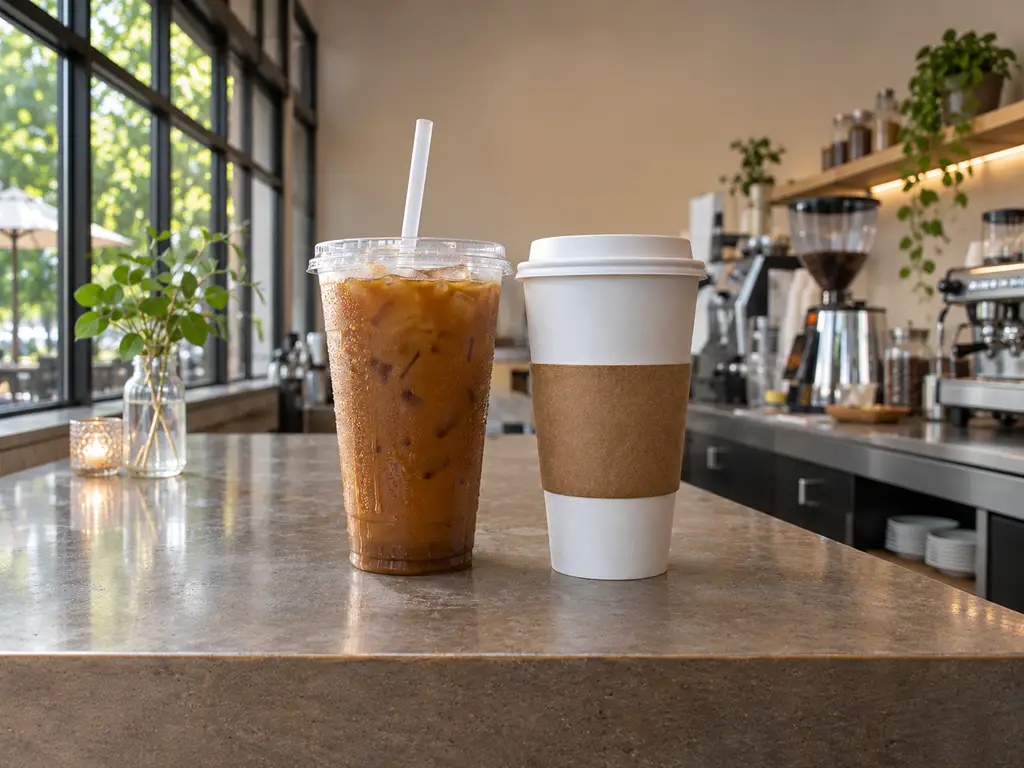
The insulation story is the one piece of this system with a public engineering paper trail. In February 2018 the company announced it would eliminate polystyrene foam cups from its entire supply chain by 2020, replacing them with a double-walled paper cup whose air gap insulates well enough that the cup no longer needs a cardboard sleeve (Waste Dive, 2018). The rollout was paced to manufacturing capacity. It started in California and New York in spring 2018, reached New England by December 2019 with about 70% of the system already converted (Dunkin’ Brands, 2019), and completed globally in May 2020 (Dunkin’ Brands, 2020). The lids moved to a recyclable #5 polypropylene.
≈1 billion
foam cups a year pulled out of the waste stream
19 million lbs
of polystyrene removed annually, by the company’s accounting
The boundary deserves as much attention as the achievement. The Conservation Law Foundation called the plastic-lined paper cup a “false solution” at the time, because a polyethylene coating fused to paperboard is not practically recyclable in most municipal streams (Conservation Law Foundation, 2019). The company’s own materials carry the same caveat in smaller type: recyclable lids mean recyclable where facilities accept #5 plastics, and the official communications say to check locally. Neither statement is wrong. Foam removal is real, and end-of-life recyclability is still a work in progress, and a packaging buyer who quotes only one of those facts to their own customers is setting up a credibility problem.
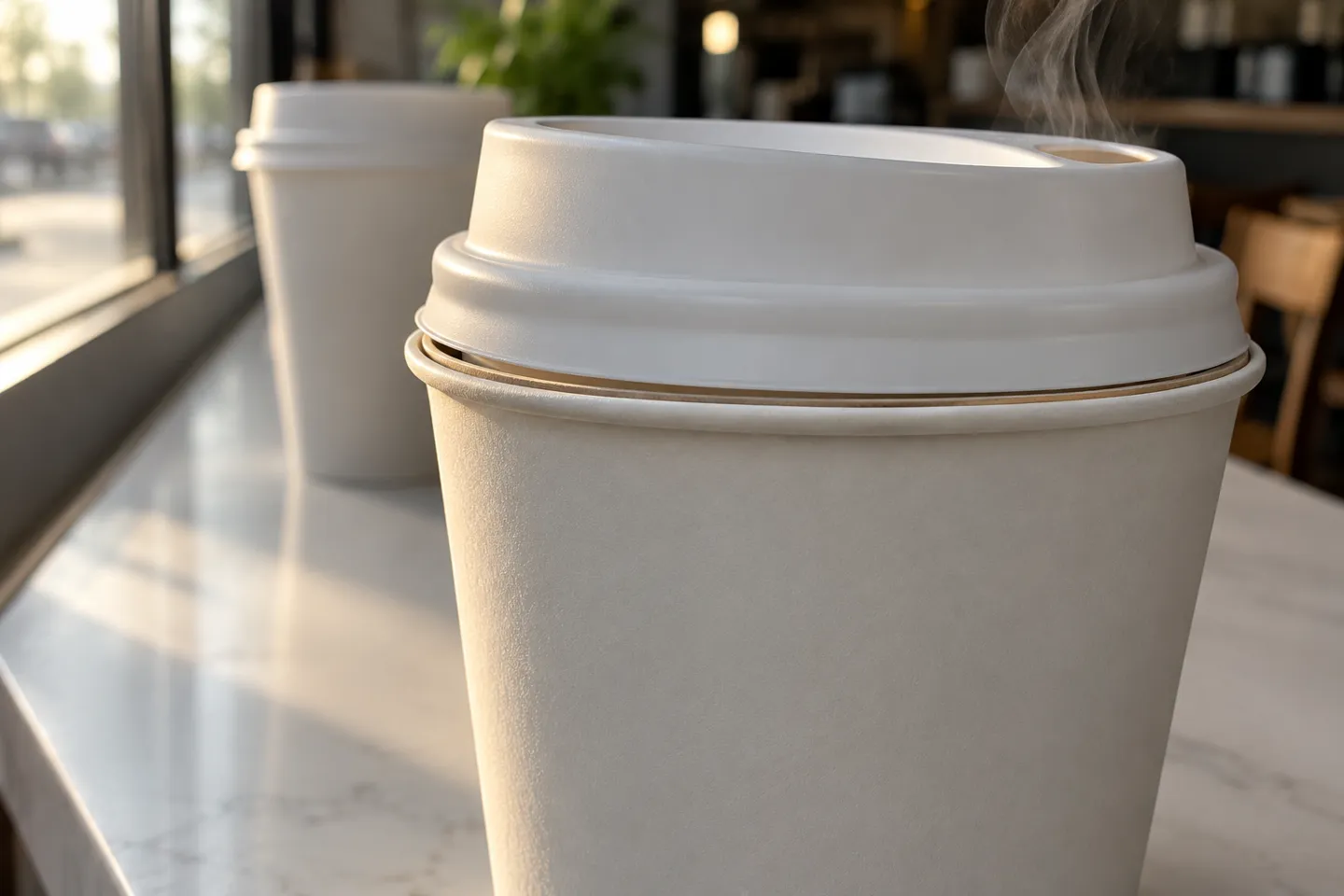
One more boundary belongs in this section: insulation has a clock. A double-wall cup buys time against temperature loss, it does not stop it. An order that sits in a car for an hour arrives below serving temperature in any packaging on the market, which is why the honest delivery promise is about the first twenty minutes, not the first hour.
Group Orders and Limited Drops
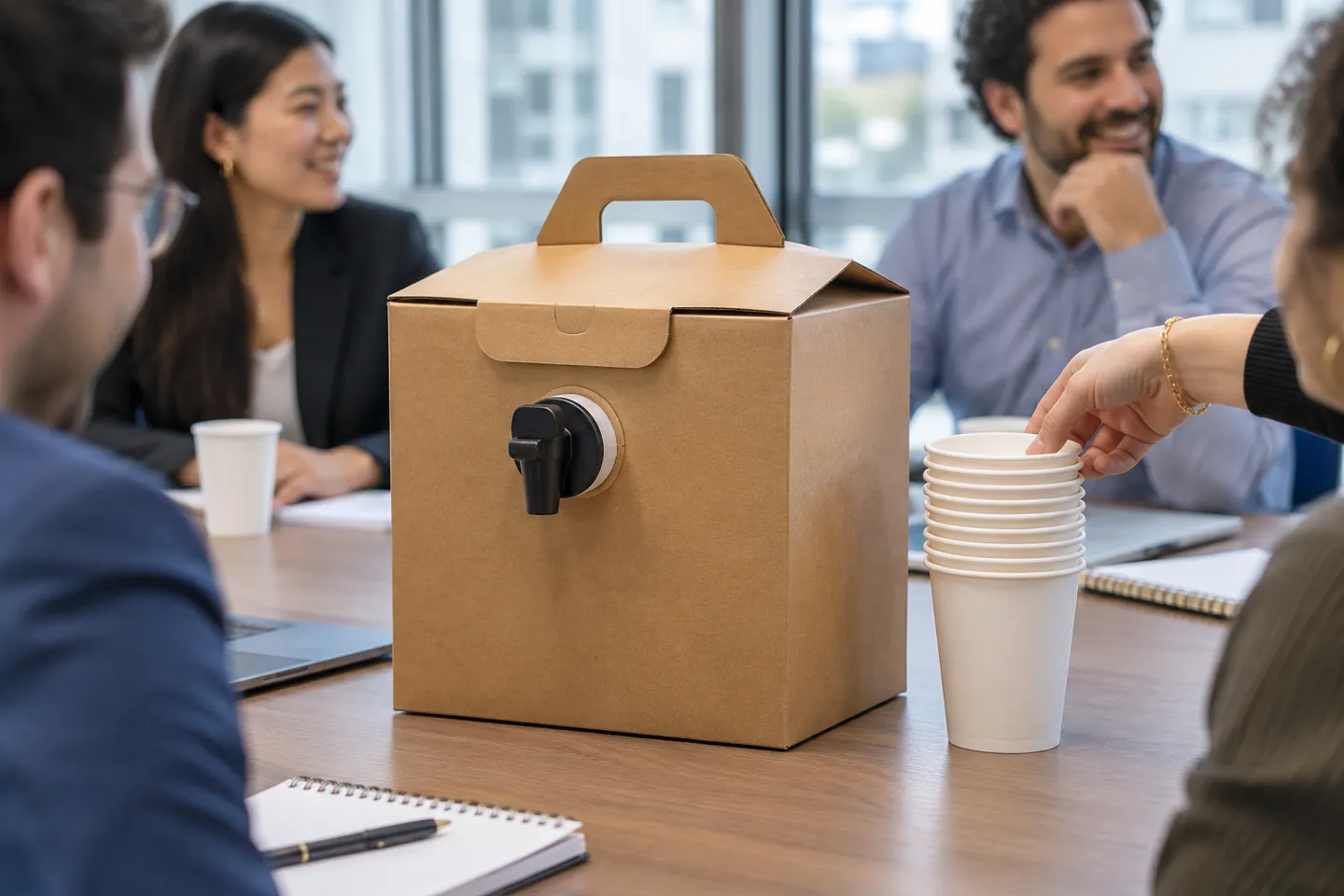
Between carryout and delivery sits the scene that made Box O’ Joe famous: the meeting, the tailgate, the office Friday. The group container solves a counting problem. Ten individual cups mean ten lids, ten sleeves, ten chances to drop one; a lidded brew box with a pour spout means one vessel, one pour, one cup per person downstream. The same logic scaled cold in recent summers, with community reports of a 48-ounce shared cold-drink bucket rolling out nationally, a format that turns a personal treat into a table centerpiece (Reddit, r/popculturechat, 2025).
Limited collaborative packaging runs on the same supply chain but with a much sharper clock. When the brand put out the Dunkings packaging alongside its meal deal promotion in early 2024, restaurants received the special-format boxes on normal menus with no operational warning, and staff and customers alike posted about being surprised by them (Reddit, r/DunkinDonuts, 2025). A limited drop quietly tests something buyers rarely ask about: how fast a supplier can change print plates and deliver new artwork onto existing container formats without stopping the line. Flexible printing capacity and fast proof turnaround are the invisible requirements behind every seasonal cup, and they are worth asking any prospective supplier about, because most packaging failures on limited runs are schedule failures, not print failures.
For the same reason, the small-format end of the group scene, the bakery boxes and mini treat boxes that show up at office parties and school events, belongs to this part of the system rather than to carryout: the product is the same, but the occasion is a group of people sharing, and the container follows the occasion.
The Shelf: Retail Packaging and the 11-Ounce Question
Everything above happens within arm’s reach of a customer. The fourth scene is the grocery shelf, where the brand’s ground coffee and single-serve pods live in completely different packaging logic: the container’s job is not to survive a car ride but to win a shelf decision and then sit in a home pantry for weeks.
Retail packaging answers to merchandising pressure, and merchandising pressure shows up in grams. In a recent consumer post, shoppers on r/shrinkflation documented the at-home ground coffee line moving from a 12-ounce bag to an 11-ounce bag at the same shelf position (Reddit, r/shrinkflation, 2026). The report is consumer-sourced, not a company statement, so treat it as a documented community observation rather than an official change log. The pattern it describes, though, is industry-wide: when input costs rise, the bag is the first place a brand adjusts, and the boundary that separates adjustment from backlash is whether the weight change is stated clearly on the front of the pack.
For a packaging buyer, the retail shelf is the least relevant scene in this article, and it still teaches the same lesson as the rest: the container is a decision instrument. On the shelf it decides between brands; at the counter it decides whether the donuts arrive intact; in the delivery bag it decides whether the coffee is separate from the sandwich. Same material family, four different jobs.
Getting the Same System for Your Own Shop
Reading the system is free. Building one is a procurement project, and it runs on a four-step process that maps almost exactly to the structure above.
Step one is writing the spec, and the spec is where most first-time buyers underdeliver. A supplier cannot quote from “a box like Dunkin’s”; a supplier quotes from a list: container type and count format, board weight in gsm, coating type (polyethylene or PLA where compostability matters), number of print colors, and whether artwork is CMYK or Pantone-matched.
Step two is proofing. The industry rhythm that works is a digital proof within a day or two, then a physical sample in hand before any mass run, because print plates are cut against the approved proof and changes after that point cost real money.
Step three is compliance paperwork. Food-contact certification for the destination market (FDA documentation for the US, LFGB for Germany and much of the EU), plus chain-of-custody certification for the board itself, is a document request, not a promise, and it should be asked for before the deposit, not after.
Step four is MOQ and lead time, where small shops hit the wall that the Facebook bakery groups keep documenting: a solo bakery wanting its logo on a donut box runs into minimum order quantities that dwarf its monthly volume. The groups’ answer is co-op buying: several shops split one production run so the minimums come within reach.
Your Pre-Inquiry Self-Check
- Does the spec sheet carry container type, count format, board weight in gsm, coating type, print colors, and artwork matching (CMYK or Pantone)?
- Is the proof cadence agreed: a digital proof within a day or two, then a physical sample in hand before any mass run?
- Are the compliance documents requested before the deposit: FDA or LFGB food-contact papers, plus chain-of-custody for the board?
- Does the minimum order quantity fit the shop’s monthly volume, and is co-op buying an option if it does not?
- Are MOQ, freight, and split-order options quoted together before the budget check?
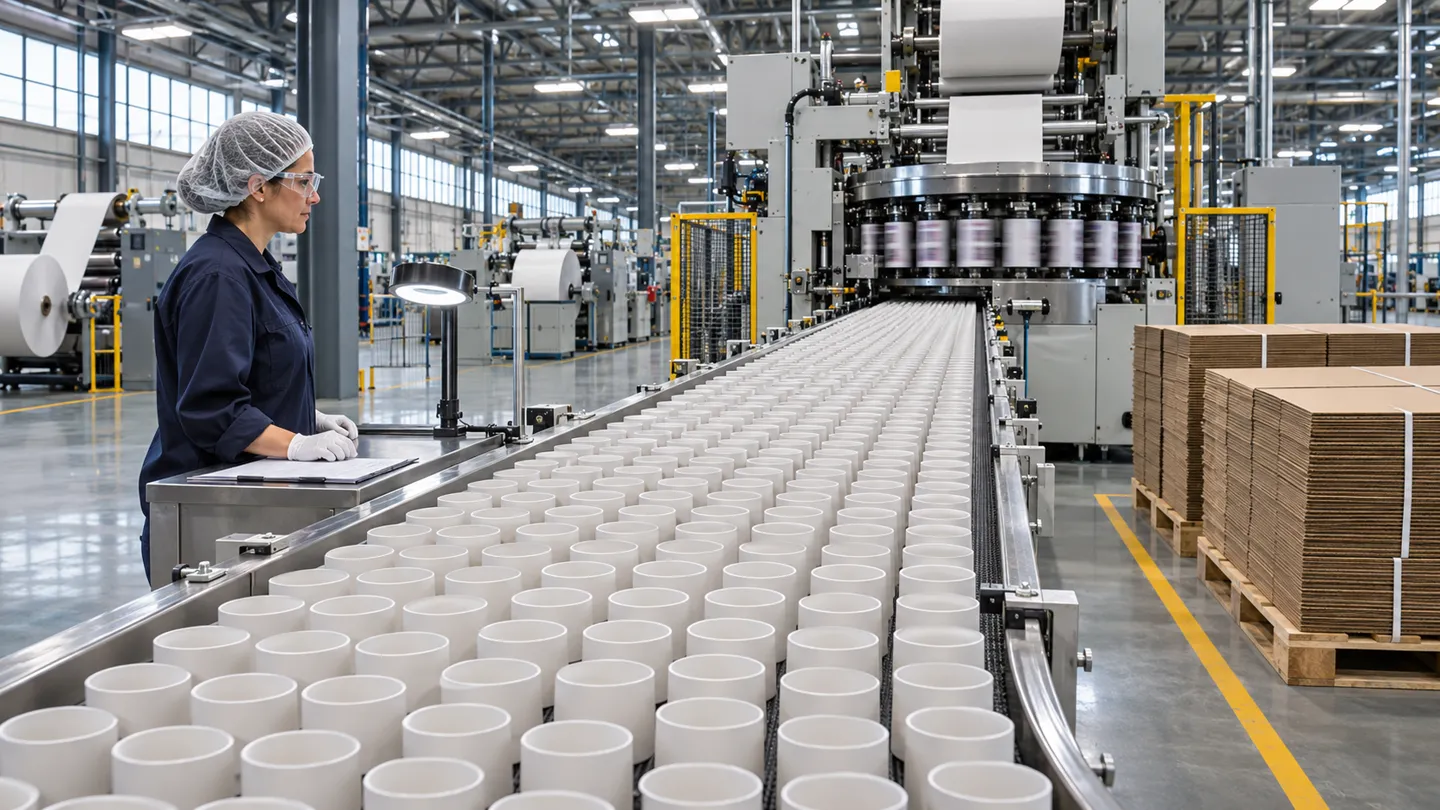
This is the point where the example gets specific. Our own custom program at YoonPak runs on published numbers: custom printing starts at a 30,000-piece minimum per item for ripple-wall construction with 10,000 pieces for stock items (our product catalog), a digital proof lands within one working day, standard samples ship free within 48 hours, and standard products deliver three to six weeks after order confirmation. We publish those numbers because the gap between “we can print your logo” and “here is the exact count, proof time, and calendar” is where most sourcing relationships break, and we would rather the break happen in your first email than in your sixth.
Reading Dunkin’s System as a Product Line
For importers and wholesalers, the case reads differently than it does for a solo bakery. Three conclusions, each traceable to something documented above.
First, the product line is a scene matrix, not a hero SKU. The lineup table in the first section shows six container families, each tied to an occasion, and the 2019 rollout replaced them together. An importer stocking only the best-selling single item, usually the hot cup, is stocking one cell of a matrix that customers buy across, and the order that gets away is the buyer who needed the box, the carrier, and the bag in the same container load.
Second, the delivery leg is the acceptance test. Every documented failure above, the leaked icing box, the coffee-against-food box, the tipped cup, is a delivery-leg failure with a specific engineering cause, which makes it a sampling protocol: when qualifying a factory, order samples and test the four failure modes deliberately, tilt the box to thirty degrees, steam-test a hot cup sealed inside a carton, and check grease holdout on the bottom board. Coatings, board grades, and sidewall seals are factory-floor variables, which is why this test happens at the factory level and not at a print broker’s; the broker can print on a box but cannot change how the box is glued.
Third, the MOQ wall is a channel opportunity. The co-op buying threads in bakery groups are small shops trying to aggregate demand by hand. An importer or wholesale distributor does that aggregation as the business model, quoting mixed-container programs across several downstream shops against one production run. That is exactly the structural advantage the print-broker tier lacks. Factory programs price by the run, and the party that assembles the run captures the margin.
Each of these positions has a precondition. The matrix play assumes you serve multiple foodservice segments; a single-category specialist should take one cell deep instead. The acceptance-test protocol needs agreed pass criteria in writing, or sampling arguments become relationship arguments. And the aggregation play carries real inventory and credit costs; it is a margin source, not a free win.
What translates, in the end, is not any single box. It is the discipline of the system: every container earns its place by solving one occasion’s failure mode, and the whole lineup survives contact with drivers, tilted car seats, and steaming coffee because somebody tested those moments before launch. That part requires no brand budget at all, only the willingness to test the way the delivery driver will.
If you are assembling a scene-based packaging program for your own channels, you can compare material certifications and custom-print terms in our catalog (YoonPak), where the food-contact papers come only from ISO- and BSCI-certified suppliers and meet FDA and LFGB contact standards.
Get a Custom Packaging Quote for Your Shop
Send your container list and logo artwork: a digital proof lands within one working day, and standard samples ship free within 48 hours.
Request Your Custom QuoteReferences
- Packaging Gateway. “Dunkin’ to introduce new product packaging across US restaurants.” 2019. https://www.packaging-gateway.com/news/dunkin-introduce-product-packaging/
- Comunicaffe. “Dunkin’ rolls out new branding in all of its store in the United States.” 2019. https://www.comunicaffe.com/dunkin-rolls-out-new-branding-in-all-of-its-store-in-the-united-states/
- Waste Dive. “Dunkin’ Donuts to phase out polystyrene foam cups by 2020.” 2018. https://www.wastedive.com/news/dunkin-donuts-phase-out-polystyrene-foam-cups-2020/516558/
- Dunkin’ Brands. “Dunkin’s New Double-Walled Paper Cup Hits New England.” 2019. https://news.dunkindonuts.com/blog/double-walled-paper-cup-dunkin
- Dunkin’ Brands. “Farewell to Foam: Dunkin’ Completes Global Transition to Paper Cups.” 2020. https://news.dunkindonuts.com/news/farewell-to-foam-dunkin-completes-global-transition-to-paper-cups
- Conservation Law Foundation. “Swapping Out One Unnecessary Evil for Another.” 2019. https://www.clf.org/blog/swapping-one-unnecessary-evil-for-another/
- Reddit, r/DunkinDonuts. “What corporate bonehead came up with this packaging?” 2025. https://www.reddit.com/r/DunkinDonuts/comments/1rks5ye/what_corporate_bonehead_came_up_with_this/
- Reddit, r/DunkinDonuts. “Why package the coffee with the food?” 2025. https://www.reddit.com/r/DunkinDonuts/comments/1rmdpzc/why_package_the_coffee_with_the_food/
- Reddit, r/Anticonsumption. “I’m a delivery driver and this is the crazy stupid amount of packaging DD uses.” 2024. https://www.reddit.com/r/Anticonsumption/comments/1gwnjg9/im_a_delivery_driver_and_this_is_the_crazy_stupid/
- Reddit, r/shrinkflation. “Dunkin Donuts coffee has changed their packaging.” 2026. https://www.reddit.com/r/shrinkflation/comments/1vmccq4/dunkin_donuts_coffee_has_changed_their_packaging/
- Reddit, r/popculturechat. “Dunkin’ Donuts is now launching its viral 48-ounce drink bucket nationwide.” 2025. https://www.reddit.com/r/popculturechat/comments/1tdhgea/dunkin_donuts_is_now_launching_its_viral_48ounce/
- Reddit, r/DunkinDonuts. “$6 Meal Deal is back with new Dunkings packaging!” 2025. https://www.reddit.com/r/DunkinDonuts/comments/1iiclti/6_meal_deal_is_back_with_new_dunkings_packaging/

 English
 German
 Spanish
 Italian
 Dutch
 French
 Portuguese
 Russian
 Arabic
 Korean