

McDonald’s Burger Boxes: What Makes Them Work and How to Get Your Own Made
Why the Box Is Part of the Menu
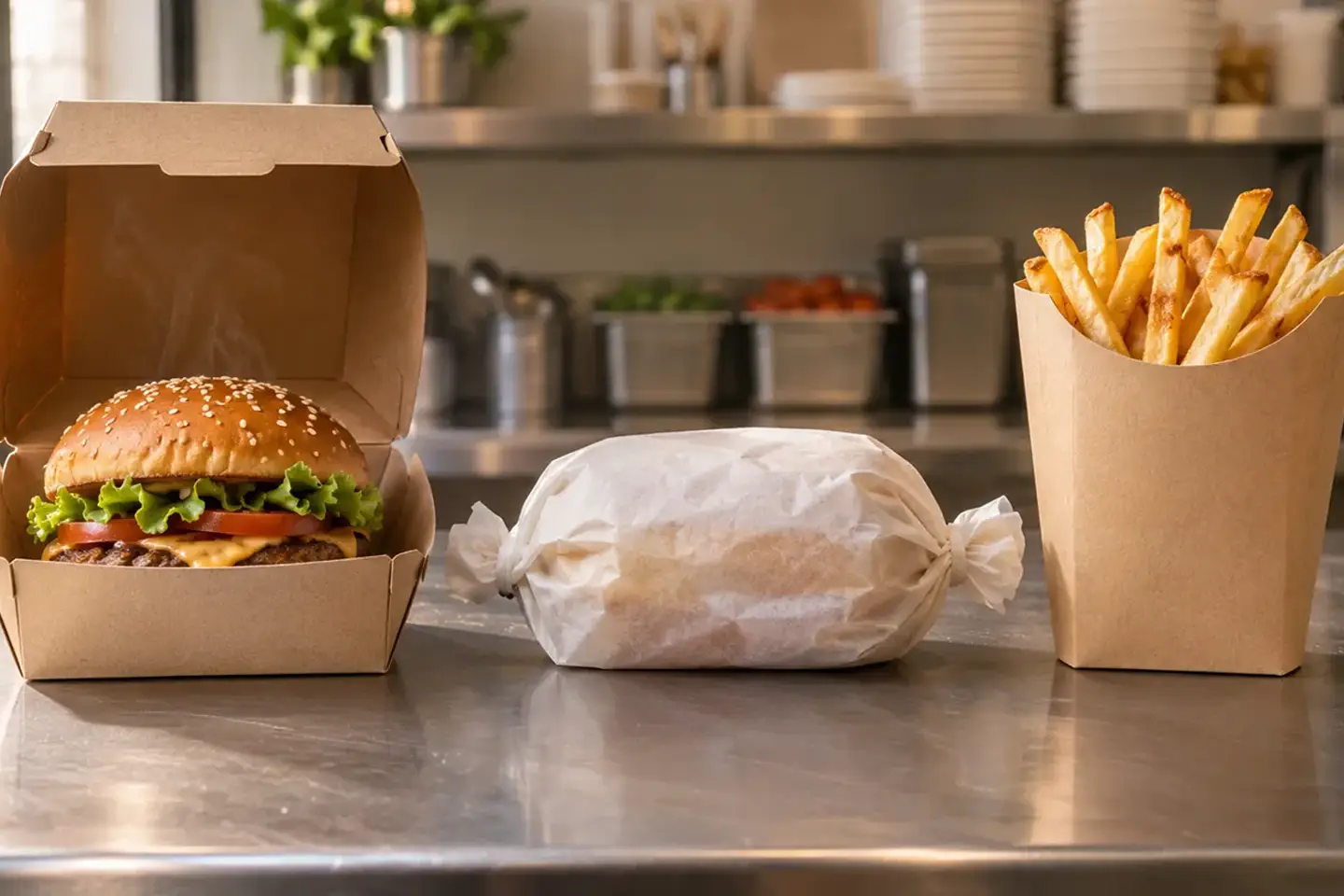
Two burgers leave the same McDonald’s kitchen within seconds of each other. One drops into a printed cardboard box with a lid. The other gets rolled into a flat paper sleeve. The two patties cost nearly the same to produce, yet in many markets the boxed one sells for roughly twice the price (r/NoStupidQuestions, 2022). Nothing in the recipes explains that gap. The box is doing part of the pricing.
Ask the crew assembling the orders and you get the same answer from the other side of the counter: boxed sandwiches are the premium list, wrapped ones are the value list (r/McDonaldsEmployees, 2022). In Canada that means Big Macs, Quarter Pounders and McChickens ride in cartons while McDouble and double cheeseburgers stay in paper. A commenter from Singapore noted that only the Big Mac gets the box there. The roster changes by market. The logic does not.
That logic is older than it looks. A box reads as substance, so the premium tier buys the box and the value tier keeps the sleeve, because if everything is boxed then nothing is special (r/NoStupidQuestions, 2022). The premium signal has a cost of its own, by the way. In-car eaters complain that a boxed burger leaves them sticky with nowhere to set it. That kind of complaint stays attached to a format rather than a restaurant (r/unpopularopinion, 2022).
If you run a burger menu, that lever is yours too. The box you choose is where a premium burger signals its price before the first bite, and where a value burger stays honest. This piece is about the box itself as an object: the structures it comes in, what each structure decides for your counter and your delivery bag, and how to get one made for your own brand. It is not a menu review.
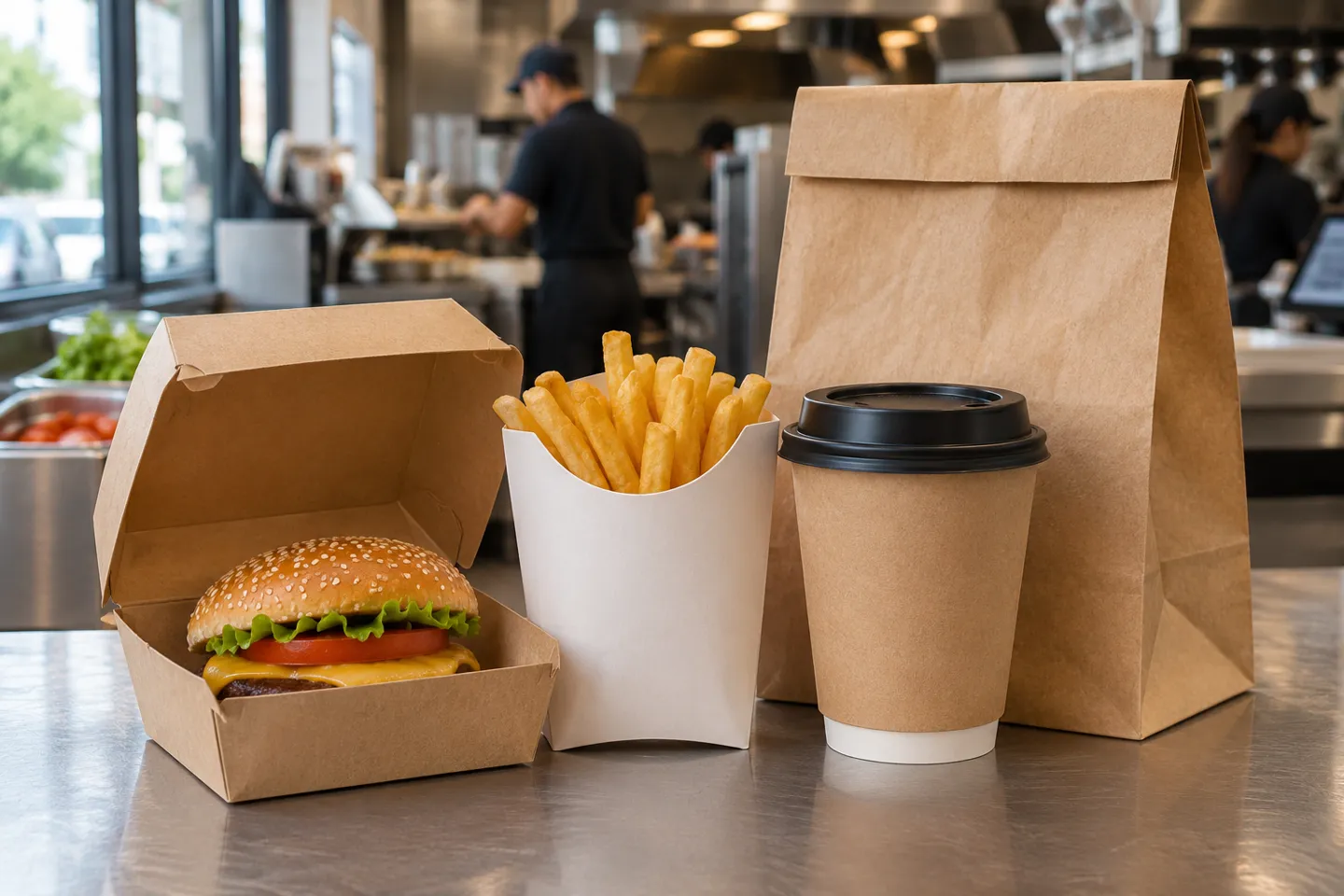
The Burger Box Family: Four Structures and What Each One Decides
The cardboard burger box is older than the foam clamshell most people remember. When the Big Mac went national in 1968, it traveled in a folded square cardboard carton with a round cardboard collar around the sandwich (Wikipedia, n.d.). Through the late 1970s the polystyrene foam clamshell took over the category: cheap to mold, insulating, rigid. It also produced the category’s most extreme structure: the McD.L.T. double clamshell. It kept the hot side, meat and bottom bun, physically separated from the cold side of lettuce, tomato and cheese until the moment of eating (National Museum of American History, n.d.).
Then the material under the structure collapsed. Polystyrene became the environmental symbol of fast food through the 1980s. The double container died with its menu item, and the industry rebuilt the clamshell in coated paper (National Museum of American History, n.d.). Every structure on the market today is a response to that history, which is why it earns the two paragraphs it just took. The foam-era survivors have a second life now: collectors pay for them (Etsy, n.d.).
⭐ Hinged Clamshell: The Default for a Reason
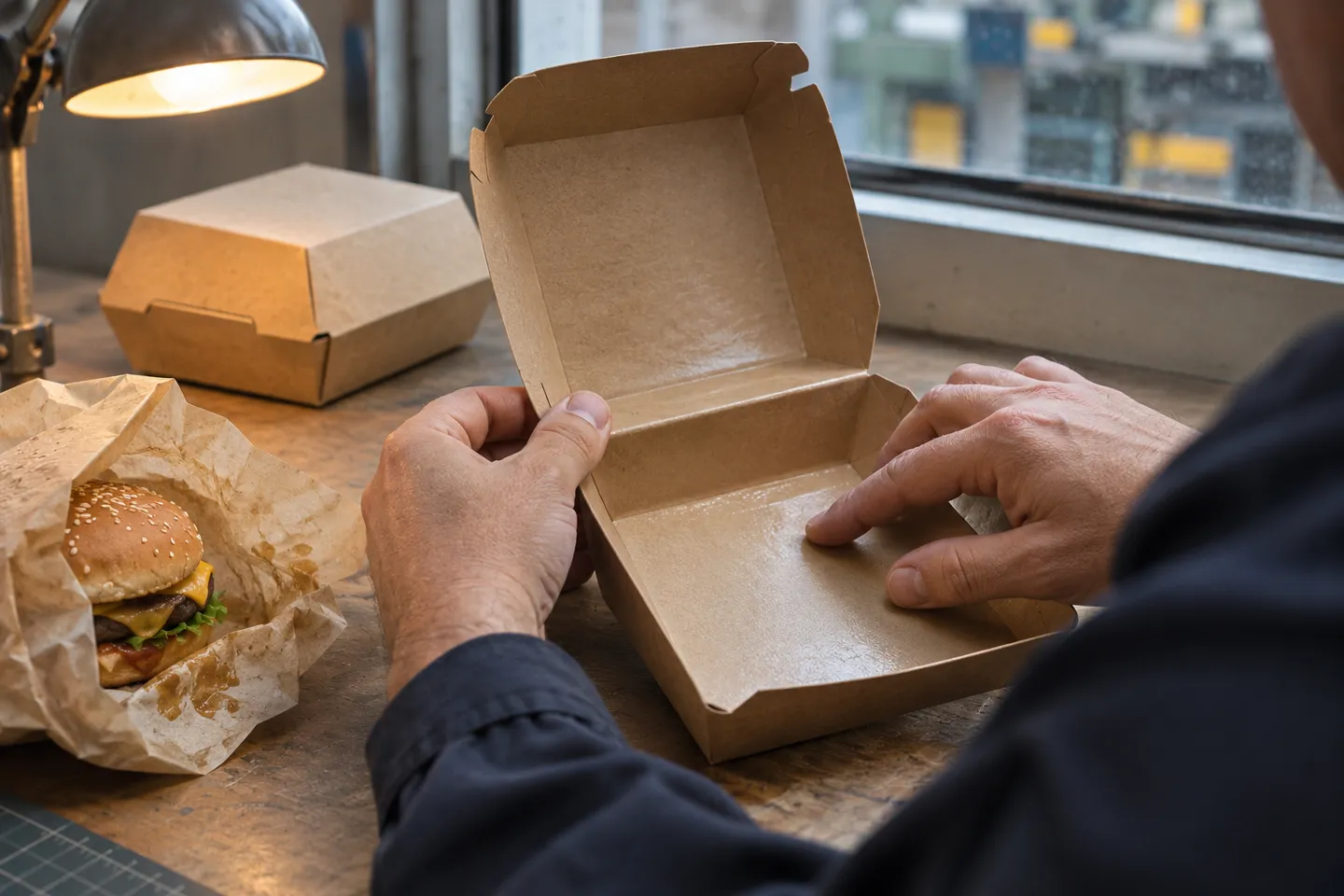
One piece, one hinge. The lid closes into its own base. Assembly at the pass is a single motion, the lid doubles as a tray during the meal, and a customer can hold and eat one-handed. After the foam era ended, this shape rebuilt in coated paperboard became the industry default, and it is the closest thing the market has to a standard premium burger box.
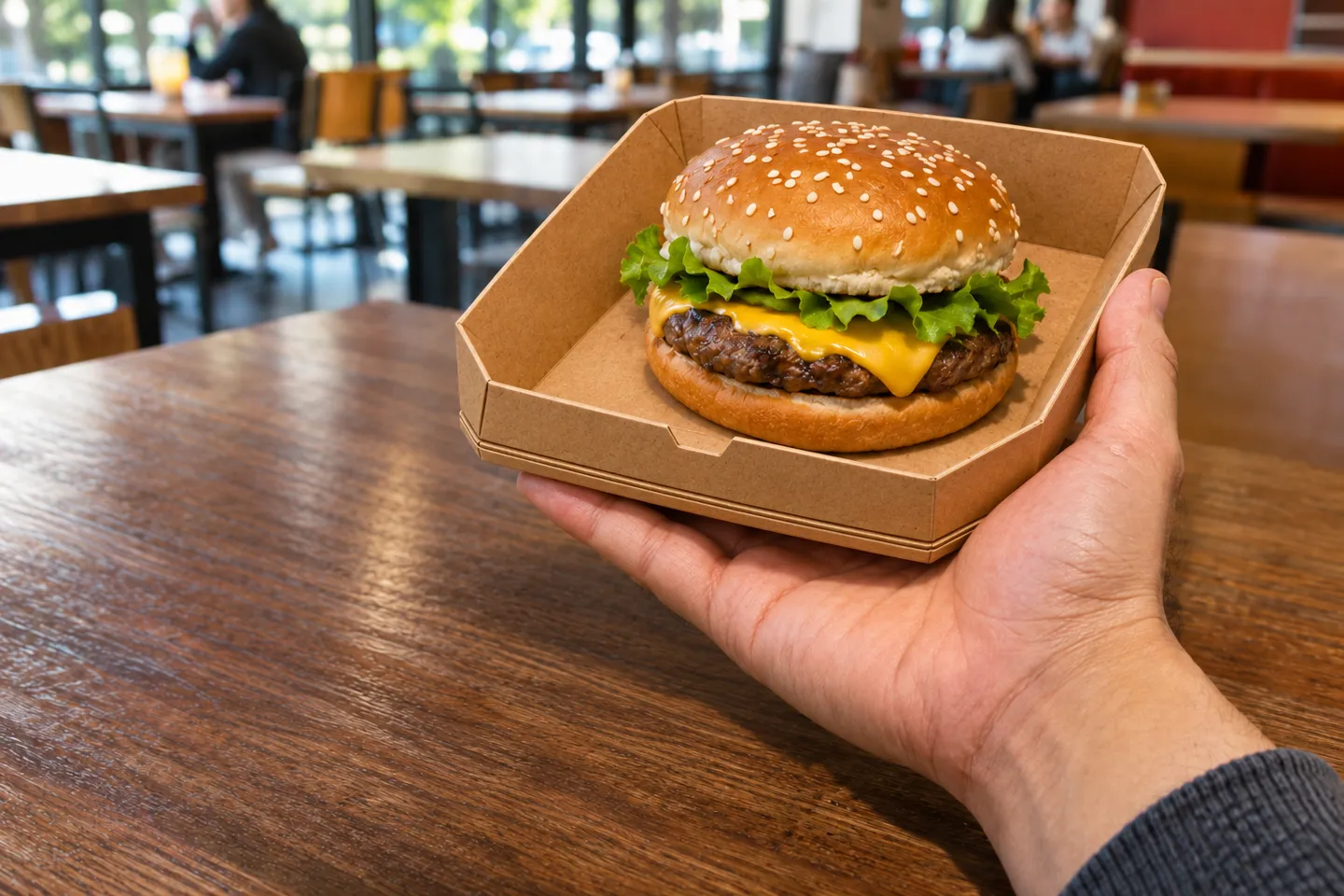
Its boundary is vertical. A hinged lid interferes with tall builds, so internal height must clear your biggest burger including the crown of the top bun.
Measure the tallest build you sell, not the average one, before ordering any clamshell.
Two-Piece Tray and Lid: Seal and Stack, One Extra Motion
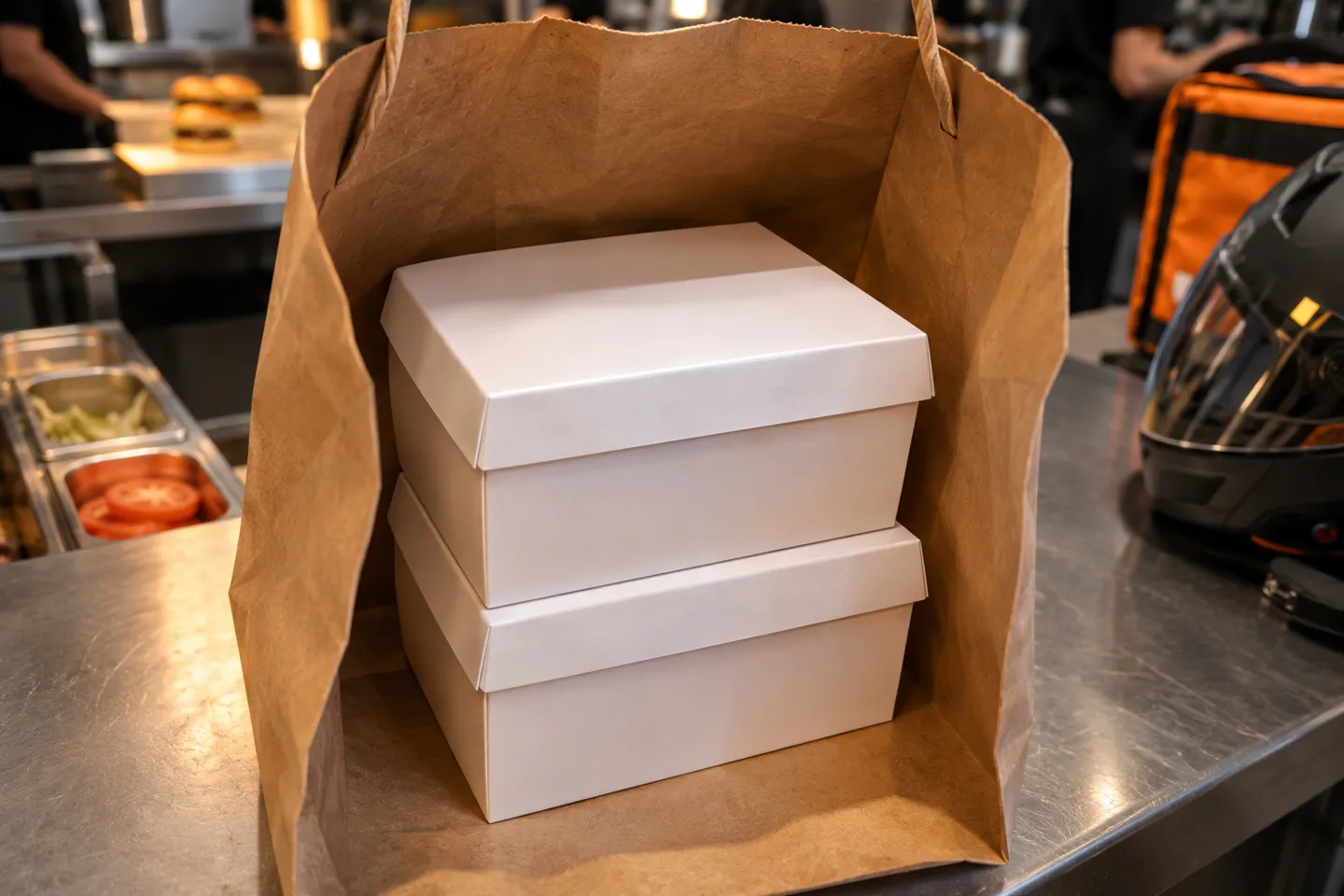
Separate base plus lid gives you the best seal and the best stacking, which matters when boxes ride in delivery bags instead of dining rooms. The price is one more assembly motion at the counter, and at peak hour that motion is labor. This is the structure big, tall builds usually end up in.
The cost of getting size wrong inside this structure showed up publicly when McDonald’s USA introduced the Big Arch, its biggest burger in years. A 455-point thread on r/McDonalds debated the new, larger box.
Field report: the Big Arch box
“now the sandwich will have extra room to fall apart as they turn the box upside down to put it in the bag”
Top comment, 122 upvotes of 455, on the r/McDonalds Big Arch box thread
That failure is worth memorizing because it is generic. Extra headroom between burger and lid becomes collapse every time a box is inverted into a bag, which is standard practice at rush hour everywhere.
One-Piece Folded Carton: The 1967 Original, Still the Cheapest
The folded square carton that carried the first Big Mac still exists in modern form. It ships flat, uses the least material, and converts to the lowest per-unit cost on the menu. What it gives away is rigidity: no stiff lid, a weak one-hand hold, and limited grease defense unless the board is properly coated. It fits a value list honestly and fails a premium list visibly, which makes it the mirror image of the clamshell.
The Double-Compartment Relic
The McD.L.T.’s split clamshell solved a real problem, soggy cold produce next to hot meat, with physical separation. But the material that made it practical was polystyrene, and when the material went, the structure and its menu item went with it (National Museum of American History, n.d.). The lesson survives: structure serves the food, material serves the structure, and when material policy changes, structures that depend on the old material die with it.
Four burger box structures against the decisions they make
| Structure | Assembly at the pass | Hold and eat-in | Venting and heat | Stacking and delivery | Best fit | Confirm before ordering |
|---|---|---|---|---|---|---|
| Hinged clamshell ⭐ | One motion, fastest | Lid becomes tray, one-hand friendly | Vent holes available on coated board | Good | Default premium burger in quick service | Internal height vs tallest build, hinge strength |
| Two-piece tray and lid | Two motions | Most formal, two hands | Plan venting, lids trap steam | Best, rigid lid caps the stack | Tall builds and delivery-heavy menus | Peak-hour assembly labor vs seal benefit |
| One-piece folded carton | Zero fold, arrives set | Weakest, no rigid lid | Limited | Flattens for storage, crush-prone in use | Value list, low-grease items | Grease coating spec in writing |
| Paper wrap (comparison row) | No structure | Hand-held only | Breathes naturally | None, needs bag support | Value burgers | Sauce load vs paper grade |
Two practical details sit on top of the structures. First, venting. The chain’s own perforated Big Mac lid exists because trapped steam softens a crisp build, and a public teardown showed the hole pattern doing exactly that job (HellthyJunkFood, n.d.). Vent holes are now a standard option on coated board, and they belong on any juicy or crispy build. Second, sizing: there is no standard size. The museum’s Big Mac clamshell measures 13 × 13.5 × 7 cm (National Museum of American History, n.d.). Export listings for clone-style boxes quote 105 × 105 × 85 mm and 110 × 110 × 105 mm (Alibaba, n.d.). The Big Arch required its own larger carton. Size follows the build, patty count and bun crown included.
The burger box also has neighbors in the same front-of-house family: fry sleeves and boats beside it, chicken buckets above it. All are built on the same coated-paper logic and usually sourced in the same program.
Getting the Same Box Made for Your Own Brand
Nobody sells “the McDonald’s box” at retail, and you cannot buy their packaging secondhand in any serious volume. What the market actually sells is the same structure at your spec, and export listings say so in their own titles: “Custom McDonald’s Sizes Food Grade Burger Box Cardboard” (Alibaba, n.d.). Read that translation literally: custom boxes built to those dimensions, food grade, your logo. That is the same route available to you, and it runs through six steps.
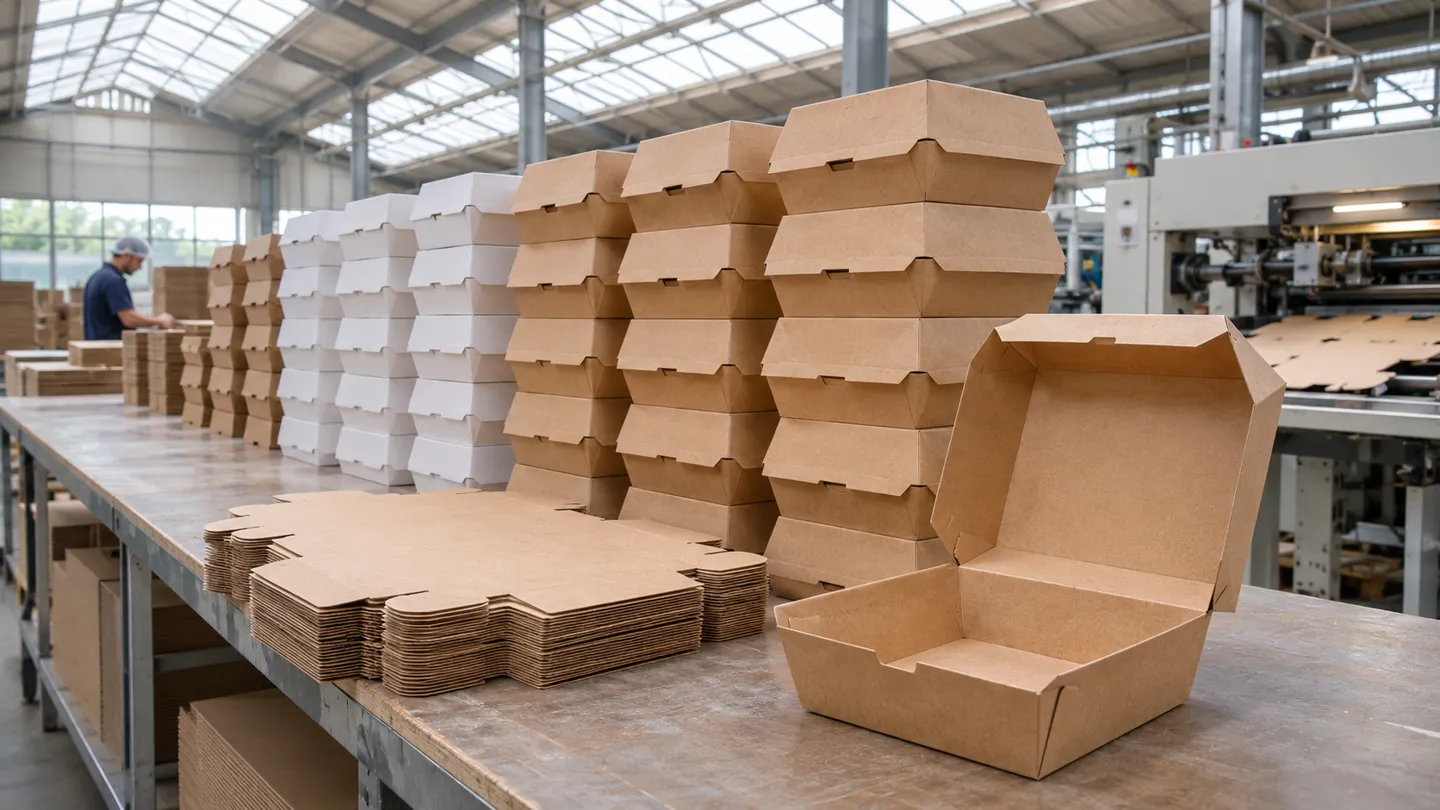
The Ordering Chain, Step by Step
Fix the spec before asking for a price. Measure your tallest build, height and diagonal, pick the structure from the matrix above, and decide the grease route, because every number on the quote depends on those three decisions.
Then sample. Export suppliers commonly provide free stock samples and charge for custom prototypes, so ask which is which (Alibaba, n.d.). Then test with real food: stack them, work the hinge, and bag your tallest build upside down the way rush hour actually does it.
Artwork comes third: vector files in PDF, AI or CDR format at around 300 dpi, and most suppliers offer in-house design when you cannot supply clean files (Alibaba, n.d.).
Then the quote and prototype sign-off, where the quote should list board weight, coating type, ink and colors, minimum order, lead time and trade terms line by line. Production follows. The question to ask is what inspection cadence the factory runs, because hourly checks with whole-lot rejection are the standard worth demanding rather than accepting whatever is offered.
Delivery is the last step, and it runs on two clocks. Export listings quote 7-18 days of production lead time before shipment, then 15-35 days by sea (Alibaba, n.d.). Full custom programs through established factories typically run three to six weeks from approved sample to door.
From spec to delivery
- 1Fix spec: structure, tallest-build dimensions, grease route.
- 2Sample: free stock vs paid custom prototype, test with real food.
- 3Artwork: vector PDF/AI/CDR, 300 dpi, in-house design available.
- 4Quote and sign-off: board weight, coating, colors, MOQ, lead time, terms, line by line.
- 5Production: ask for hourly QC and lot-rejection policy.
- 6Delivery: 7-18 days production plus 15-35 days sea freight on export lanes.
What the Price Bands Actually Tell You
The public market quotes two ends of the same box. Export clone listings run near $0.03 per box at 10,000 pieces (Alibaba, n.d.). US small-batch custom printing starts around $0.50 to $0.55 (PremiumCustomBoxes, n.d.). That fifteen-fold spread is not markup; it is board weight, coating, print colors, tooling amortization, trade terms and order size stacked on top of each other.
“Same box” in a listing title means same dimensions, not same spec, so the line to demand in writing is board weight in gsm and the named coating. A quote that lands far below the band with no board spec is not a bargain; the missing grams are the margin.
The public price band
$0.03
Per box at 10,000 pieces, export clone listings
$0.50-0.55
Per box, US small-batch custom printing
Board, Grease Resistance and Ink
One-side coated paperboard is the mainstream substrate, and export specs list it plainly (Alibaba, n.d.). Grease defense comes in three routes, each a trade. A PE lining is proven and cheap but hostile to paper recycling streams. A PLA lining, made from plant starch, buys compostability at higher cost. An unlined grease-resistant treatment keeps the board recyclable and needs the most testing against your greasiest item. Match the route to what your local waste stream actually accepts and what your menu actually drips.
Printing splits by volume and by job. Flexo single-color is the workhorse for large repeat runs; offset CMYK handles photographic brand work; Pantone spots hold color consistent across batches and across other packaging in the same program. Food-contact surfaces take soy-based or water-based inks as the norm. And claim microwave safety only when the material supports it, because customers will test the claim in their own microwave.
Compliance, MOQ and Lead Time: The Lines to Demand
Ask for documents, not adjectives. FDA compliance covers US food contact, LFGB covers the EU market, and factory-level ISO 9001 or BRC certificates are reasonable requests at any order size. A supplier who will not produce the files is telling you something, and the correct response is walking.
Minimum order quantities for custom box SKUs are publicly listed at floors around 10,000 pieces (Alibaba, n.d.). Some factories advertise flexible MOQs for growing accounts, so get the specific number for your specific spec in writing rather than assuming the listing applies.
Both MOQ and lead time have honest boundaries. Ten thousand boxes is heavy cash and shelf space for a single store. That is why local small-batch printers exist at higher unit cost, and why stock kraft clamshells with a sticker or sleeve program work as a first step. Rush programs exist on the production side too, but sample approval gates everything. Compressing prototype testing to save a week is how the inverted-bag failure gets discovered after launch instead of before.
Before You Sign: Failure Modes and the Checks That Prevent Them
Every failure below has already happened somewhere at scale, which is good news, because it means each one has a known test that catches it before your launch. The checks cost a few samples and a few days.
Pre-signature checks on real samples
- Grease soak-through: run your greasiest real burger in the sample for 48 hours, then inspect the outer panel and the delivery bag.
- Soggy build: hold an assembled burger 15 minutes in the closed box, then judge bun texture and vent performance.
- Inverted-bag collapse: bag your tallest build upside down, the standard rush-hour motion, and watch what moves.
- Stack crush: load cartons to your planned shelf or delivery-stack height and check the bottom box after a day.
Each test maps to one order line. The 48-hour grease test validates the coating choice, the 15-minute wet test validates venting, and the inversion test validates internal height. The stack test validates board weight. A sample that fails one of these is not nearly right; it is the wrong quote.
Supplier verification runs on the same logic in three documents. Food-contact compliance files, FDA or LFGB as your market requires, arrive as PDFs rather than claims. A consistency clause ties the production batch to the approved sample. Claim terms are negotiable market practice: photo-and-video claims without physical returns, with remake windows in the 30-day range, exist in the industry and are worth asking for by name.
Scale changes the depth of checking, not the list. Small local batches justify spot checks on delivery. Container-direct orders justify a pre-shipment inspection tied to a non-conformance remake clause in the purchase order. The asymmetry is the argument: these tests cost days, while the failures they prevent repeat every shift, on every order, in front of customers.
Run these checks on real samples: YoonPak sends free samples of your own box spec before any signature.
Request Free SamplesHow the Pros Read a Burger Box Quote
The floor price is commoditized, and everyone can see the listing, so unit price only decides which supplier pool you are shopping in. The rows that decide outcomes are the ones underneath it: board weight, grease route, structure fit, and how completely the size family covers your menu. A buyer who grades those four rows first is reading the quote the way the factory does.
Size is the row that quietly runs the daily failure rate. Buy the family: single, double and tall builds each with their own box, rather than one universal carton. The universal carton is how the upside-down-bag collapse happens at your counter every shift. The money saved on one fewer SKU comes back out through remakes and remade impressions.
Reading a burger box quote line by line
| Quote line | What it decides | How hard to push |
|---|---|---|
| Board weight (gsm) | Grease performance and stack rigidity | Demand the exact number in writing |
| Coating or liner type | Grease route and recycling fit | Demand the named material |
| Structure and internal height | Daily failure rate on tall builds | Match to your tallest build |
| Size family coverage | One SKU per build vs collapse risk | Push for per-build sizes |
| Print process and colors | Brand signal quality | Match spend to menu tier |
| MOQ | Cash tied up and shelf space | Negotiate, get your spec’s number |
| Lead time and terms | Launch dates and restock rhythm | Get the remedy clause |
| Unit price | Which supplier pool you shop in | Relax, the floor is public |
The strongest argument for reading quotes this way is on the historical record. When polystyrene fell out of favor, a structure died with its material and its menu item went with both (National Museum of American History, n.d.). Packaging at this level is a business decision wearing a cardboard costume, and it deserves the same scrutiny as an equipment lease.
There is a boundary here too, and it is a real one. If your model is a value menu of wrapped items, heavy box spending fails its own test, and stock cartons with one-color printing will do the job honestly. The framework earns its keep where the box is the signal, which for most burger menus is the premium half of the board.
When you are ready to put a real quote next to this framework, it helps to work with a factory that already runs it this way. YoonPak customizes burger boxes by size, shape, logo and material. Our four-step custom packaging process runs from consultation and free design support to a written quote and free samples before mass production (four-step custom packaging process). We run hourly QC on the line and hold Pantone and CMYK color matching across paper types; the wider front-of-house family is available as wholesale takeaway food boxes (wholesale takeaway food boxes). We will send samples before we ask for a signature.
Take the newest quote on your desk and read it against the table above: structure first, board and grease in writing, sizes per build, documents attached. The box is the cheapest thing in your store that touches every burger you sell.
Get Your Own Burger Boxes Made
Custom sizes, food-grade board and your logo. A written quote and free samples before mass production.
Request a Free QuoteReferences
- National Museum of American History. “McDonald’s McD.L.T. Double Clam Shell Container.” n.d. https://americanhistory.si.edu/collections/object/nmah_1200811
- National Museum of American History. “McDonald’s Big Mac Clam Shell Container.” n.d. https://americanhistory.si.edu/collections/object/nmah_1200816
- Wikipedia. “Big Mac.” n.d. https://en.wikipedia.org/wiki/Big_Mac
- r/NoStupidQuestions. “Why are some McDonald’s burgers wrapped but others in a box?” 2022. https://www.reddit.com/r/NoStupidQuestions/comments/sgxj2y/why_are_some_mcdonalds_burgers_wrapped_but_others/
- r/McDonaldsEmployees. “Why do some burgers come in that little cardboard box and others come wrapped in regular paper?” 2022. https://www.reddit.com/r/McDonaldsEmployees/comments/vdwpo1/why_do_some_burgers_come_in_that_little_cardboard/
- r/McDonalds. “Size of new sandwiche box.” 2026. https://www.reddit.com/r/McDonalds/comments/1rdjnuj/size_of_new_sandwiche_box/
- r/unpopularopinion. “Mcdonalds box burger package is an inconvenience.” 2022. https://www.reddit.com/r/unpopularopinion/comments/x9n6og/mcdonalds_box_burger_package_is_an_inconvenience/
- HellthyJunkFood. “McDonald’s New Perforated Big Mac Box Tested.” Facebook video. n.d. https://www.facebook.com/Hellthyjunkfood/videos/1246913783922470/
- Etsy. “Mcdonalds Burger Box.” n.d. https://www.etsy.com/market/mcdonalds_burger_box

 English
 German
 Spanish
 Italian
 Dutch
 French
 Portuguese
 Russian
 Arabic
 Korean