

McDonald’s French Fry Box: What It Is, Why It Works, and How to Get Your Own
What the McDonald’s French Fry Box Actually Is (and What It Isn’t)
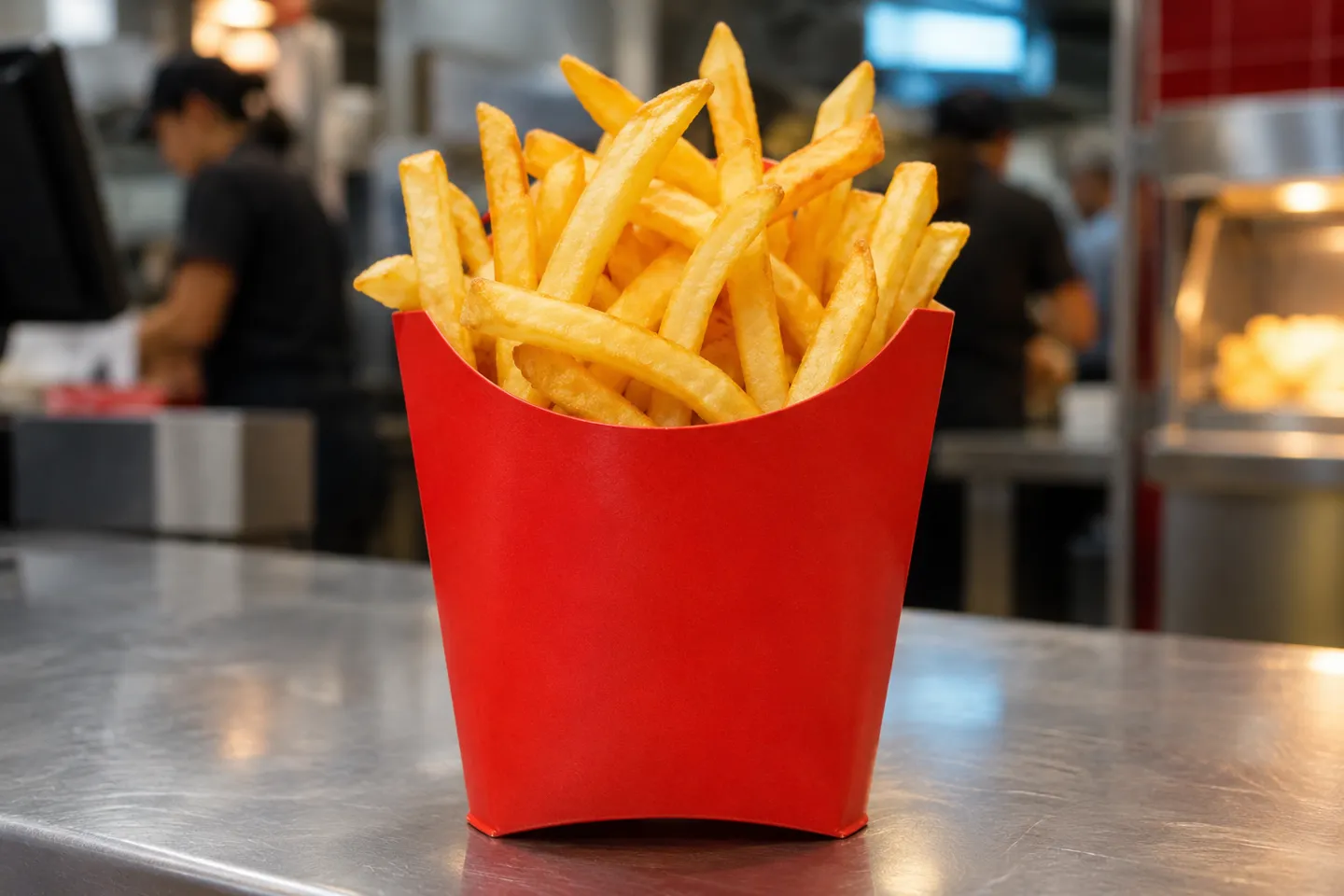
A red cardboard carton, open at the top, flared just enough to grip, standing on the counter with fries piled past the rim. That is the object most people mean when they look up the McDonald’s french fries box. It has no grand official name. Kitchen crews say fry carton, collectors say fry box, and an entire Reddit thread exists largely because people couldn’t agree on what to call it (Reddit r/NoStupidQuestions, 2023).
One mix-up is worth clearing before anything else, because search results tangle it constantly: the carton is not a menu item. Ordering a Basket of Fries gets you a wider, shallower container sold as a shareable portion. The box this article is about is the container itself, the open-top carton that small, medium, and large fries ship in. Different object, different question, and the rest of this article stays with the container.
Here is the argument this article makes: the fry box is not iconic because it is red. The color arrived after the logic. It became one of the most recognized food containers on earth because it solves several problems at once, and it has been doing that since 1970. Once you see the engineering, the printable templates, the collector listings, and the wedding favors all start to make sense as copies of a working design.
Where People Get One: Menu, Collectibles, and DIY
The official route is the shortest: order fries. The carton is packaging, not merchandise, so it is not something McDonald’s sells on its own. If you want an empty one for a toddler’s play kitchen, the advice from employees on r/McDonalds is disarmingly simple, just ask at the counter, where unused packaging is often handed over for nothing (Reddit r/McDonalds, 2026).
The collector route runs through Etsy and eBay, and it is more active than most people expect. Printable paper templates hover around fifteen dollars, sealed and used vintage cartons turn up regularly, novelty fry box pens exist, and full collector lots get listed into three figures (Etsy, 2026; eBay, 2026).
The DIY route is the biggest by volume, and it splits into three crafts. Free printable PDF templates fold into a near-perfect prop. Origami tutorials build the box from a single sheet, no printing needed. And for the 3D printing crowd, STL models of the box are free to download for display pieces and storage odds and ends.
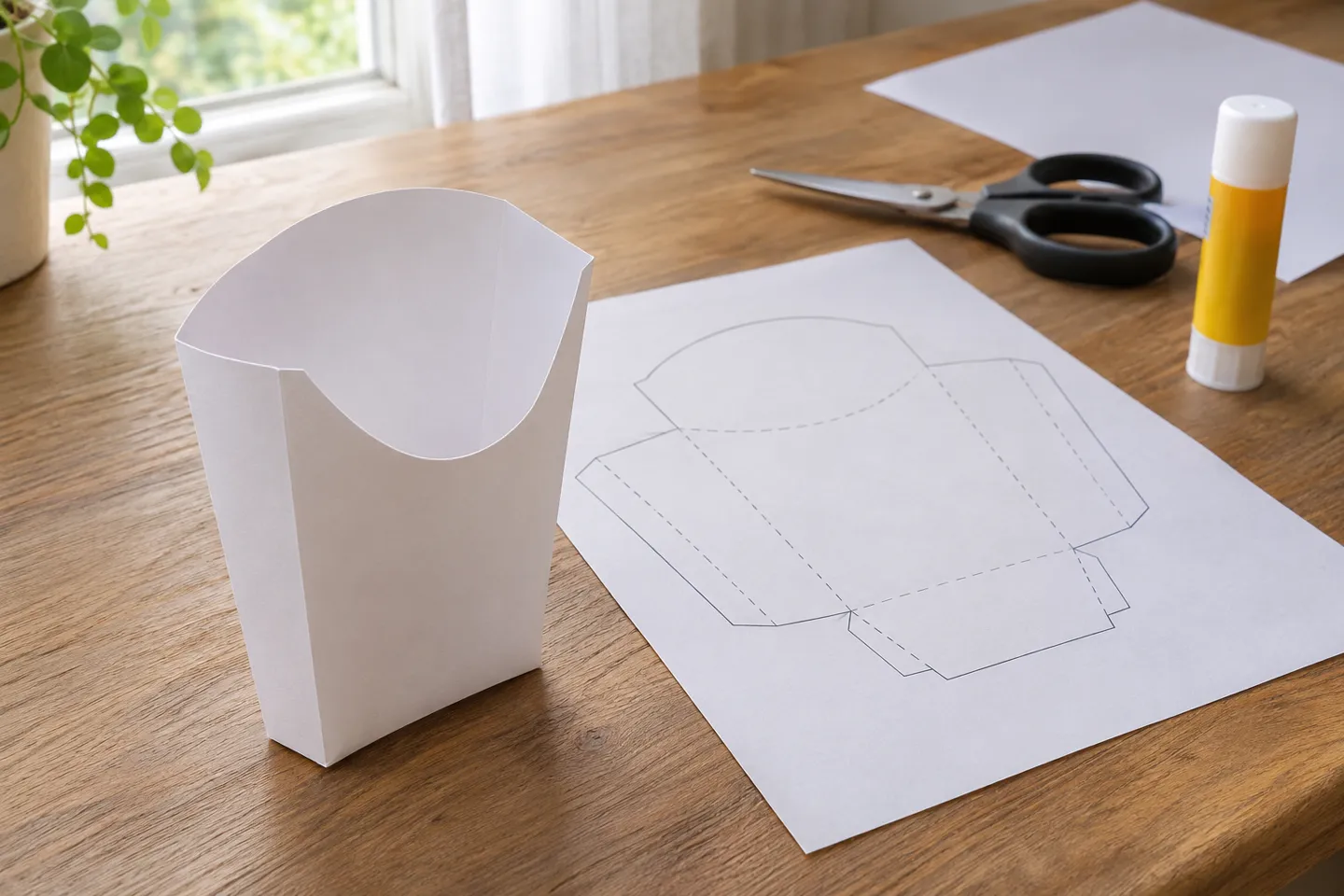
There is a fourth, quieter market hiding under these: parties. Sellers on Etsy personalize fry boxes as wedding and anniversary favors, a category where top listings carry hundreds of reviews. The McDonald’s fry box has become a party format, not just a fast-food container.
Which route fits you?
Want it free: ask at the counter, unused packaging is often given away.
Want the real vintage thing: Etsy and eBay collector listings.
Want a prop for crafts or a play kitchen: printable PDFs, origami tutorials, free 3D STL files.
Want them for a wedding or party: personalized fry boxes from party-favor sellers.
One caveat applies to every route: a paper craft prop and a working fry carton are not the same object. The next two sections take that gap apart.
Why the Box Is Designed That Way: Two Problems, One Carton
The 1970 Redesign: One Box, Two Problems
In 1970, the fry box was redesigned to answer two questions that fought each other. Kitchens of that era had less than 1,000 square feet of total space, and packaging for high-volume service still had to be stored somewhere inside them. At the same time, a lunch rush could not spare seconds per order fumbling boxes together (McDonald’s Corporate, 2020).
The answer was a carton that ships flat, stores in a fraction of the assembled volume, and pops open in one motion when the scoop comes down. Storage and speed, one package, zero compromise between them.
The scoop is the other half of the system. The French fry scoop held in the Smithsonian’s National Museum of American History was designed to dispense a precise amount. It was calibrated so that one heaped scoop filled one carton, portion after portion (National Museum of American History, n.d.). Container and scoop were designed together, which is why every carton looks equally full.
The 1970 redesign
1970
Redesign year
<1,000
Sq ft of kitchen space
One paper box solved storage and speed at the same time.
The Three Jobs: Heat, Steam, and Grease
Strip the branding and the carton is quietly doing three jobs.
First, heat. Paperboard insulates without cooking the food, and the open top means no lid to fight when you want a fry. You eat out of the box while walking, which a clamshell or a bag makes awkward.
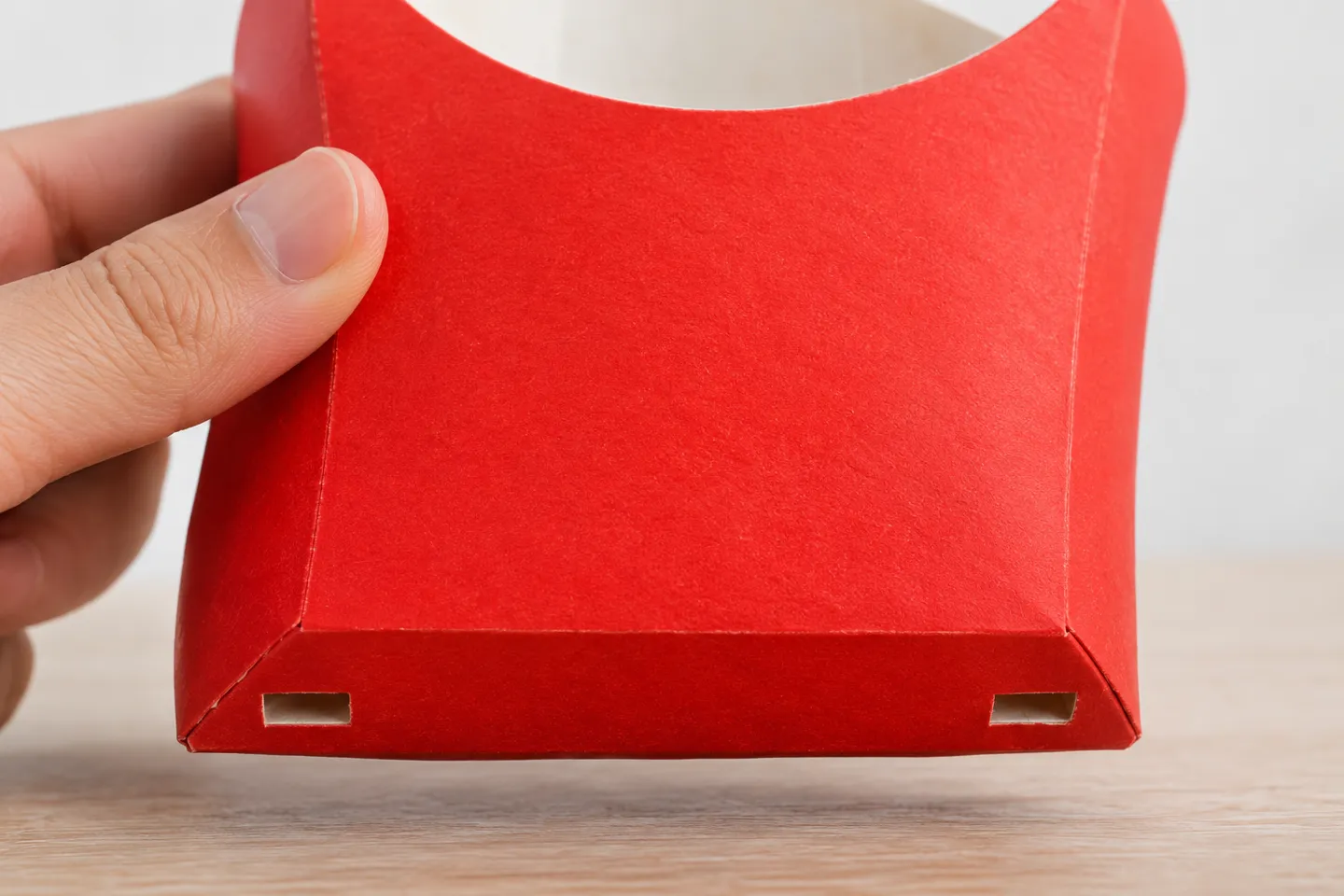
Second, steam. Fresh fries keep releasing water vapor for minutes after they leave the fryer. Trapped steam condenses, and condensed water is what turns a crisp crust leathery, which is why packaging suppliers tell food businesses to prefer ventilated paper containers over sealed ones (Herald Packaging, 2026). This is where the two gaps at the bottom of the medium and large cartons come in. Reddit users have singled those gaps out as a design flaw that makes the last fries unreachable (Reddit r/NoStupidQuestions, 2023). McDonald’s has never published a spec explaining them. Two engineering readings fit, though. The gaps bleed steam out of the bottom, away from the fries. They also stiffen the carton so a full load does not bow out. Either way, the honest summary is that the “flaw” looks a lot like a feature nobody explained, and the fries you lose to the gap are cheaper than the crust you would lose to trapped steam.
Third, grease. Resistance to oil comes from a treatment, not from thicker paper. Fry cartons get oil and grease resistant barriers precisely because fries shed grease and moisture onto plain paperboard (Washington State Department of Ecology, 2021). The chemistry has a history of its own. For decades the industry relied on PFAS-based coatings, exceptionally good at repelling grease. Packaging makers have been moving to alternatives since the health concerns mounted (C&EN, 2021). When the outside of a fry carton stays clean, a coating is doing the work, not the paper.
Three jobs, one carton
Heat
Insulation without a lid; speed at the counter.
Steam
Bottom gaps vent steam; stiffness under a full load.
Grease
A barrier treatment, not thicker paper.
Where the Copy Stops: Legal and Physical Limits
The fry box may be the most copied food container in the world, and it sits next to two very different walls. One wall is legal, and it decides what you may print. The other is physical, and it decides whether your copy actually works.
The Trademark Line Between Tribute and Copy
The golden arches are a trademark. The overall look of the packaging, the red carton with its specific markings, is what lawyers call trade dress, a protectable commercial appearance. For a home birthday party, none of this matters. The wall appears the moment money changes hands.
Marketplace sellers have worked this out in practice. Scroll the personalized fry box listings on Etsy and notice the wording: “McDonald’s style”, “McDonald’s inspired”, never the marks themselves (Etsy, 2026). That phrasing is the compliance convention of a whole product category.
An open-top paperboard carton is a generic form anyone may produce. The logo, the color scheme tied to the brand, and the overall trade dress are not. Printing your own brand onto the classic shape is the legitimate move, and it is exactly what packaging manufacturers do for restaurants and food trucks every day.
The shape is free. The identifiers are not.
When a Fry Box Fails: Grease, Steam, and Food Safety
A printable template fails as serveware twice, once chemically and once physically.
Chemically: food-contact packaging is produced against standards such as the FDA’s food-contact rules in the United States and LFGB in Europe. Office paper and standard craft stock are not made to those requirements, and home printer ink is nobody’s idea of a food-safe coating. A prop that looks like a fry carton is still a prop.
Physically: a sealed container full of hot fries turns into a condensation chamber, and the crust pays for it within minutes (Herald Packaging, 2026). Regulars at takeout counters have figured this out from the customer side. One popular tip literally instructs people to ask the restaurant to poke a hole in the box so the steam can vent (Reddit r/LifeProTips, 2021).
Never serve hot, greasy fries out of craft-paper props or plain printer stock. The material is not food-contact rated, the ink is not food-safe, and a sealed lid traps the steam that kills the crunch.
Run your own scenario against the matrix before you spend money on any version:
Can you copy the fry box? A scenario check
| Your scenario | What works | What fails or gets risky | Confirm before you order |
|---|---|---|---|
| Home party prop for kids or decor | Printable PDFs, origami, 3D print, empty cartons from the counter | Serving real fries in craft stock; food-contact rules and printer ink disqualify it | Keep real fries in proper serveware and use props for display |
| Wedding or party favors, given or sold | Custom-printed neutral fry boxes with your own wording, “style” or “inspired” phrasing from sellers | Any protected logo, marks, or the full brand look; selling copies invites trademark trouble | Food-grade grease-resistant paper and food-safe ink from the supplier |
| Your own restaurant, truck, or counter | Own-brand custom fry packaging in the classic shape | Sealed or lidded shapes for hot takeaway, they trap steam | Grease-barrier treatment, vent gaps, and a small-medium-large size ladder |
| Private-label party supplies for resale | Own-brand design produced under your label | Listing anything with protected identifiers, marketplace takedowns are routine | Supplier food-contact certificates (FDA, LFGB) and the supplier’s MOQ tier |
Getting Your Own Version: Shapes and What to Check
The classic carton is one point on a bigger map, and the right shape depends on where your fries are eaten.
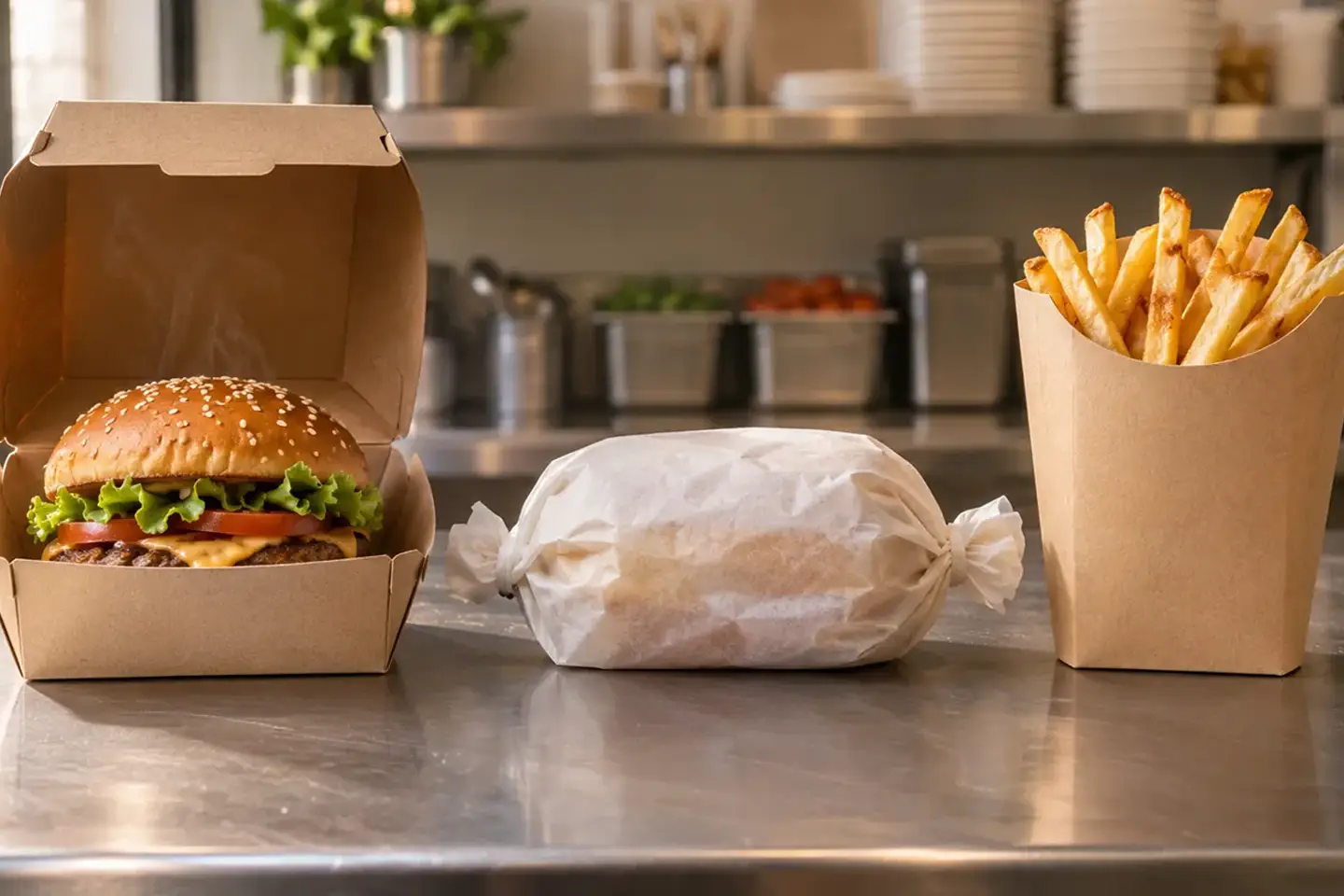
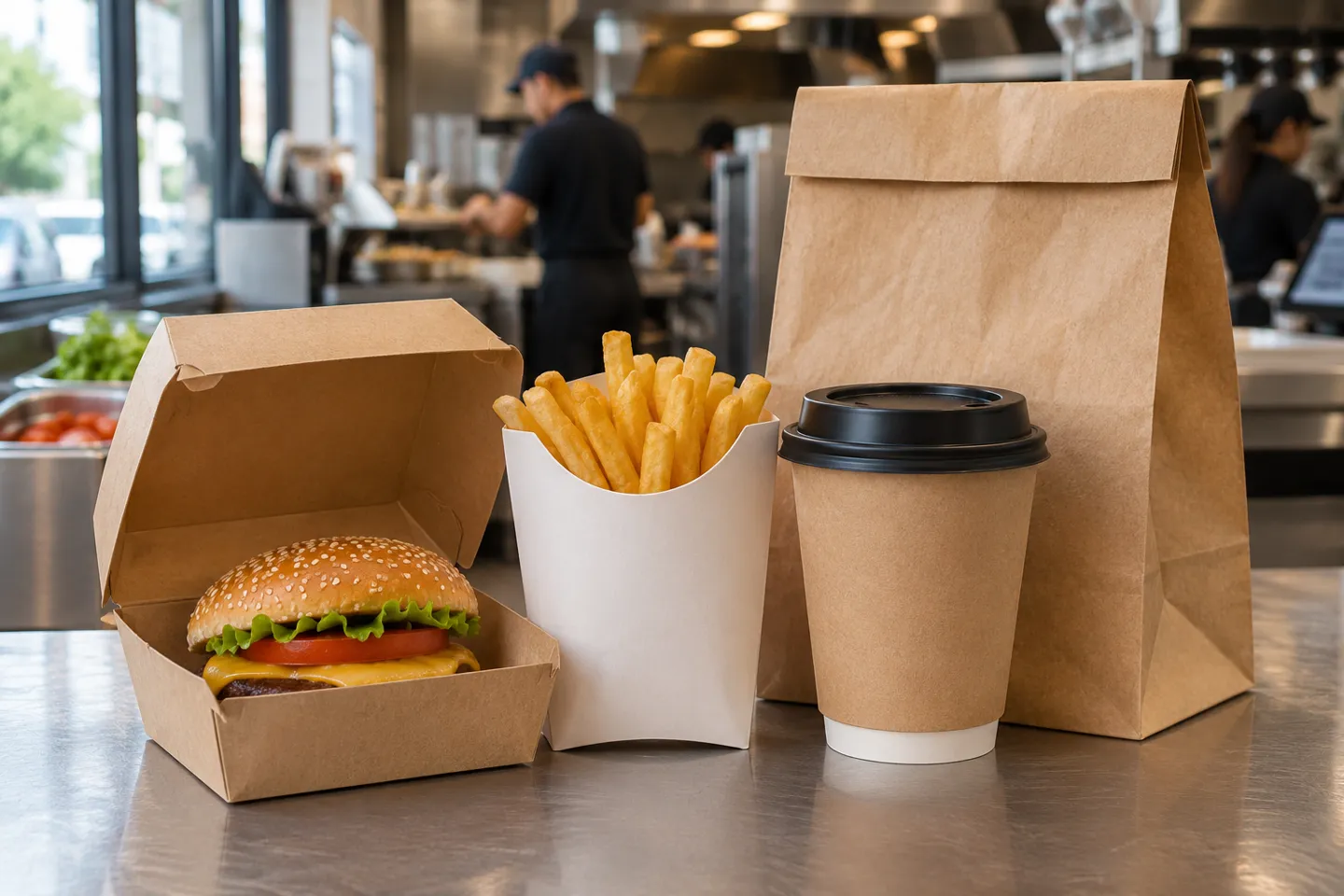
An open-top carton is the counter standard, fastest to fill and friendliest to eat from. A fry packet or sleeve, open at both ends, suits street food and quick handoffs. A serving tray handles cinema portions and multi-item snacking. A tray and cup holder combo pairs fries with a drink for delivery sets. A paper bag extends delivery life by holding heat longer. And for sharing sizes, the big-container cousin of the fry box, think bucket format, the same engineering in a larger shell.
Fry packaging shapes by scenario
| Shape | Best for | Weak spot |
|---|---|---|
| Open-top carton | Counter service, eat-while-walking | Faster heat loss than a bag on long deliveries |
| Fry packet / sleeve | Street food, one-hand eating | Holds less; not for large portions |
| Serving tray | Cinemas, food courts, multi-item snacks | No walls, fries slide on the move |
| Tray + cup holder combo | Delivery and drive-thru sets | Bulkier to store flat stock |
| Paper bag | Delivery, holding heat | Hides the product, can trap steam if sealed |
| Bucket format | Share sizes, family packs | Overkill for single portions |
Whatever shape you land on, three checks separate a working carton from a printed prop. Ask for the grease-barrier specification, a food-contact grease-resistant treatment, with water-based and PFAS-free options now the industry direction (C&EN, 2021; Washington State Department of Ecology, 2021). Ask how the carton vents, real gaps or holes that bleed steam, not decoration. Ask for the size ladder, small through large in consistent portion steps, so one scoop standard covers the range.
Then match your quantity to the right kind of supplier. Small print shops advertise custom fry boxes with minimums as low as 200 pieces, built for local restaurants and events (Ecoally, 2026). Factory-direct programs usually start in the tens of thousands of pieces. Both are legitimate, they are just different tools, and comparing a print-shop quote against a factory quote is how buyers end up disappointed in price, lead time, or both.
What This Classic Teaches Packaging Buyers
Take the red away, take the arches away, and what is left is a system: a scoop-calibrated portion, an open top for speed, gaps that bleed steam, and a grease barrier that keeps the outside clean. That system, not the color, is why the searches, the templates, and the wedding favors exist.
The Reddit thread about the “design flaw” is the tell. Users read the bottom gaps as a defect because nobody ever explained them, and the question has kept coming back ever since. For anyone selling packaging, that distance between engineering intent and public understanding is not a bug in the market, it is ready-made sales knowledge: explain the gap, and you are the supplier who knows boxes, not the one who just quotes them.
So treat this classic as an engineering course, not a printing course. Before comparing artwork proofs and unit prices, audit suppliers on three things: the grease-barrier spec, a venting structure that actually moves steam, and a size system that holds portions consistent. A supplier who answers all three in writing will also survive the questions you have not thought to ask yet.
And be honest about quantity before you compare quotes. A 200-piece print run and a tens-of-thousands factory program are different purchases with different economics. The cheapest quote usually wins by leaving the engineering out, and you meet that difference later, at the complaint stage, one soggy batch at a time.
If you want the classic shape under your own brand, YoonPak makes custom french fry packaging with free design support, a digital proof within one business day, and samples dispatched within 48 hours.
Put the classic fry box to work under your own brand
Custom sizes, food-grade grease barriers, and real venting, engineered to your spec.
Request Your Free QuoteReferences
- McDonald’s Corporate. “The History and Evolution of McDonald’s Packaging.” 2020.
https://corporate.mcdonalds.com/corpmcd/our-stories/article/Packaging-History.html - National Museum of American History (Smithsonian). “McDonald’s French Fry Scoop.” n.d.
https://americanhistory.si.edu/collections/object/nmah_1121846 - Reddit r/NoStupidQuestions. “What’s the container that you get fries in called?” 2023.
https://www.reddit.com/r/NoStupidQuestions/comments/10lo4q6/whats_the_container_that_you_get_fries_in_called/ - Reddit r/NoStupidQuestions. “Why do McDonalds fries containers have gaps at the bottom?” 2023.
https://www.reddit.com/r/NoStupidQuestions/comments/15j2zdz/why_do_mcdonalds_fries_containers_have_gaps_at/ - Reddit r/McDonalds. “How can I get an unused burger and fry cardboard container for a toddler play kitchen?” 2026.
https://www.reddit.com/r/McDonalds/comments/1tsjfv2/how_can_i_get_an_unused_burger_and_fry_cardboard/ - Reddit r/LifeProTips. “When you order takeout french fries (non-fast food), ask the restaurant to poke a hole in the box.” 2021.
https://www.reddit.com/r/LifeProTips/comments/ouackt/lpt_when_you_order_takeout_french_fries_nonfast/ - Etsy. “Mcdonalds Fry Box” market listings. 2026.
https://www.etsy.com/market/mcdonalds_fry_box - eBay. “Mcdonalds Fry Box” shop listings. 2026.
https://www.ebay.com/shop/mcdonalds-fry-box?_nkw=mcdonalds+fry+box - Washington State Department of Ecology. “Safer Alternatives to PFAS in Food Packaging.” 2021.
https://apps.ecology.wa.gov/publications/documents/2104007.pdf - C&EN (Chemical & Engineering News). “What’s after PFAS for paper food packaging?” 2021.
https://cen.acs.org/materials/coatings/PFAS-paper-food-packaging/99/i36

 English
 German
 Spanish
 Italian
 Dutch
 French
 Portuguese
 Russian
 Arabic
 Korean