

McDonald’s Packaging: What It’s Made Of and How to Get the Same Grade for Your Own Brand
What McDonald’s Packaging Is Actually Made Of
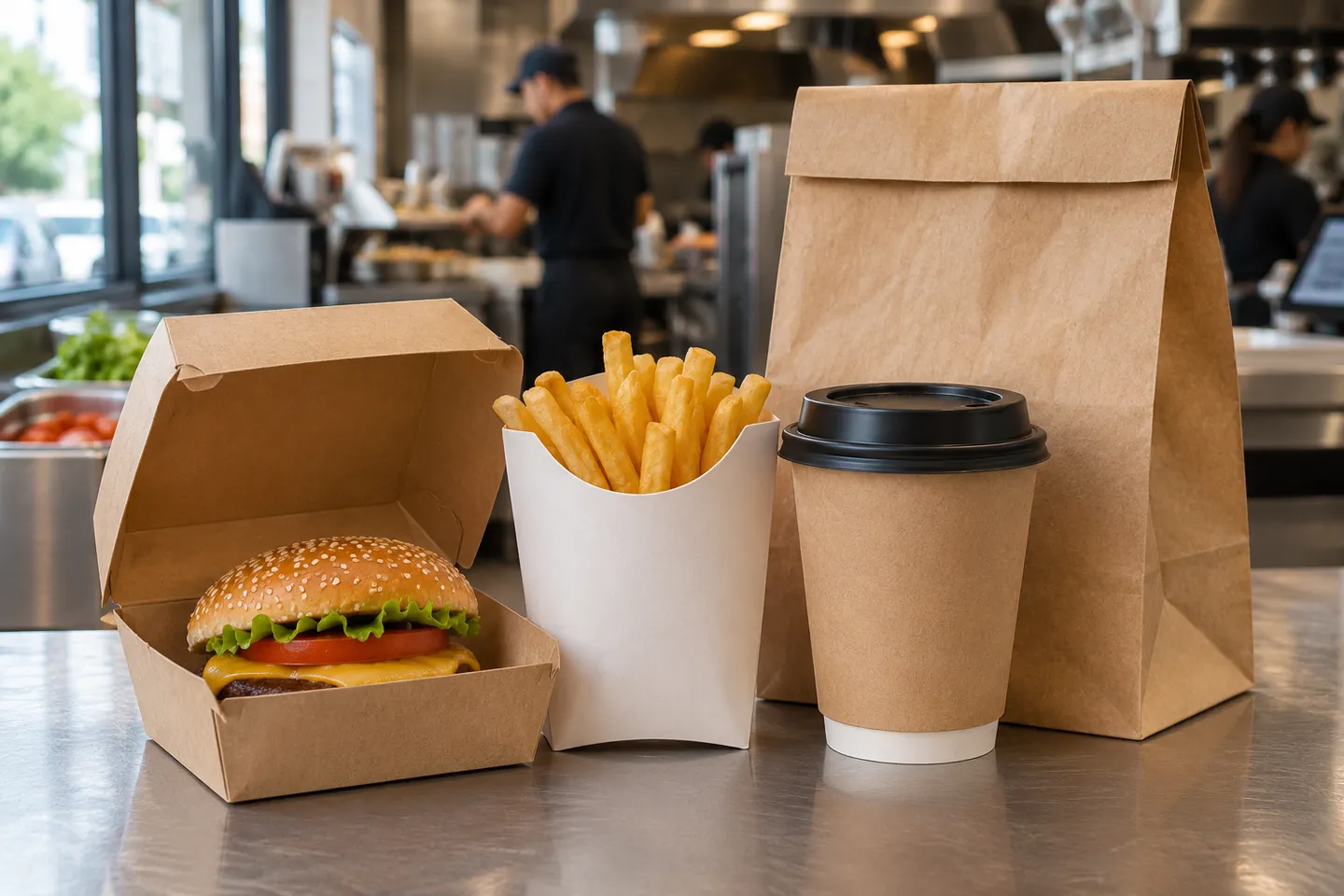
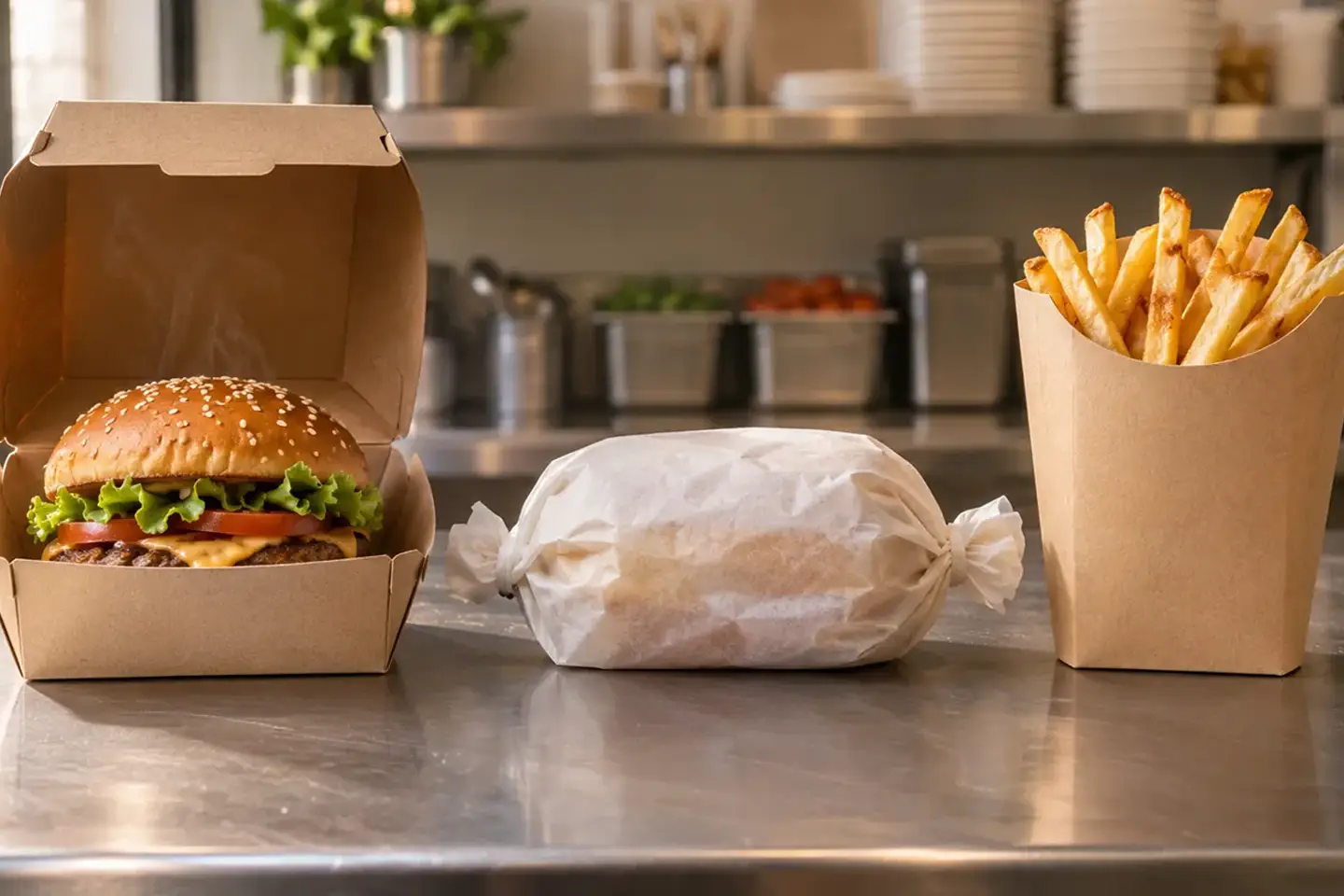
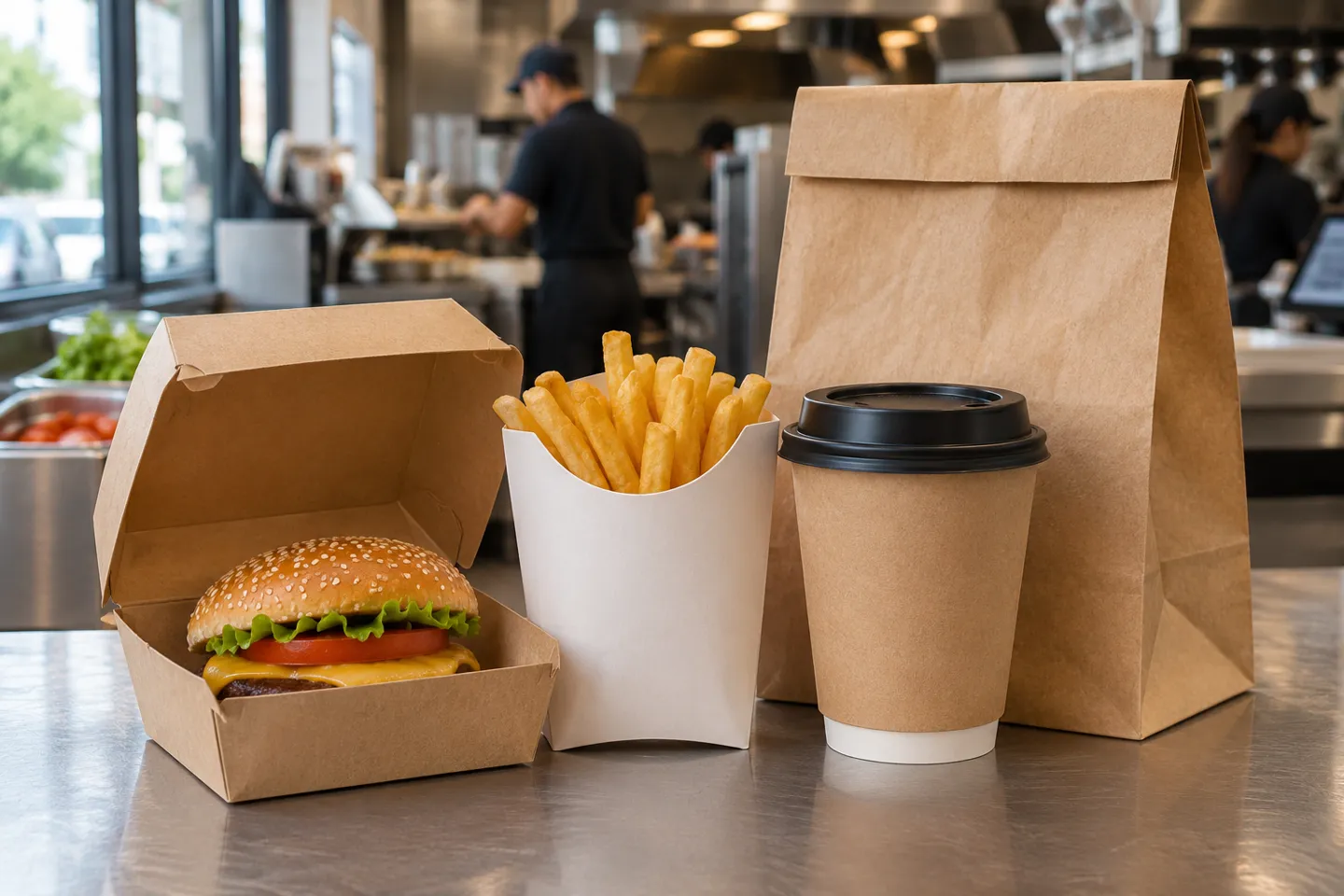
A burger clamshell looks like plain paper until you ask why the grease from a patty never bleeds through the outside. The answer starts with the material itself. McDonald’s states that most of its guest packaging is fiber-based, meaning it is made primarily from paper, pulp, cardboard, or wood (McDonald’s Corporate, 2026). That single sentence covers most of what you see in a meal tray. The burger box, the fry sleeve, the hot cup, and the carry-out bag are all built on plant fiber.
“Fiber-based” is a family, not one material, and each member does a different job. Burger boxes and fry sleeves use stiff paperboard, kraft or bleached white, chosen for rigidity. Cups use lighter paper, often in two layers for heat. Bags use kraft with a square bottom so they stand and carry. Where food is wet or greasy, the fiber gets help from a thin coating, and that coating carries a catch of its own.
One clarification before going further. A US restaurant supply store called McDonald Paper & Restaurant Supplies has nothing to do with the chain. The vintage wrappers sold to collectors are a separate market entirely. This article is about the actual food packaging: what it is, why it changed, and how a smaller food business can buy to the same standard.
| Package | Base material | What it is doing |
|---|---|---|
| Burger clamshell | Paperboard, kraft or white | Rigidity, heat holding |
| Sandwich wrap | Greaseproof paper, sometimes foil-lined | Grease control in hand |
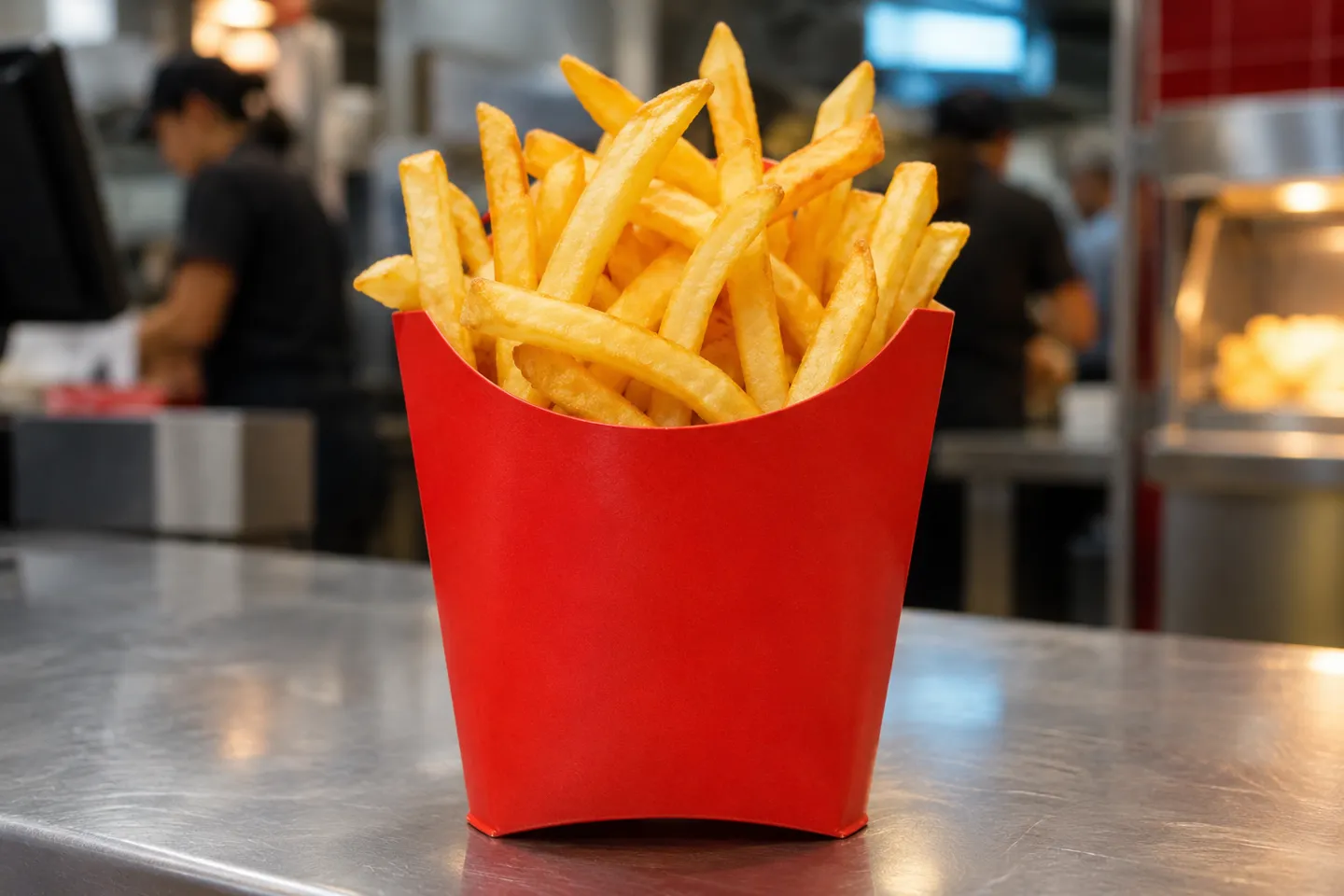
| Fry sleeve | Stiff paperboard | Open-top serving, grip |
| Hot cup | Paper, single or double wall | Heat with a lining barrier |
| Cold cup | Mostly PET plastic | Outside the fiber story |
| Meal bag | Kraft paper, square bottom | Carrying a combo |
| Trays and boats | Paperboard or molded fiber | Sauces and sharing |
The material map explains what each package is. It does not explain why the same fiber behaves so differently once it is folded into a box, a sleeve, or a cup. That difference comes from structure.
The Six Structures That Carry a Fast-Food Meal
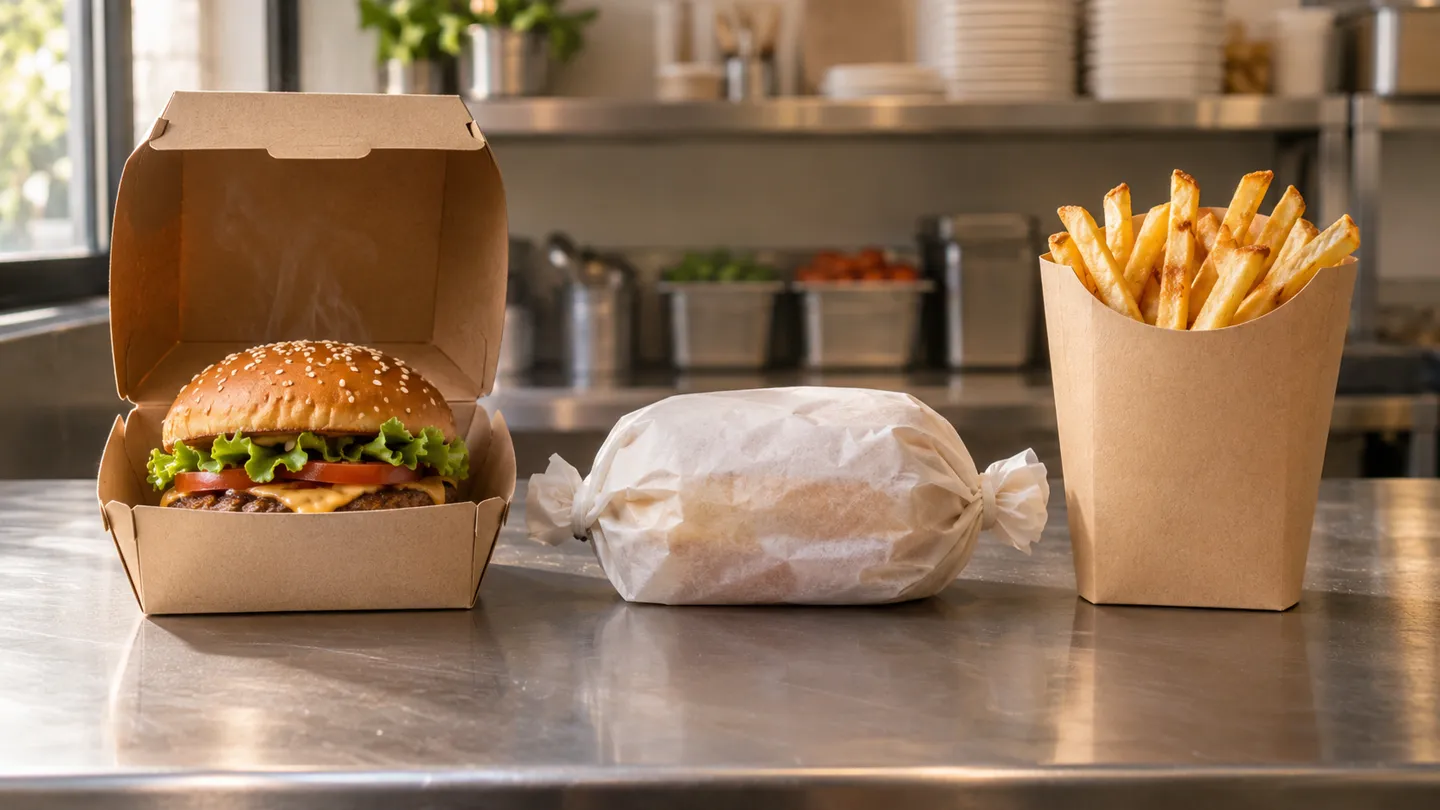
Fast-food packaging is a set of structures, and each one is an answer to a specific physical problem. The clamshell is the most common. It is a one-piece hinged box that folds closed in a second, holds heat around the burger, and ships flat in a stack. That combination won design awards when the red fry box debuted in 1970 as a joint project with a packaging supplier (McDonald’s Corporate, 2020).
The sandwich wrap is the opposite approach: a sheet, not a box. Greaseproof paper keeps oil in and lets heat escape slowly, and a foil lining is added for items that must stay hot longer. The fry sleeve solves a narrower problem, an open top for grabbing fries while keeping oil off fingers, using stiff board with a coated inside face.
Cups are where structure turns into engineering. A single-wall cup relies on its lining to hold the drink. A double-wall cup adds an air gap between two layers. That air gap is why a hot chocolate survives a drive-through without burning the driver’s hand. Extra rigidity calls for corrugated board with a fine flute, as in delivery clamshells. B-flute is the standard choice in the US market for this kind of food box.
Bags and trays round out the set. A square-bottom kraft bag stands upright and carries a full combo without a second hand. Boats and trays, increasingly formed from molded fiber, hold sauces, nuggets, and sides with walls that resist soaking. Molded fiber deserves a note of its own: it is pressed from wet pulp into shape, and it is becoming the default for rigid serving pieces.
| Structure | Problem it solves | How it does it |
|---|---|---|
| Clamshell ⭐ | Heat retention plus flat shipping | One-piece hinge; corrugated option traps air |
| Sandwich wrap | Grease in hand, slow heat loss | Dense greaseproof fiber or a foil liner |
| Fry sleeve | Open access, oil-free grip | Stiff board, coated inside face |
| Double-wall cup | Hot drink, cool hand | Air gap between two paper layers |
| Square-bottom bag | Carrying a full order | Flat base, kraft tensile strength |
| Boat and tray | Wet and shared sides | Molded fiber walls resist soaking |
Every structure above depends on the same quiet helper: a barrier that keeps oil and water where they belong. That barrier is also the reason a “recyclable” paper cup and a grease-soaked fry sleeve are not equally welcome in a recycling stream. That is exactly where the plain-brown shift begins.
Why Big Chains Went Plain: Three Forces, Not One Trend
The compliance push
In January 2021, the chain committed to removing added PFAS from all guest packaging globally by 2025. PFAS are a class of fluorinated grease-barrier chemicals (Safer States, 2021). This was not voluntary virtue. Washington State and Maine had already passed laws phasing PFAS out of food packaging from January 2022 (As You Sow, 2020). Municipal composting rules keep adding pressure. Users on r/McDonalds note that locations switching to compostable-style packaging usually do so because local regulations demand it. When a grease barrier chemical gets legislated out, the packaging has to change, not just the marketing.
The recycling problem
The second force is the awkward truth about coated fiber. Paper is recyclable; oil and linings complicate it. A fiber cup with a plastic lining needs a facility that can separate the two. A fry sleeve soaked in oil can contaminate a paper batch and downgrade the whole load. The company’s own pages describe efforts to close the loop locally. Even so, the claim “fiber-based and recyclable” survives a greasy lunch rush far less reliably than the claim suggests. Users have been asking exactly this for years: if the oil soaks in, does the recycling claim still hold? The honest answer: it depends on the coating and the local facility. That is why plain, uncoated, single-material kraft has become the safe default.
The cost logic
The third force rarely appears in corporate pages: money. Plain kraft board runs on flexo printing, a one-or-two color process that costs far less than the four-color offset work behind full-bleed illustrated packaging. Fewer ink stations, simpler lining decisions, and standard unbleached board also mean fewer specification risks across thousands of suppliers and markets. When three pressures, regulation, recyclability, and unit cost, all point the same direction, plain brown stops being a style and becomes the rational default.
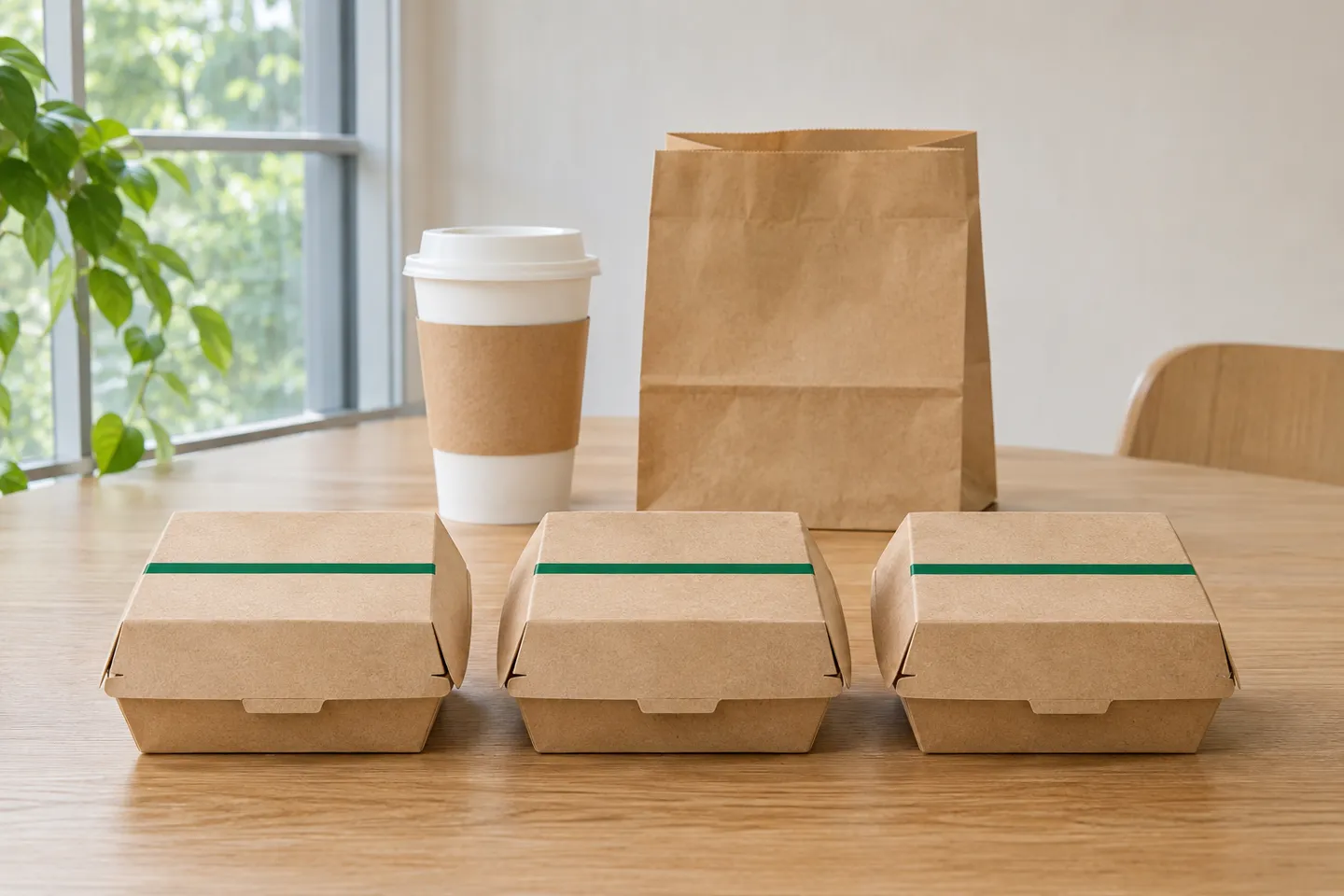
The design history confirms it was a decision, not a drift. Foam clamshells gave way to paper through the 1990s. In that decade, a partnership with an environmental group eliminated more than 300 million pounds of packaging (McDonald’s Corporate, 2020). Illustration-heavy printed packaging dominated the 2000s and 2010s. Then, in February 2021, the chain swapped full-bleed illustration for a minimalist single-color graphic system designed by Pearlfisher (Designboom, 2021).
The 2021 redesign
In February 2021, McDonald’s replaced its illustration-heavy packaging with a minimalist single-color graphic system designed by Pearlfisher. Identity moved from covering the box to drawing it well.
That redesign is the tell. If full-color printing were the source of the brand’s visual power, a minimalist system would have weakened it. The opposite happened: simple line graphics on unbleached board read stronger, because the identity lives in the drawing, not the ink coverage. Alongside the redesign, the company kept a public target. All guest packaging should come from renewable, recycled, or certified sources by 2025 (McDonald’s Corporate, 2018).
One boundary belongs here, because the trend is easy to copy wrongly. Going plain works when the structure and material underneath are still doing their job: heat held, grease blocked, grip dry. A plain bag that soaks through, or a bare box that arrives soggy, is not minimalism, it is a downgrade the customer can feel. Check your material and structure first, then adopt the look; the look alone transfers none of the value.
For an operator watching this from the outside, the question is no longer “why did they go plain.” It is “what exactly should I buy to get that grade.” That is a checklist question, and it has a checklist answer.
YoonPak prices custom fiber packaging against exactly this standard; send your product list and we will quote it line by line.
Request a Same-Grade QuoteChoosing the Same Grade for Your Own Brand
The scene matrix: structure first, then material
The same grade does not mean the same box. It means matching structure and material to each food you actually sell, with a boundary condition attached to every choice. The matrix below is built for a burger-and-fries operation, and it extends to drinks and delivery.
| Application scene | Recommended structure | Recommended material combo | Check before you commit |
|---|---|---|---|
| Burgers ⭐ | Clamshell, flat board or corrugated | Food-grade virgin kraft or white board; grease-resistant coating; B-flute if delivery-heavy | Confirm the grease barrier type (coating vs dense fiber) and heat retention over your delivery window |
| Fried chicken and fries | Open-top sleeves, boats | Stiff paperboard, coated inside face | Ask for the oil hold-out at your frying temperatures; confirm the temperature ceiling in writing |
| Hot drinks | Double-wall cup | Paper with PE or PLA lining | PLA only pays off if your local composting stream actually accepts it |
| Cold drinks | PET cup, or paper with verified cold lining | PET | Paper cold cups need a verified condensation lining; sweat failures kill takeaway reviews |
| Delivery combos | Square-bottom kraft bag plus corrugated clamshell | Kraft board plus B-flute | Confirm stack compression strength if bags ride on top of each other |
| Soups, salads, family buckets | Paper bowls, molded fiber trays, buckets | PE-lined board or molded fiber | Confirm lid seal and the supplier’s leak-claim procedure before the first bulk order |
Two edge categories complete the map rather than demand rows of their own. Molded fiber trays share the soup-and-salad row’s logic. Family buckets are the bucket-size version of the paperboard line.
The material checklist to demand from a supplier
The checklist is where grade becomes enforceable. Food contact comes first: FDA compliance for the US market and LFGB for Europe are the baseline food-contact certificates to see, not just hear about. Fiber sourcing follows: FSC certification on the board tells you where the fiber comes from, and it is increasingly a procurement requirement for chains and retailers. If you market compostability, ask for the actual certificates. BPI covers North America and DIN CERTCO covers Europe. A compostable claim without a certificate is just a word on the box.
Then the barrier decision: PE lining is the standard waterproof, oil-proof choice, PLA is the plant-based alternative, and uncoated dense greaseproof fiber is the simplest recycling story. Board spec comes next, including grammage and, for corrugated clamshells, the flute type. Finally, printing. A single-color logo on kraft runs on flexo presses and keeps unit cost down at small volumes. Full-color CMYK with Pantone matching runs on offset presses and pays off at larger runs. The process boundary between flexo and offset is exactly where most small-brand budgets leak.
The numbers to nail down before you order
10,000+
pieces minimum order per item
25-35
days for custom printed orders
300 dpi
vector artwork in .ai, .pdf, or .cdr
Three numbers decide whether a quote is real. First, the minimum order quantity. Published SKU pages for kraft food boxes list MOQs starting at 10,000 pieces per item. That is the honest scale at which custom printing starts to make price sense. Second, lead time. Custom printed orders are quoted at 25 to 35 days depending on order size and finish, per the published product pages. Standard stock items typically ship within 3 to 6 weeks. Third, artwork. Suppliers require 300 dpi vector files in .ai, .pdf, or .cdr for clean print results. A bitmap logo lifted from a website will not survive printing.
Here is one concrete benchmark. The published MOQ for kraft food boxes starts at 10,000 pieces per item. Custom printed orders run 25 to 35 days depending on quantity and finish. That is the same process we run at YoonPak. Our four-step custom workflow starts with your category and material choice, moves through artwork at the 300 dpi vector standard, and locks a confirmed schedule before sampling. You can review the supplier’s custom packaging process end to end before any deposit.
Before you wire a deposit, run your shortlist against three questions
- Does the structure match each food you sell, with the boundary condition written down?
- Which failure ends the product first, oil, heat, or sogginess, and has the supplier committed to the barrier that prevents it?
- Are the certificates, MOQ, and lead time quoted on paper rather than in chat?
If all three hold, the quote is comparable.
Those numbers settle what to buy. Who can actually produce at this grade is a different question, and the answer has two very different paths.
Who Actually Makes This Packaging, and How You Get It
The chain-scale path is a managed system. Packaging production sits with specialized manufacturers. Huhtamaki’s folding carton unit in Northern Ireland was named McDonald’s UK and Ireland Supplier of the Year for 2019 (Huhtamaki, 2019). Detpak has supplied the chain in Australia for more than 40 years (Detpak, 2021). HAVI, the logistics group that coordinates that supply chain, named it Quality Supplier of the Year. Contracts at this level run for years, volumes run into the billions, and the door does not open for a ten-location chain.
The operator path is OEM custom manufacturing, and it follows a four-step sequence. Step one, define the category and material: which structures from the matrix above, in kraft or white board, with which lining. Step two, artwork and print method: 300 dpi vector files, and a deliberate choice of single-color flexo or full-color offset. Step three, confirm MOQ and lead time in writing, the two numbers from the previous section. Step four, sample, then scale. Standard samples are often free. Custom-design samples usually carry a fee, and the production run follows once the sample is approved.
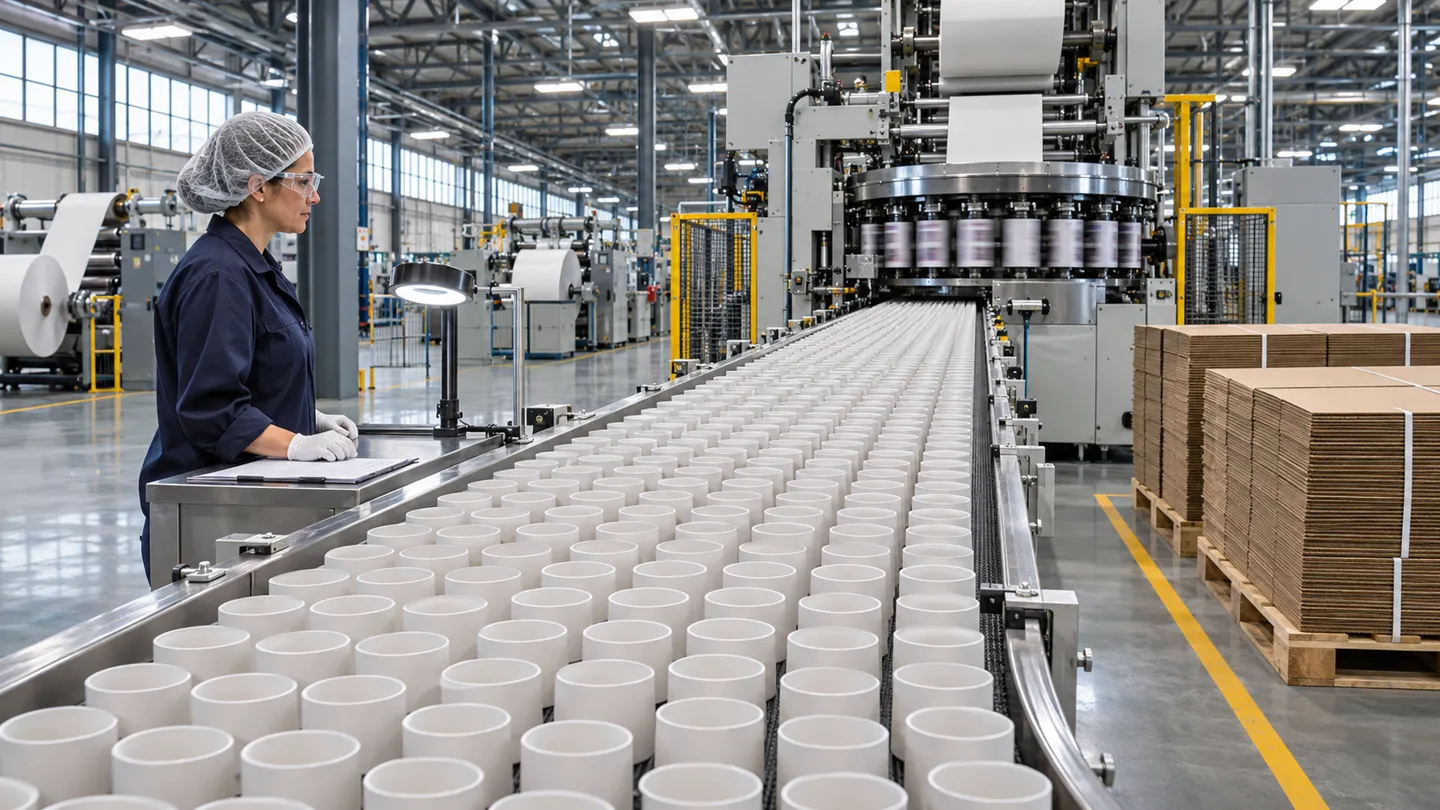
Both paths are real, and the honest answer for a restaurant or cloud kitchen is the second one. You will not sign a Huhtamaki-scale contract. Even so, the same structures, certifications, and materials are available at 10,000-piece scale. The supplier base that serves the chains also serves everyone below them.
Before the first bulk order gets wired, know where this category fails. Every failure mode below has already cost someone a product launch.
Where This Packaging Fails: Boundaries and Avoidable Mistakes
The first failure is the recyclable claim itself. Fiber is recyclable; grease is not a recyclable’s friend. An oil-soaked sleeve can downgrade a paper batch. A lined cup needs a facility that can actually separate the layers. “Recyclable” is a statement about material, not about your customer’s local bin, so a claim that reads well on the box can still fail at the curb.
The second failure is the most public one. In August 2019, the company admitted that its new UK paper straws, roughly 1.8 million a day, could not be recycled. Their thickness defeated the waste processors. The plastic straws they had replaced could be recycled (BBC News, 2019). A swap made for environmental reasons produced an environmental own-goal, and it started with a material decision made without checking the end-of-life path.
The third failure is structural simplification done badly. When locations moved from containers to bags, customers noticed, and one widely upvoted r/McDonalds thread put it bluntly: it feels like eating Burger King food. Packaging is doing brand work in the customer’s hands, and stripping structure without replacing what it did shows up immediately as a perceived quality drop.
Three confirmations before any bulk order
- 1The temperature ceiling of the board and barrier, in writing, against your hottest item.
- 2The lining type and food-contact certificates (FDA/LFGB), not the sales claim.
- 3That your recyclability or compostability claim matches the recycling or composting system your customers actually use.
None of these failures are exotic. They are the predictable result of buying on price and looks while skipping the boundary conditions, which is why the checklist in the previous section reads like it does. The remaining question is not technical at all: with the grade defined and the failures mapped, where should a small brand actually put its money?
The Business Read: Where a Small Brand Should Spend
The chain’s benchmark feel comes from what customers never see on purpose: grease staying inside the wrap and heat surviving the drive-through. A sleeve that keeps fingers dry does the same work. Those effects are material and structure. Meanwhile the visible layer, the graphics, went the opposite way, toward minimal single-color drawing. Read together, the signal for a small operator is precise: the expensive-looking part of chain packaging is not the printing, it is the specification.
So the stance is this: do not copy the full-bleed printing that the chains themselves just abandoned; copy the material and structure standard underneath it. Build your identity the way the 2021 redesign did, a plain kraft or white base with a disciplined single-color logo. Flexo economics favor exactly that at small volumes, and the money you do not spend on ink coverage goes where customers can feel it.
The budget priority falls out of the matrix and the failure list. First: grease barrier and food-contact compliance, because that is where product and reputation actually fail. Second: structure, heat retention for delivery, compression for stacked bags, grip for hot drinks. Third: printing, single color first, full color reserved for promotional runs. The sustainable packaging market was valued at $303.6 billion in 2025. It is projected to reach $555.0 billion by 2033, a 7.6 percent annual growth rate (Grand View Research, 2026). Certified, compliant fiber is becoming easier to source, not harder. Spend on the parts of the spec that regulators and customers are both pushing toward.
For importers and distributors the same logic reads across the catalog: stock by where the rules are heading, PFAS exit dates and certified fiber first, verifiable compostability next. The price-tier stock is the stock that gets legislated out first.
Price This Grade Against Your Own Menu
YoonPak produces FSC-certified fiber packaging with FDA- and LFGB-compliant food contact across burger boxes, cups, and bags.
Request a Side-by-Side QuoteReferences
- McDonald’s Corporate. “Packaging, Toys & Waste.” 2026. https://corporate.mcdonalds.com/corpmcd/our-purpose-and-impact/our-planet/packaging-toys-and-waste.html
- McDonald’s Corporate. “The History and Evolution of McDonald’s Packaging.” 2020. https://corporate.mcdonalds.com/corpmcd/our-stories/article/Packaging-History.html
- McDonald’s Corporate. “By 2025, all of McDonald’s Packaging to Come from Renewable, Recycled or Certified Sources.” 2018. https://corporate.mcdonalds.com/corpmcd/our-stories/article/renewable_packaging.html
- Safer States. “McDonald’s announces global ban of toxic chemicals in food packaging.” 2021. https://www.saferstates.org/press-room/mcdonalds-announces-global-ban-of-toxic-chemicals-in-food-packaging/
- As You Sow. “McDonald’s Corporation: Report on Actions to Reduce PFAS in Food Contact Materials.” 2020. https://www.asyousow.org/resolutions/2020/12/10/mcdonalds-report-on-actions-to-reduce-pfas-in-food-contact-materials
- BBC News. “McDonald’s paper straws cannot be recycled.” 2019. https://www.bbc.com/news/business-49234054
- Designboom. “McDonald’s unveils global packaging redesign with a focus on graphics.” 2021. https://www.designboom.com/design/mcdonalds-global-packaging-pearlfisher-02-16-2021/
- Pearlfisher. “McDonald’s: A Minimalistic Packaging Redesign.” 2021. https://pearlfisher.com/work/mcdonalds/
- HAVI. “About.” 2026. https://havi.com/about/
- Grand View Research. “Sustainable Packaging Market Size Report, 2033.” 2026. https://www.grandviewresearch.com/industry-analysis/sustainable-packaging-market-report

 English
 German
 Spanish
 Italian
 Dutch
 French
 Portuguese
 Russian
 Arabic
 Korean