

Dunkin Donut Box Size: What the Numbers Really Are and How to Pick Yours
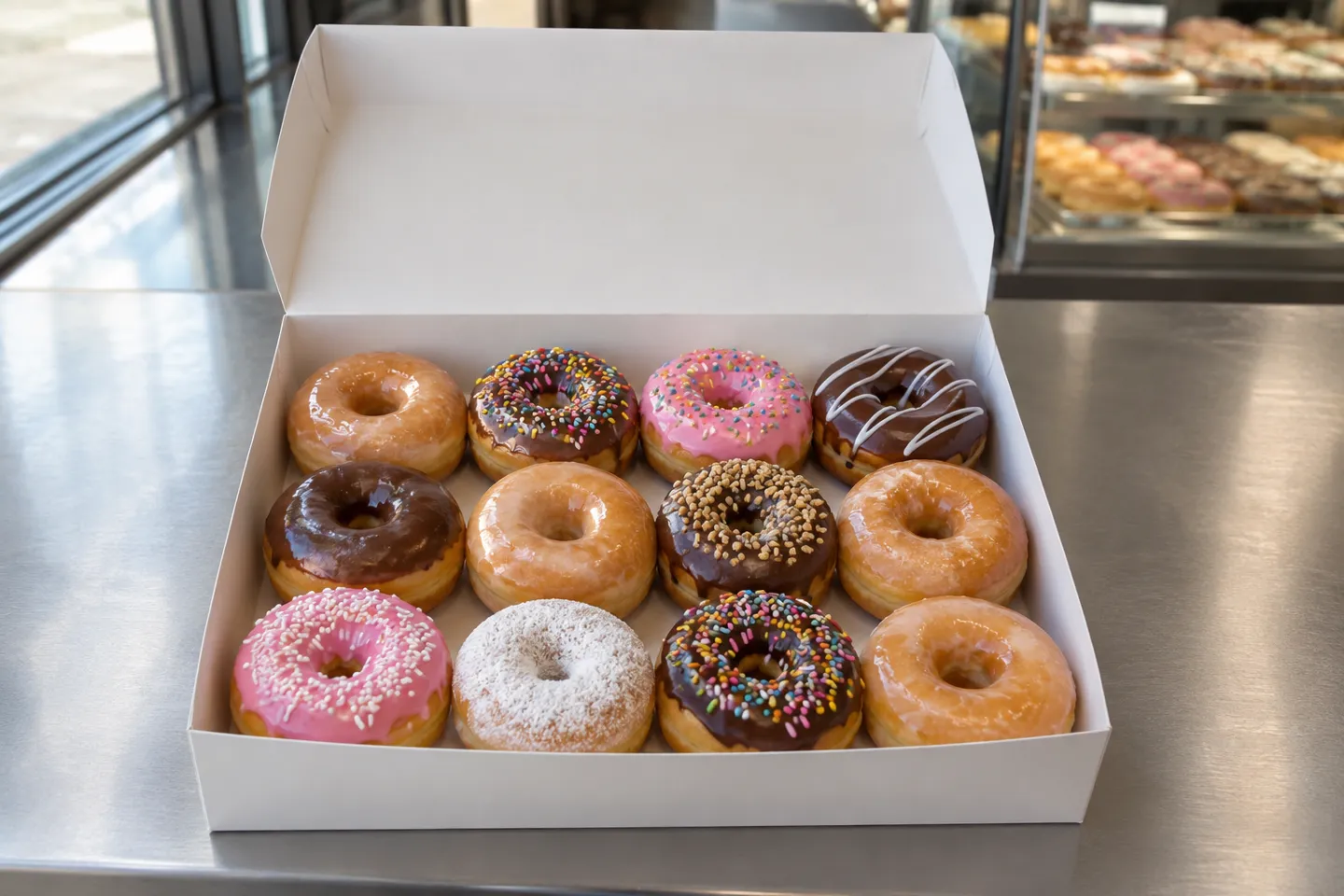
Twelve donuts ride home in a flat white box, four across and three deep. That box is one of the most copied packages in American foodservice. Almost nobody can tell you its exact inches, and the honest answer is that there is no single one. Stores move donuts in half-dozen and dozen boxes, plus 25-count Munchkins tubs, and the dimensions shift with the donut, the layout, and who made the box.
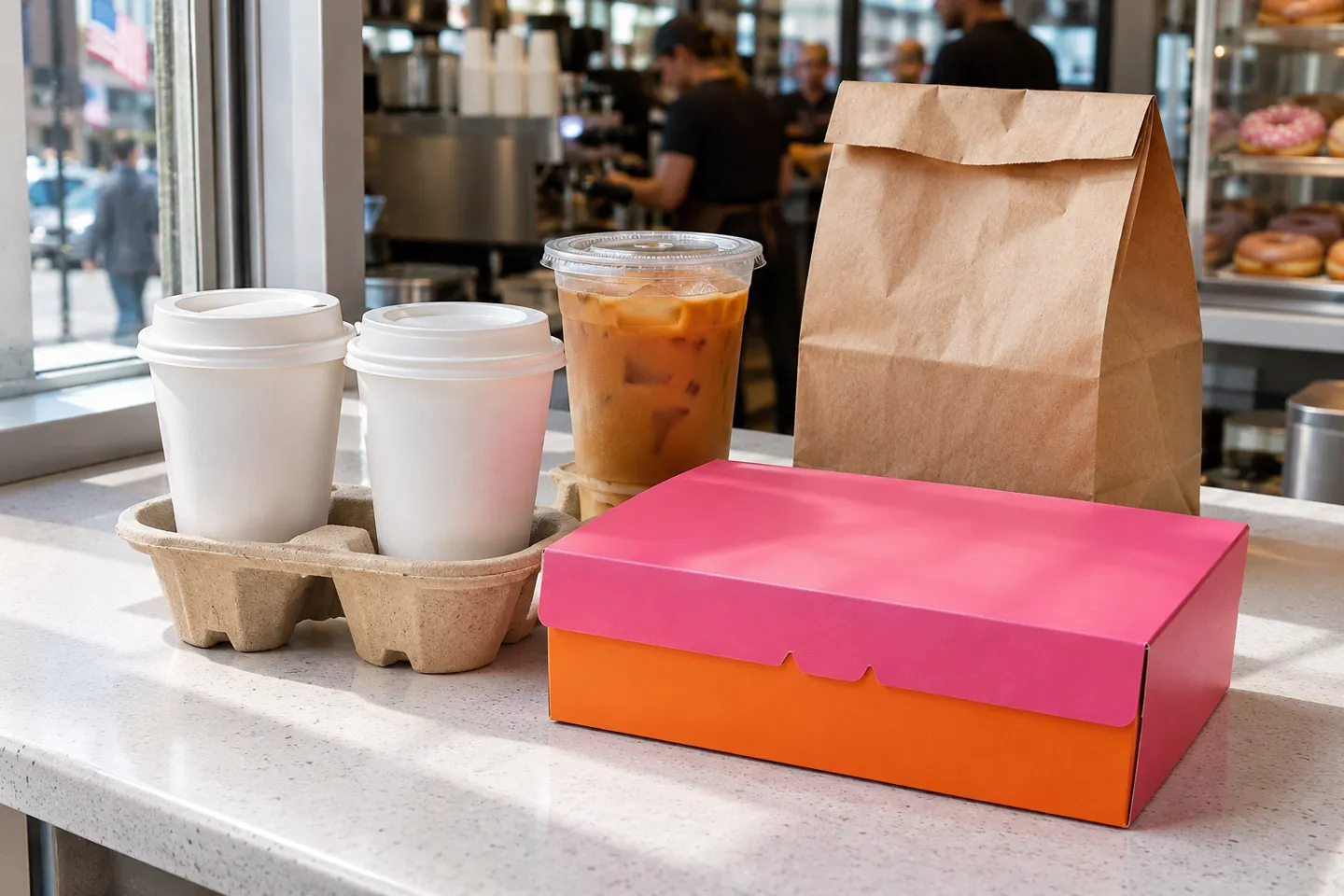
Part of the confusion is naming. “Dunkin donut box” can point at three different objects. It can mean the paperboard box that holds donuts, the Box O’ Joe carrier that holds ten servings of coffee, or the Munchkins tub that holds donut holes. Fan-market replica boxes add a fourth meaning, and they measure nothing like a store box. A replica listing in the Philippine market, for example, specs out at 6.3 by 3.6 by 5 inches and is designed to hold two cupcakes. This article is about the first object only: the donut box itself.
Here is the anchor fact that keeps the rest of this honest. Dunkin publishes its menu but not its packaging specs (Dunkin’, 2026). The menu lists Half Dozen and Dozen Donuts, yet no inch measurement appears anywhere official. So every specific dimension you will find online is one of three things: a stock-box specification from a supplier, an estimate from a packaging guide, or a replica product listing. Knowing which is which matters more than memorizing any single number.
The money side is settled, at least for customers. Menu trackers put a classic dozen at roughly $10 to $15 depending on location and donut mix (Dunkin Menu Prices, 2026). Against that ticket, the box is pennies. For a shop owner, though, the box math works differently, and it starts with understanding that not all donut boxes are shaped the same way.
The Four Box Constructions Behind Every Donut Box
Every dimension dispute in this topic traces back to construction. Four structures dominate, and each one packs donuts differently.
Flat-lid shallow trays are the workhorse, and the auto-popup fold is the version most shops use. The box arrives flat, springs open in seconds, and takes a single layer of donuts in a grid. A typical dozen tray from a restaurant supplier is one-piece paperboard with no window, built for speed at the counter (WebstaurantStore, 2026).
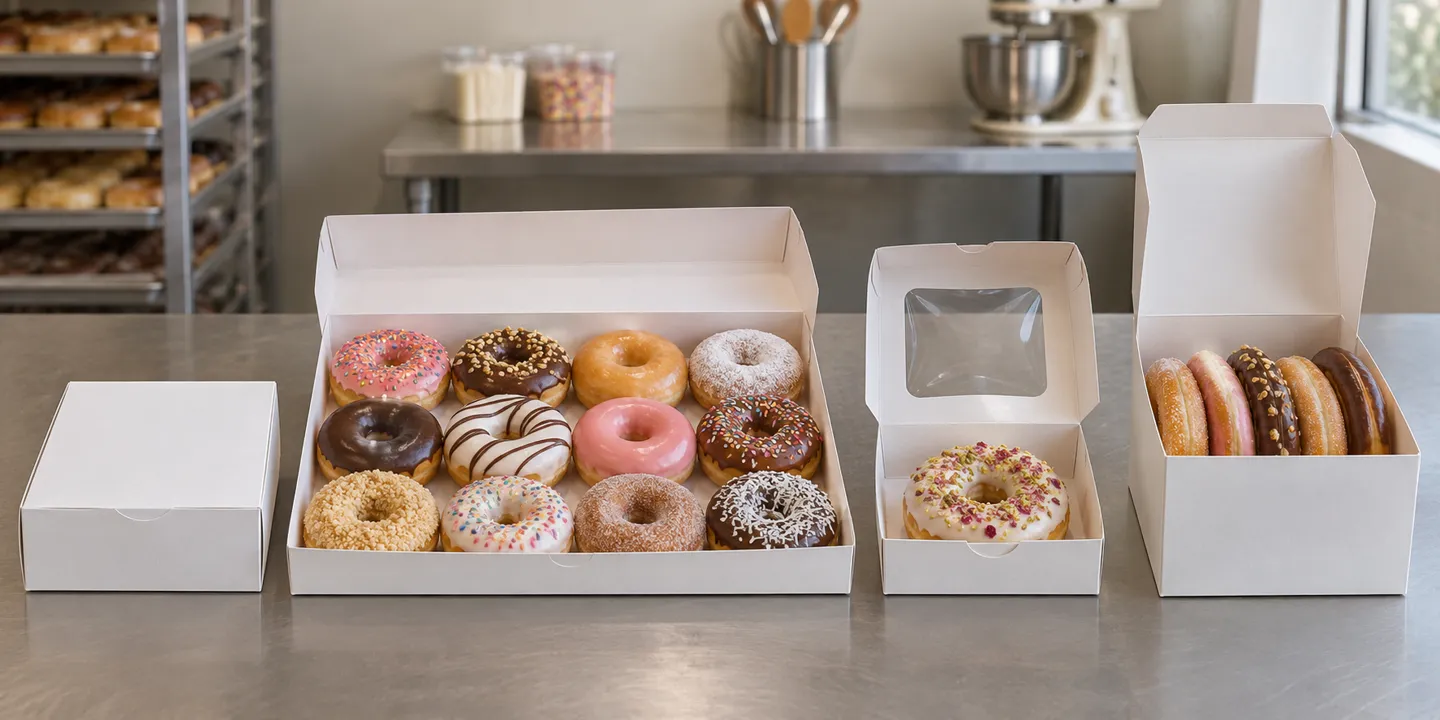
Clamshell boxes hinge at the back and close over a single order. They protect icing better than a sliding lid because the top does not rub the product. Manufacturers that specialize in bakery packaging carry clamshell donut boxes as their own sub-line for exactly this reason.
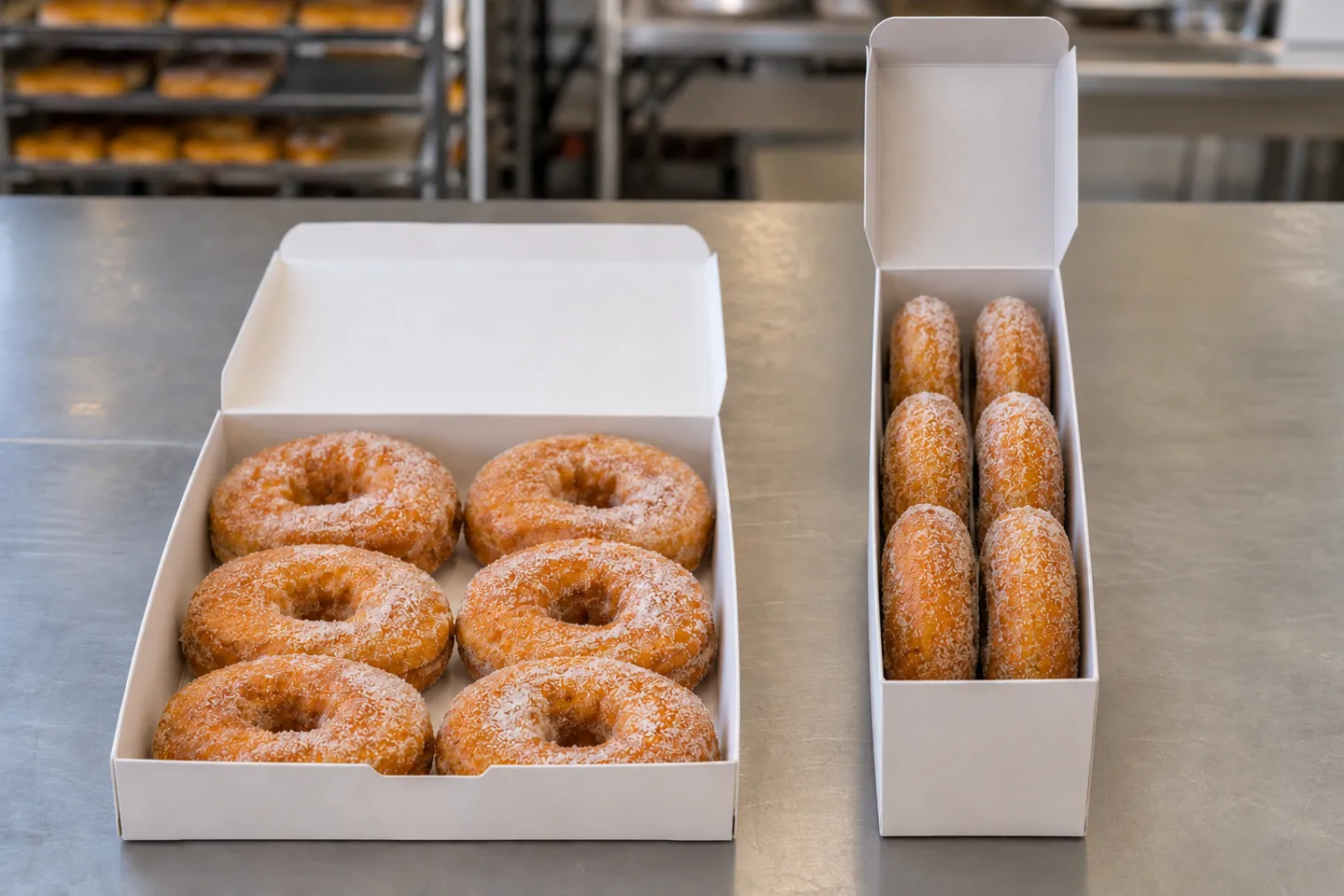
Upright deep boxes stand donuts on edge instead of laying them flat. A wholesale packer sells one at 9 by 5 by 4 inches that holds 12 cake donuts vertically (Brenmarco, 2026). Same count, completely different footprint, and a third of the height. This is the structure people forget when they argue about dimensions.
Window boxes add a clear PET panel to any of the above. The window does one job: it lets customers see the glaze before they buy. That is why retail-facing bakeries favor them, and why buyers on supplier sites mention posting the box to social media as free marketing (WebstaurantStore, 2026).
Round boxes, heart shapes, carrying handles, and internal inserts exist too, but they sit in custom-order territory rather than stock shelves. A paper bag covers the single-donut sale, and employees at chain stores pack bags and boxes by count for exactly that reason.
| Construction | How it loads | Typical scenario |
|---|---|---|
| Flat-lid shallow tray (auto-popup) | Donuts lie flat in a grid, usually 4 by 3 for a dozen | Counter service, volume orders |
| Clamshell | Donuts lie flat, lid hinges closed over them | Single orders, iced or topped donuts |
| Upright deep box | Donuts stand on edge in rows | Cake-style donuts, carry-out protection |
| Window box | Any layout plus a PET panel | Retail display, gifting |
One boundary applies across all four: an upright deep box only works for sturdy product. Cake and side-style donuts can stand; glazed yeast rings cannot, because the walls smear the icing.
Why Every “Real” Donut Box Dimension List Disagrees
A Dozen Box Has No Single Size
The disagreement is structural, not sloppy. Donut diameters vary from about 3 to 4 inches, and box length follows the grid math. Lay donuts four across and the box needs roughly four diameters plus clearance. One buyer review on a 15-inch dozen tray states the limit plainly (WebstaurantStore, 2026). Their 4-inch donuts fit only 3 per row, so a full dozen of their product would need the 16-inch box.. That is the whole argument in one sentence. A shop selling 3-inch cake donuts and a shop selling 4-inch yeast rings cannot share a dozen box. Suppliers make both, and guides quote whichever one they happened to measure.
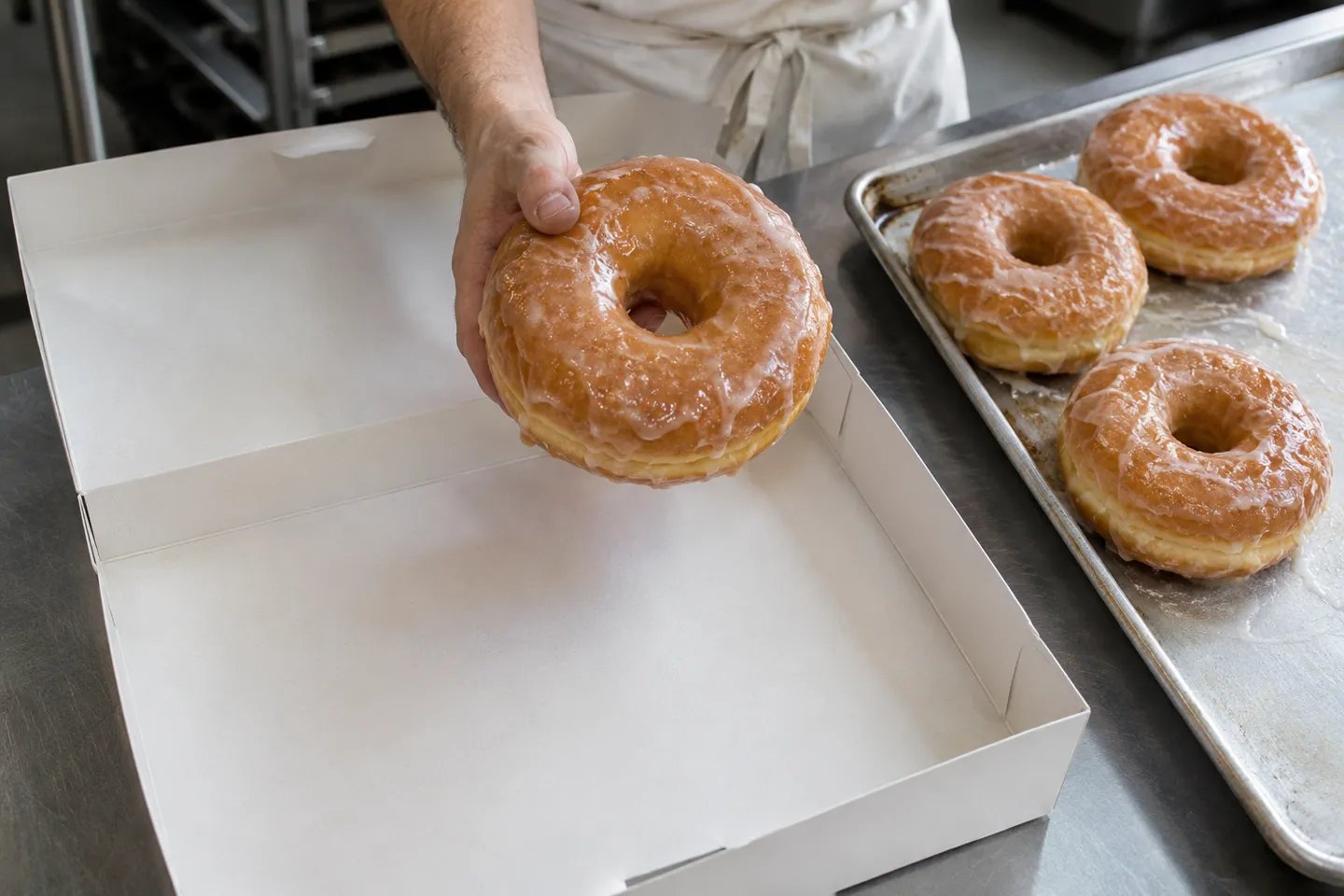
Source mixing makes it worse. Stock supplier pages list real specifications, packaging guides publish estimates, and replica sellers list fan products, yet search results present all three as if they were the same fact.
The Ranges That Actually Circulate
Read the figures below as ranges with a source type attached, not as answers.
| Format | Dimensions that circulate (L × W × H, inches) | Where the figure comes from |
|---|---|---|
| Half dozen | 9 × 4 × 3.5 up to 12.5 × 8.5 × 3 | Stock supplier window-box line (WebstaurantStore, 2026); packaging standard-sizes page (Georgette Packaging, 2026) |
| Dozen, flat | 12 × 8 × 2.5 through 16 × 12 × 2.25 | Guide estimates of 14 × 9 × 3.5 (Packify, 2026) and 14.25 × 10.75 × 2.25 to 16 × 12 × 2.25 (Oxo Packaging, 2026); stock specs of 15 × 11.5 × 2.25 (EasyBox Packaging, 2026) and 16 × 11 × 2.5 (Tcoivs via Amazon, 2026) |
| Dozen, upright | 9 × 5 × 4 | Wholesale packer listing for 12 cake donuts (Brenmarco, 2026) |
The dozen row alone spans 4 inches of length. None of those sources is wrong; each one measured a different product for a different donut.
The One Band Worth Remembering
Amid the spread, the stock market has converged on a favorite.
The Stock Band
The same “holds 12 donuts” box is sold anywhere from 12 to 16 inches long, and the foodservice stock channel moves the most volume on one band:
15 × 11.5 × 2.25 in
That spec is a standard stock item at major restaurant suppliers, priced at $8.89 per 10-pack, with dozens of buyer reviews behind it (WebstaurantStore, 2026). A band with that much stock behind it is cheap to buy, fast to resupply, and predictable to pack. Before you lock one in, though, measure your own donut diameter and multiply across your grid; the band is a starting point, not a substitute for the math.
How a Donut Shop Actually Chooses: Combo, Specs, Cost
The Minimum Stocking Combo
A new shop does not need fifteen SKUs of packaging. Four cover the order book:
- Half-dozen flat tray catches the small order and the sampler mindset.
- Dozen flat tray, pinned near the mainstream band, handles the volume order and catering runs.
- Window clamshell takes the single fancy order, the gift purchase, and everything a customer might photograph.
- Upright deep box absorbs cake-donut carry-out without crushing.
Shops that sell heavier boxes of donuts add a paper bag sized to the dozen tray, and staff pack bags by count when boxes run short.
Function Specs That Change Performance
Each option below is a fork, and the right answer depends on your product and case conditions:
- Vent holes. Hot product needs them; steam softens glaze in a sealed box. Chilled display cases need them closed or skipped, because vents pull cold air out. Pick based on product temperature at packing, not habit.
- Board grade. Export bakery-box lines commonly run 210 to 350 gsm paperboard with PE or PLA lamination. Light single-layer orders live fine at the low end; heavy glazing, stacked transport, or catering trays belong at the upper end. Get the floor written into the quote, not the catalog.
- Coating. PE lamination is the standard oil barrier. PLA is the plant-based route when you sell a compostability story, and FSC-certified board supports the sourcing claim. Choose by the claim you are willing to defend, because certification audits check it.
- Window. PET stays clear and rigid. For chilled product, ask for anti-fog treatment or the window will sweat shut. No window costs less and ships flatter.
- Print. Flexo handles simple one or two-color logos cheaply; offset handles detail and photos, with 1 to 6 colors and Pantone matching available on custom runs. Artwork needs to arrive as vector files at 300 dpi or better, or the proof stage stalls.
What a Box Actually Costs
Stock pricing is public and refreshingly unglamorous. At one major restaurant supplier, dozen-size bakery boxes run from about $5.79 to $10.49 per 10-pack across the 12 × 8 to 16 × 12 range (WebstaurantStore, 2026). That works out between $0.58 and $1.05 per box.. Window versions sit slightly higher.
Custom pricing stacks four charges on top of the board: printing plates or setup, color count, the gsm step you choose, and the window add-on. Volume moves the whole curve; export factories typically quote custom runs in the tens of thousands of units per item, with the exact minimum varying by factory and freight terms. That is why the standard advice inverts for custom. A shop proves its spec on stock boxes first, then moves the winning spec to a factory order once volume justifies the move.
Before signing a custom quote, hand the supplier this checklist and get each line answered in writing:
Custom Donut Box Quote Checklist
- Outer dimensions quoted against YOUR donut diameter × grid, not catalog inches.
- Board grade floor in gsm, stated.
- Lamination type named (PE or PLA) and food-contact compliance for your market (FDA, LFGB).
- Window material named (PET or PLA) and anti-fog if chilled.
- Print colors, method (flexo/offset) and Pantone references.
- Physical sample approved before the mass run.
Stack every option onto a low-ticket box and the unit cost doubles fast. A half-dozen value order does not need a window, inserts, and four-color print; match the option stack to the order economics.
Where to Get the Boxes: Stock Channels vs Factory Custom
Path one: stock channels. Restaurant supply sites and local wholesalers carry the mainstream bands in small packs. The sequence is short: match your diameter-times-grid math to a stock spec, buy the smallest pack available, and test-load it with your actual product before ordering a case. Stock suits new shops and top-up orders because there is no setup, no minimum beyond a pack, and delivery in days.
Path two: factory custom. A custom run starts with a written spec sheet: outer dimensions, board grade, lamination, window, color count. The factory returns a digital proof, often within one business day at export packaging plants. A physical sample follows, commonly inside 48 hours. Mass production, for standard sea runs, then takes the common 3-to-6-week window. Custom suits a spec that stock cannot match, or a volume where per-box savings beat the setup costs.
The watershed between the two paths is a pair of questions: how far is your spec from the mainstream band, and how stable is your volume? Close and stable means custom pays. Far or unstable means stock until both change.
How Donut Boxes Fail and How to Prevent It
Real buyer reviews name the failure modes better than any catalog. On one dozen-tray listing, buyers report corners separating at the seam on entire batches (WebstaurantStore, 2026). Bottoms sag when the box is overloaded, and 4-inch donuts fail to fit the 15-inch length.. Customers notice the mismatch from the other side too; donut shrinkage inside an unchanged box is a recurring complaint in brand fan communities. Seams, structure, size: almost every failure falls in one of those three families, and all three are checkable before money moves.
| Box choice | Fails when | Verify before ordering |
|---|---|---|
| Dozen flat tray | Seam unglues on a batch; bottom sags under overfill | Seam type and glue spec; gsm floor in writing; load test with heaviest product |
| Window clamshell | Window fogs on chilled product; hinge fatigues | PET named; anti-fog if chilled; hinge cycling sample |
| Upright deep box | Tall glazed product smears on the walls | Product height clearance measured against internal depth |
| Half-dozen tray | Oversized artisan donuts overflow the grid | Diameter × grid math done on your product, not the catalog’s |
| Custom printed run | Artwork rejections stall the schedule | 300 dpi vector files; Pantone references; pre-run sample approval |
Measure the donut, not the box: diameter × grid count decides the outer dimension. Every returned case of misfit boxes was ordered from a catalog number instead.
The Business Logic of Donut Box Stocking
Re-read the size contradiction as a business signal. The same count shipping in different lengths means packaging is a designed decision, not a fixed standard. The market has already voted on a workhorse band with real volume behind it. That vote is information.
For a buyer, the implications are concrete. An off-spec size cuts you off from the cheap stock channel, because nobody warehouses your special length; every reorder becomes a custom run with setup costs and a lead time. A mainstream-band spec keeps you interchangeable, able to top up from any supplier in days. It also keeps the box at pennies against a $10 to $15 ticket instead of dollars against it.
So the stocking strategy writes itself. List boxes by construction first, pin the dozen and half-dozen dimensions to the proven band, and spend the differentiation budget where customers actually look: the print and the window. One boundary applies: this is a strategy for buyers who control their own spec. If a franchisor hands you a packaging spec, your job is execution, not optimization.
The box is the only part of the order every customer touches, which is why the cheap part deserves a deliberate decision.
Our clamshell and flat-lid donut boxes at YoonPak run 210 to 350 gsm paperboard with PE or PLA lamination, built to your diameter-by-grid spec. We add a window when you want one, and you can compare our clamshell and flat-lid donut boxes against your current stock list before your next case order.
Get a Donut Box Quote Built to Your Spec
Send your diameter-by-grid size, board grade, and window needs; YoonPak returns a digital proof, a physical sample, and a written quote before any mass run.
Request a Custom QuoteReferences
- Dunkin’. “Dozen Donuts.” Menu, 2026. https://www.dunkindonuts.com/menu/categories/donuts-bagels-bakery/donuts/dozen-donuts/
- WebstaurantStore. “Baker’s Lane 15 x 11 1/2 x 2 1/4 in White Auto-Popup Donut / Bakery Box, 10/Pack.” 2026. https://www.webstaurantstore.com/bakers-lane-15-x-11-12-x-2-14-white-customizable-autopopup-donut-bakery-box-pack/99915112CBBL.html
- Brenmarco. “Donut Box for 12 Cake Donuts 9 x 5 x 4 in, 250/Case.” 2026. https://www.brenmarco.com/product/donut-box/
- Tcoivs. “20-Pack 16 x 11 x 2.5 in Bakery Boxes with Window.” Amazon, 2026. https://www.amazon.com/Tcoivs-20-Pack-Auto-Popup-Muffins-Pastries/dp/B08YQSW2LN
- Dunkin Menu Prices. “Dunkin Donuts Menu with Prices 2026.” 2026. https://dunkincoffeemenu.com/dunkin-donuts-menu-with-prices-2026/

 English
 German
 Spanish
 Italian
 Dutch
 French
 Portuguese
 Russian
 Arabic
 Korean